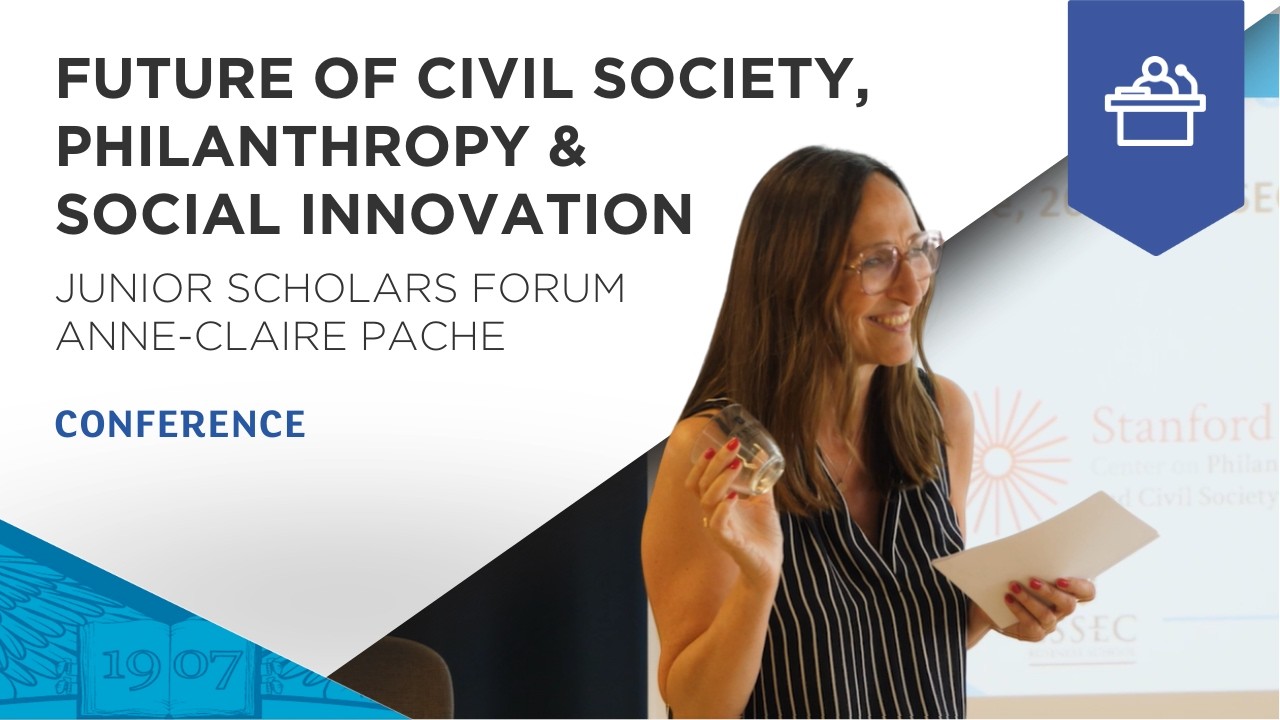
Future of Civil Society, Philanthropy & Social Innovation with Anne-Claire Pache | ESSEC Conference
Keywords
Summary
133 words
Critical Evaluation
Value of the Information & Strength of the Argument
The value of the information lies in its use of a concrete, contemporary case study to illustrate the potential and challenges of organizational democracy. The argumentation is coherent, moving from a specific example to broader theoretical implications. Pache acknowledges the preliminary nature of her research, which adds credibility. However, the talk is more descriptive than analytical, and the early-stage data limits the depth of conclusions.
Scientific Rigor, Source Quality, Title Accuracy
The speaker is a professor at ESSEC and co-chair of the Philanthropy Chair, lending academic credibility. The case of Duralex is well-documented in French media, and the ongoing research is conducted with reputable scholars. The title accurately reflects the content, though it is broad. The talk does not cite specific sources, but the context of the Stanford PACS forum implies academic rigor. The description provides links to ESSEC’s knowledge platform and official website, which are relevant for further information.
159 words
Title / Content Match
The title accurately reflects the content, which focuses on the future of civil society and social innovation through the lens of organizational democracy.
Quality & Reliability
7/10
The speaker is a recognized academic (Professor at ESSEC) and the content is based on ongoing research with preliminary data. The case study is real and documented, but the insights are early-stage and not yet peer-reviewed.
Key Moments
Markers derived by PSI from the transcript: the creator did not define chapters.
- Introduction and context of the keynote on democracy and participation in organizations.
- Introduction of the Duralex glass as a symbol of French public schools and democracy.
- History of Duralex: creation, success, and repeated bankruptcies due to short-term profit focus.
- The sixth bankruptcy and the workers' decision to form a cooperative.
- The coalition building and the court decision to sell to employees.
- Early findings: challenges of turning formal ownership into actual influence.
- Challenges: distrust, managerial literacy, and financial pressure.
- The risk that democracy becomes a luxury and the need for time.
- Conclusion: implications for strengthening democracy in society.
Cited Sources
- ESSEC Knowledge — Platform for research and insights from ESSEC, potentially relevant for further reading.
- ESSEC Business School — Official website of the institution hosting the conference.
- ESSEC LinkedIn — Professional network page for ESSEC.
- ESSEC YouTube Channel — Channel where the video is published.
Concurring Sources
- Stanford PACS — Co-organizer of the forum, focusing on philanthropy and civil society.
Contribution & Novelties
The talk provides a real-world example of a workers cooperative transformation, offering early insights into the challenges of implementing organizational democracy. It bridges theory and practice, highlighting the gap between formal structures and actual empowerment.
Pour aller plus loin :
- Worker cooperative — Overview of worker cooperatives and their principles.
- Social economy — Definition and scope of the social economy sector.
- Organizational democracy — Concept of democratic participation in organizations.
- Julie Battilana — Scholar known for research on social innovation and organizations.
82 words
Radar Profile
The radar profile shows moderate scores across all dimensions, with slightly higher quality and reliability due to the academic context. The talk is informative but not highly technical, and the quantity of information is limited by its short duration.