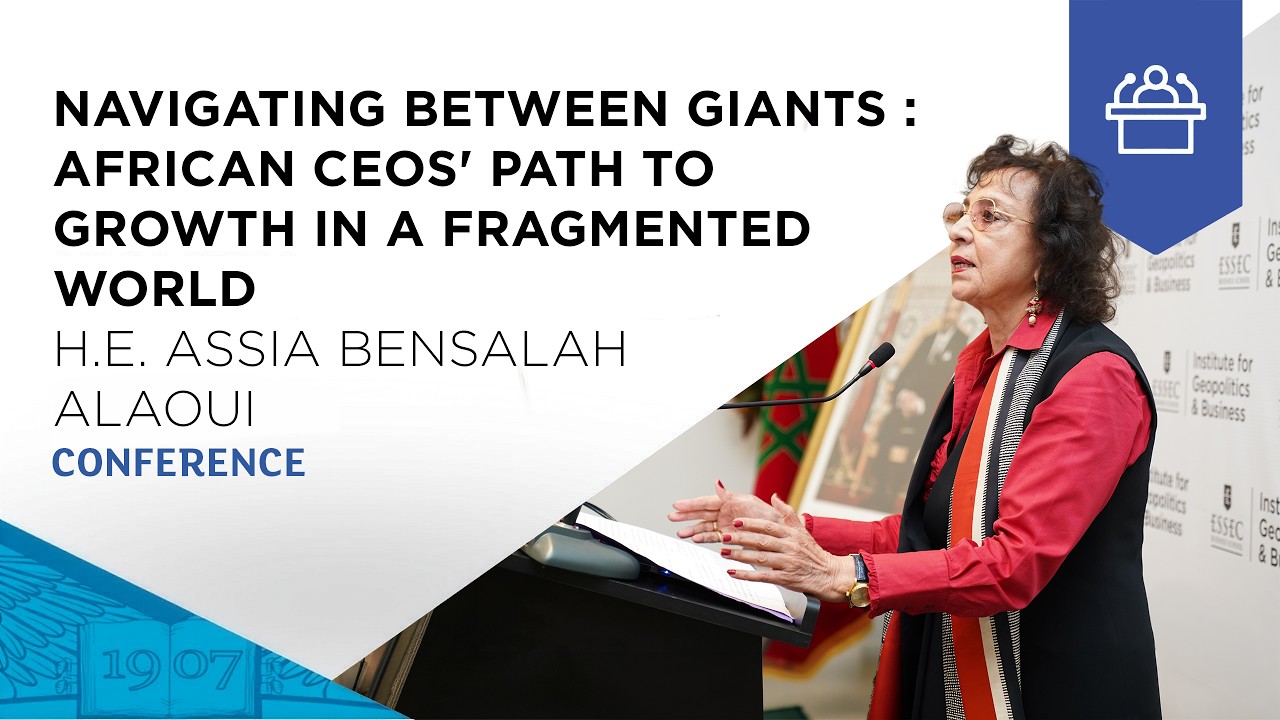
Africa and the polycrisis - Assia BENSALAH ALAOUI at the Tricontinental Dialogue | ESSEC Conference
Keywords
Summary
151 words
Critical Evaluation
Value of the Information & Strength of the Argument
The talk provides valuable insights into the current geopolitical and economic landscape, synthesizing multiple credible sources (IMF, IPCC, WEF, PwC, McKinsey, Deloitte) to support its arguments. The speaker’s diplomatic background lends authority, and she effectively connects global trends to African-specific challenges. The argumentation is coherent, moving from problem identification to actionable leadership principles. However, some claims lack precise citations (e.g., AI electricity consumption, specific statistics), and the talk is more of an expert opinion than a rigorous academic analysis. The proposed solutions, while sensible, are somewhat generic and not deeply elaborated.
Scientific Rigor, Source Quality, Title Accuracy
The speaker references reputable organizations and reports (IMF, IPCC, WEF, PwC, McKinsey, Deloitte, ECB) and concepts (VUCA, BANI, polycrisis) accurately. The title accurately reflects the content, focusing on Africa within the global polycrisis. The talk is well-structured and grounded in real-world examples. However, some statistics are presented without specific citations, and the talk is an opinion piece rather than a peer-reviewed analysis. The description provides links to ESSEC’s Institute for Geopolitics & Business, which adds credibility, but no direct sources are cited in the video itself.
192 words
Title / Content Match
The title accurately reflects the content, focusing on Africa's challenges within the global polycrisis, as delivered by the keynote speaker.
Quality & Reliability
7/10
The speaker is an ambassador-at-large with high-level diplomatic experience, providing authoritative insights on geopolitics and business. The talk references credible sources (IMF, IPCC, WEF, PwC, McKinsey, Deloitte, ECB) and concepts (VUCA, BANI, polycrisis). However, some claims lack precise citations (e.g., AI electricity consumption, specific statistics), and the talk is an opinion piece rather than a peer-reviewed analysis.
Key Moments
Markers derived by PSI from the transcript: the creator did not define chapters.
- Introduction and thanks; sets the stage on uncertainty and polycrisis.
- Defines VUCA and BANI eras; introduces polycrisis concept.
- Discusses Africa's specific vulnerabilities within the polycrisis.
- Geopolitical fragmentation: US-China rivalry, conflicts, and supply chain reconfiguration.
- Climate change as financial and operational risk; IPCC and ECB data.
- Technology and AI: opportunities and risks, including energy consumption and job impact.
- Collision of risks: AI weaponization, disinformation, and cyber threats.
- Leadership playbook: prepare, be agile, build human resilience.
- Broader reflections on business purpose, sustainability, and Ubuntu philosophy.
Cited Sources
- Institute for Geopolitics & Business — Mentioned as the organizing institute for the conference.
- ESSEC Knowledge — Linked in description as a resource for research and insights.
- ESSEC Business School — Institution hosting the conference.
- ESSEC LinkedIn — Social media presence of the institution.
- ESSEC YouTube Channel — Channel where the video is published.
Concurring Sources
- World Economic Forum Global Risks Report 2024 — Cited for ranking disinformation as top short-term risk.
- IPCC Reports — Cited for extreme weather frequency and intensity.
- PwC 2024 CEO Survey — Cited for CEO viability concerns.
- McKinsey Supply Chain Disruption — Cited for supply chain disruption frequency.
- Deloitte 2024 Sustainability Survey — Cited for sustainability pressure on CEOs.
Dissenting Sources
- No discordant sources found — The talk aligns with mainstream geopolitical and economic analyses; no contradictory sources were identified.
Contribution & Novelties
The talk provides a high-level synthesis of the polycrisis concept applied to Africa, integrating geopolitical, climate, and technological dimensions. It offers practical leadership principles (prepare, be agile, build resilience) and emphasizes the need for a paradigm shift towards sustainability and human-centric values. The speaker’s diplomatic perspective adds unique insight into Africa’s position in global power dynamics.
Pour aller plus loin :
- Polycrisis - Wikipedia — Overview of the concept of polycrisis.
- BANI - Wikipedia — Explanation of the BANI framework.
- World Economic Forum Global Risks Report — Source for global risks and disinformation ranking.
- IPCC Reports — Climate change data and projections.
- IMF Geo-economic Fragmentation — IMF’s analysis of economic fragmentation.
111 words
Radar Profile
The radar profile shows high scores in quantity of information and fiability, reflecting the speaker's extensive use of data and reputable sources. The quality of information and technical level are moderate, as the talk is more strategic than technical. Overall, the talk is well-rounded but not deeply technical.
💬 No comments were provided for analysis.