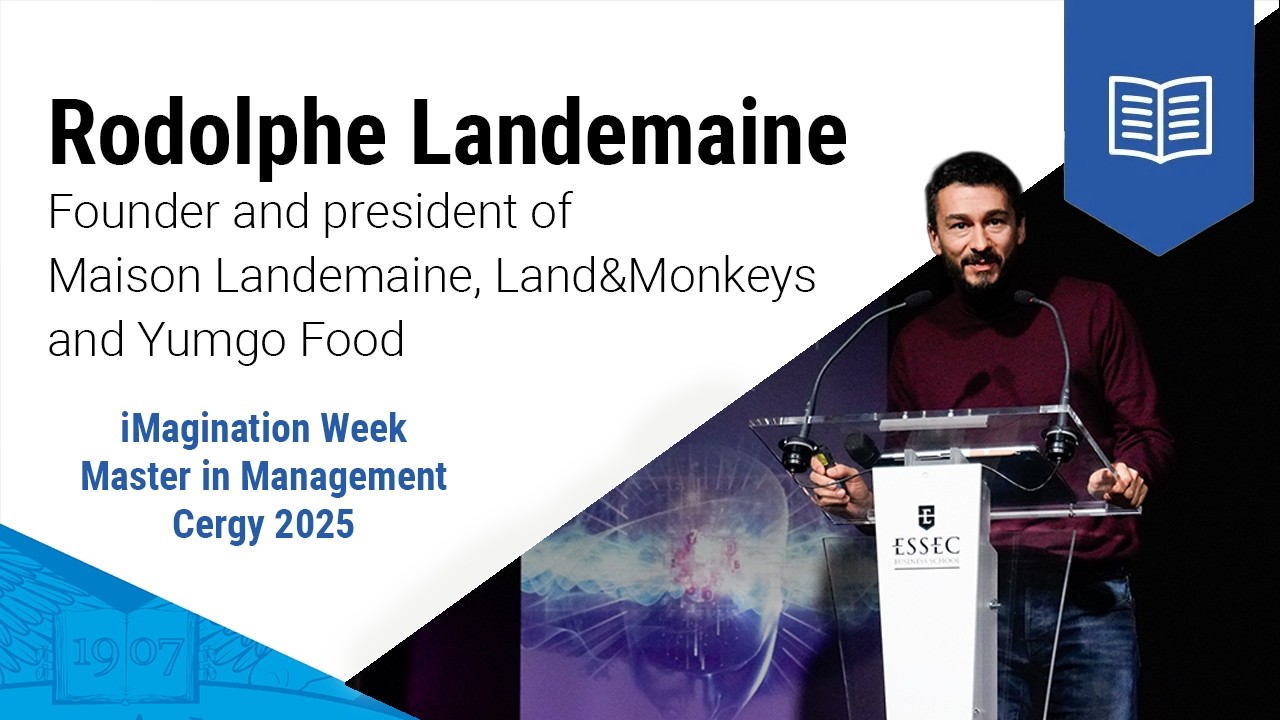
Rodolphe Landemaine - How Food Can Drive Ecological Transition | ESSEC iMagination Week 2025
Keywords
Summary
144 words
Critical Evaluation
Value of the Information & Strength of the Argument
The talk provides valuable insights into the practical application of sustainability in the food industry. Landemaine’s argumentation is based on personal experience and some statistics, but lacks rigorous scientific backing. He effectively demonstrates that sustainable business models can be economically viable, as evidenced by the success of his ventures. However, the argumentation would benefit from more concrete data and references to scientific studies.
Scientific Rigor, Source Quality, Title Accuracy
The talk is a personal testimony, so the scientific rigor is limited. Landemaine mentions some statistics (e.g., 40% of eco-actions, 70% of agricultural land) but does not provide sources. The description includes links to ESSEC’s website and knowledge platform, which are institutional but not directly related to the specific claims. The title accurately reflects the content, focusing on food as a driver of ecological transition.
143 words
Title / Content Match
The title accurately reflects the content, focusing on food as a lever for ecological transition.
Quality & Reliability
7/10
The talk is a first-person account by an entrepreneur, providing concrete examples and some statistics, but lacks rigorous sourcing and scientific depth. It is valuable as an inspirational testimony, but should be complemented with scientific literature.
Key Moments
Markers derived by PSI from the transcript: the creator did not define chapters.
- Introduction and background of Rodolphe Landemaine
- Discussion on the impact of food choices on the environment
- Presentation of Land&Monkeys and its sustainable practices
- Introduction of Yumgo Foods and plant-based egg alternatives
- Explanation of the Demain sur Terre foundation and rewilding projects
- Discussion on the shareholder foundation model and its benefits
- Conclusion and call to action for entrepreneurs
Cited Sources
- ESSEC Knowledge — Mentioned in the video description as a resource for academic content.
- ESSEC Business School Official Website — Mentioned in the video description as the official website.
- ESSEC Business School LinkedIn — Mentioned in the video description as a social media link.
Concurring Sources
- ESSEC Knowledge — Institutional platform that may contain related research on sustainability.
Contribution & Novelties
The talk offers a unique perspective on how an entrepreneur can integrate ecological transition into business models, with concrete examples from the food industry. It highlights the potential of plant-based alternatives and innovative approaches to waste reduction. The shareholder foundation model is presented as a novel way to align business success with philanthropic goals.
Pour aller plus loin :
- Planetary boundaries — Concept of limits to human impact on Earth systems.
- Rewilding — Ecological restoration approach mentioned in the talk.
- Peter Singer’s Animal Liberation — Influential book on animal ethics that inspired Landemaine.
93 words
Radar Profile
The radar profile shows moderate scores across all dimensions, with a slightly higher score in quantity of information and lower in technical level. This reflects a talk that is informative but not deeply technical, suitable for a general audience.