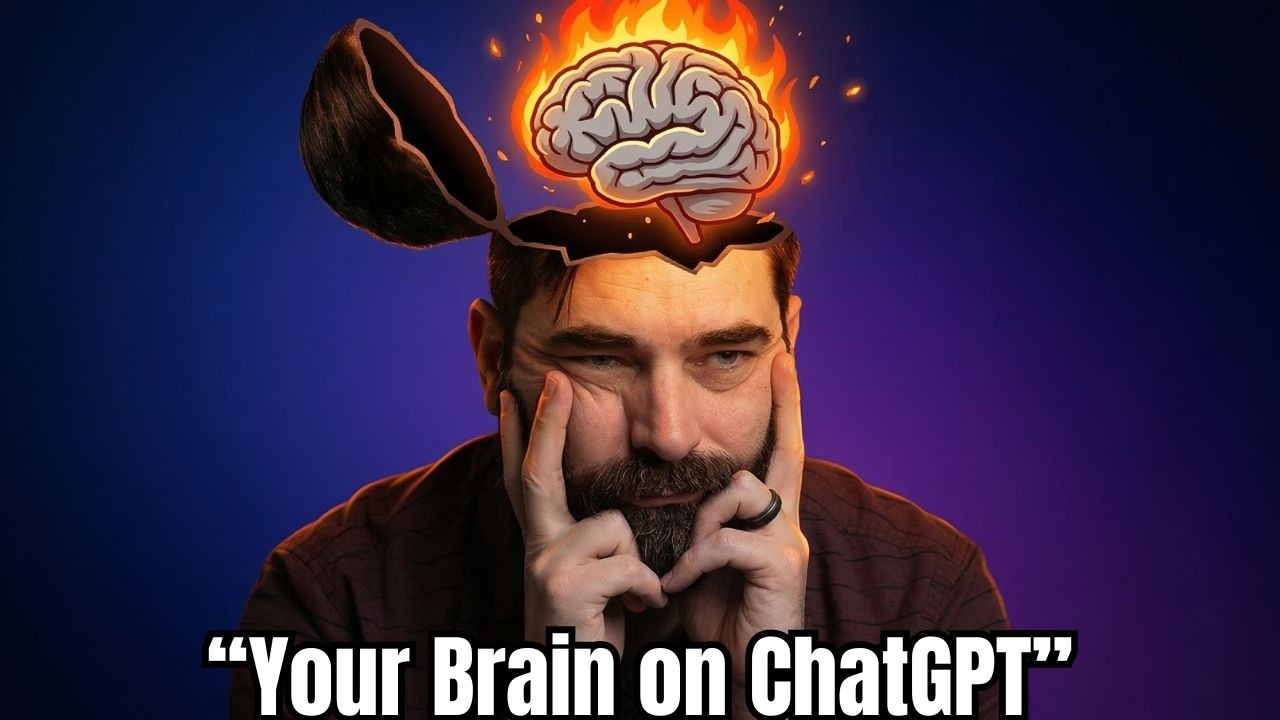
AI Is Frying Your Brain
Keywords
Summary
206 words
Critical Evaluation
Value of the Information & Strength of the Argument
The video provides valuable insights into the unintended consequences of AI adoption, supported by a mix of personal anecdote and referenced research. The argumentation is coherent and builds a compelling case that AI can intensify work and lead to cognitive fatigue. The presenter effectively connects his own experiences with the findings from HBR and MIT studies, making the information relatable. However, the argumentation is somewhat one-sided, focusing primarily on negative effects without a balanced discussion of potential benefits or counterarguments. The reliance on a few key sources, while credible, could be strengthened by a broader review of literature.
Scientific Rigor, Source Quality, Title Accuracy
The video demonstrates a good level of scientific rigor by citing specific studies and articles, including the Harvard Business Review and an MIT research paper. The sources are relevant and directly support the claims made. The title ‘AI Is Frying Your Brain’ is catchy and accurately reflects the core theme of cognitive overload and brain fry. The presenter clearly distinguishes between anecdotal evidence and research findings, which adds to the credibility. However, the summaries of the studies are simplified and lack methodological details, which could be a limitation for a more critical audience. Overall, the sources are of high quality and the title-content alignment is strong.
219 words
Title / Content Match
The title is catchy and accurately reflects the core theme: the cognitive toll of AI use.
Quality & Reliability
7/10
The video combines personal anecdote with references to several studies (HBR, MIT) and a practitioner's blog post. The sources are credible and directly cited, but the presenter's interpretation is subjective and the studies are summarized without full methodological detail.
Key Moments
Markers derived by PSI from the transcript: the creator did not define chapters.
- Introduction: Matt shares his personal feeling of being more drained and 'dumber' despite AI productivity gains.
- Discussion of HBR article 'AI Doesn't Reduce Work, It Intensifies It' and its key findings.
- Explanation of how AI leads to task expansion and blurred work-life boundaries.
- Introduction of Siddhant Khare's blog post and the paradox of faster tasks but harder days.
- Discussion of the shift from creating to reviewing and the 'FOMO treadmill'.
- Introduction of the HBR article 'When Using AI Leads to Brain Fry' and the concept of 'brain fry'.
- Presentation of the MIT study 'Your Brain on ChatGPT' and its findings on cognitive debt.
- Personal reflection on struggling with video ideas and the impact of outsourcing brainstorming.
- Practical advice: time-boxing AI sessions, separating thinking time, accepting 70% from AI.
- Conclusion: Mark Cuban quote on two types of LLM users and Matt's commitment to using AI for learning.
Cited Sources
- AI Doesn't Reduce Work, It Intensifies It — Harvard Business Review article cited as the first resource explaining how AI intensifies work.
- When Using AI Leads to Brain Fry — Harvard Business Review article that introduces the term 'brain fry' and presents a study on cognitive exhaustion.
- AI Fatigue Is Real — Blog post by Siddhant Khare that describes the paradox of AI productivity and cognitive drain.
- Your Brain on ChatGPT: Accumulation of Cognitive Debt When Using an AI Assistant for Essay Writing Tasks — MIT research paper cited to support the claim that using LLMs leads to cognitive debt and reduced brain activity.
- Mark Cuban's tweet on LLM users — Tweet quoted at the end of the video about two types of LLM users.
Concurring Sources
- AI Doesn't Reduce Work, It Intensifies It — Concurs with the video's claim that AI intensifies work and leads to cognitive fatigue.
- When Using AI Leads to Brain Fry — Concurs with the video's description of 'brain fry' and its causes.
Dissenting Sources
External References
Contribution & Novelties
The video synthesizes recent research and personal experience to highlight the cognitive costs of AI use, a topic often overshadowed by productivity hype. It offers a balanced perspective and practical advice for mitigating these effects.
Pour aller plus loin :
- Cognitive offloading — The concept of outsourcing mental tasks to tools, directly relevant to the video’s discussion of brain fry.
- Parkinson’s law — The adage that work expands to fill the time available, which the video references in the context of AI-driven task expansion.
- Decision fatigue — The deteriorating quality of decisions after a long session of decision making, relevant to the cognitive load discussed.
105 words
Radar Profile
The radar profile shows high scores in information quantity and quality, but lower in technical level and reliability, reflecting the video's focus on accessible synthesis rather than deep technical detail. The overall balance suggests a valuable overview for a general audience.
💬 Très positif. Sur les 30 commentaires analysés, la grande majorité exprime une forte résonance avec le contenu, partageant des expériences personnelles similaires de fatigue cognitive et de surcharge liée à l'IA, et remerciant le créateur pour son honnêteté.