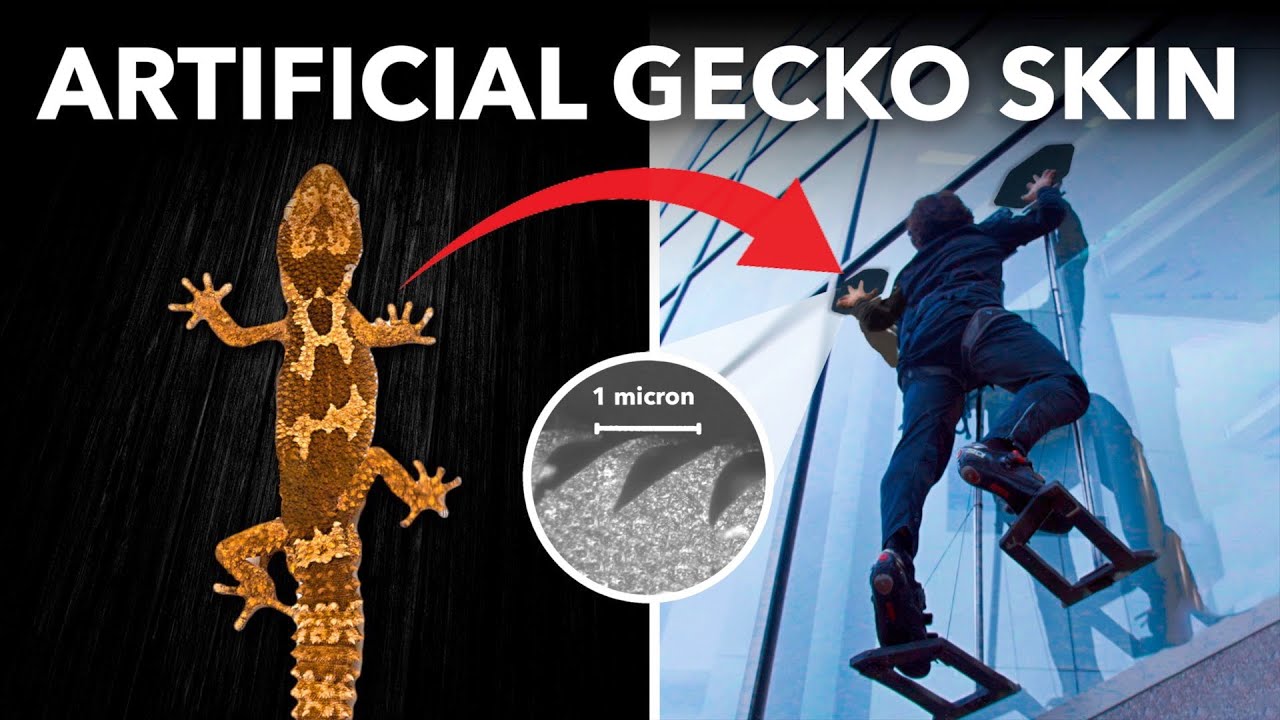
The Stickiest *Non-Sticky* Substance
Keywords
Summary
125 words
Critical Evaluation
Value of the Information & Strength of the Argument
The video provides valuable insights into the principles and applications of gecko-inspired adhesives. It effectively explains the counterintuitive behavior of the material through the lens of van der Waals forces and shear loading. The argumentation is solid, supported by demonstrations and expert explanations from the research team. The progression from fundamental physics to practical applications is logical and compelling.
Scientific Rigor, Source Quality, Title Accuracy
The video maintains high scientific rigor, featuring direct collaboration with the Stanford lab and referencing multiple peer-reviewed papers. The sources cited are credible and directly relevant. The title accurately captures the essence of the material’s unique properties. The content is well-structured and aligns with the title’s promise.
121 words
Title / Content Match
The title accurately reflects the paradoxical nature of the material, which is non-sticky yet can hold significant weight.
Quality & Reliability
9/10
High-quality science communication with direct involvement of the research lab, clear explanations, and references to peer-reviewed publications.
Key Moments
Markers derived by PSI from the transcript: the creator did not define chapters.
- Introduction to the non-sticky adhesive and its surprising ability to hold objects.
- Explanation of gecko adhesion and the role of van der Waals forces.
- Microscopic view of gecko toe structures (setae and spatulae).
- Manufacturing process of artificial gecko adhesive using wax molds.
- Demonstration of MicroTug robots pulling heavy weights.
- Application on the International Space Station with Astrobee robot.
- Robotic grippers picking up delicate items and the car-pulling anchor demonstration.
Cited Sources
- Brilliant (sponsor) — Sponsorship segment promoting the learning platform.
- Christensen et al. (2015) - µTugs — Reference for micro-robots using controllable adhesives.
- Glick et al. (2018) - Soft robotic gripper — Reference for gecko-inspired adhesive in robotic grippers.
- Hajj-Ahmad et al. (2021) - Machined metal molds — Reference for manufacturing method of directional adhesives.
- Hawkes (2015) - PhD thesis — Reference for applying dry adhesives to real-world applications.
- Kerst (2020) - PhD thesis — Reference for manufacturing and applications of gecko-inspired adhesives.
- Russell et al. (2019) - Integrative biology of gecko adhesion — Reference for the biological background of gecko adhesion.
- Suresh et al. (2019) - Spatially variant adhesive — Reference for one-way friction adhesive.
- Suresh (2020) - PhD thesis — Reference for engineering gecko-inspired adhesives.
Concurring Sources
- Russell et al. (2019) — Provides comprehensive background on gecko adhesion biology, supporting the video's explanations.
- Suresh et al. (2019) — Details the one-way friction property, which is central to the video's demonstration.
Contribution & Novelties
The video provides an accessible yet detailed explanation of gecko-inspired adhesives, bridging fundamental physics with cutting-edge engineering. It showcases recent advancements from Stanford’s lab, including applications in space robotics and micro-robotics, offering viewers a glimpse into the future of adhesive technology.
Pour aller plus loin :
- Van der Waals force — Essential background on the intermolecular forces exploited by gecko adhesives.
- Biomimetics — The field of mimicking nature for engineering solutions, contextualizing the gecko adhesive research.
- Gecko feet — Detailed biological structure and adhesion mechanisms of gecko feet.
- Dry adhesive — Overview of adhesives that work without wetness, including gecko-inspired types.
101 words
Radar Profile
The radar profile shows high scores across all dimensions, indicating a well-rounded and reliable video. The balance between information quantity, quality, technical depth, and reliability is excellent, making it a valuable educational resource.
💬 Très positif : Sur les 30 commentaires analysés, l'enthousiasme est unanime, avec des spectateurs partageant des expériences personnelles et des applications médicales potentielles, reflétant une forte appréciation du contenu.