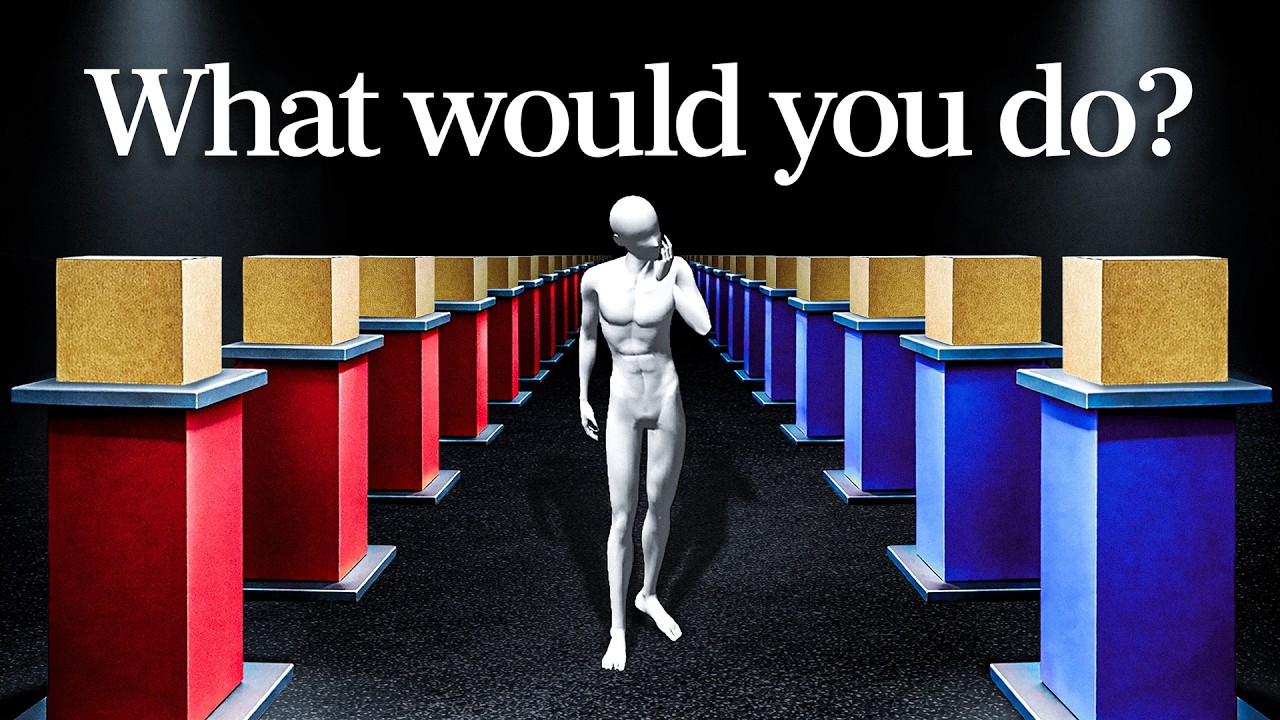
This Paradox Splits Smart People 50/50
Keywords
Summary
150 words
Critical Evaluation
The video provides a comprehensive and engaging exploration of Newcomb’s paradox, a classic problem in decision theory and philosophy. It effectively presents both sides of the argument, using interviews with experts and casual observers to illustrate the intuitive divide. The explanations of evidential and causal decision theory are clear and accessible, making complex philosophical concepts understandable to a general audience. The video’s strength lies in its balanced presentation: it does not definitively favor one side, but instead highlights the underlying assumptions that lead to different conclusions. This approach encourages viewers to critically evaluate their own reasoning.
The scientific rigor is high, as the video consults multiple experts in the field, including philosophers and decision theorists, and references academic work. The use of expected utility calculations is mathematically sound, and the video correctly distinguishes between the two decision theories. However, the video does not delve into more advanced critiques or alternative solutions to the paradox, such as the role of determinism or the possibility of a perfect predictor. This is a minor limitation, as the video aims for broad accessibility rather than exhaustive academic depth.
The quality of sources is good, with references provided in the description, including a post by Professor Huemer that informs the causal expected utility calculation. The video also cites the original paradox and its reception, adding historical context. The inclusion of a poll with over 24,000 responses provides empirical evidence of the divide, though it is not a scientific study.
The adéquation between the title and content is excellent; the title accurately captures the paradoxical nature of the problem and the split in opinions. The video’s production quality is high, with clear visuals and engaging storytelling.
Overall, the video is a valuable resource for anyone interested in decision theory, philosophy, or the nature of rationality. It successfully communicates complex ideas in an entertaining and thought-provoking manner, making it a strong contribution to science communication.
318 words
Title / Content Match
The title accurately reflects the content, as the video explores a paradox that indeed splits opinions roughly evenly, as demonstrated by polls and expert interviews.
Quality & Reliability
8/10
The video presents a well-structured exploration of Newcomb's paradox, featuring interviews with experts in decision theory and philosophy. It accurately explains the key concepts of evidential and causal decision theory, and includes references to academic sources. The content is balanced, presenting both sides of the paradox without bias. Minor limitations include the lack of formal peer-reviewed citations in the video itself, but the provided references and expert consultations enhance credibility.
Chapters
Cited Sources
- Brilliant (sponsor) — Sponsor of the video, offering a free trial and discount for viewers.
- Huemer's post on causal expected utility — Referenced for the causal expected utility calculation.
- Newcomb's Paradox references — List of references used in the video.
- Veritasium newsletter — Sign-up for weekly science updates.
- Snatoms molecular modelling kit — Product mentioned by the creator.
- Pre-order retail edition of Elements of Truth — Related to a Kickstarter game by Veritasium.
Concurring Sources
- Newcomb's problem - Wikipedia — Provides background and various perspectives on the paradox.
- Robert Nozick's original paper on Newcomb's problem — Referenced in the video as the philosopher who popularized the paradox.
Dissenting Sources
Contribution & Novelties
The video provides a clear and engaging explanation of Newcomb’s paradox, synthesizing expert opinions and presenting both decision theories in an accessible manner. It adds value by including a large audience poll and real-time reactions, making the philosophical debate tangible. The discussion on free will and rationality offers a broader perspective on the implications of the paradox.
Pour aller plus loin :
- Newcomb’s paradox - Stanford Encyclopedia of Philosophy — Comprehensive academic overview.
- Decision theory - Wikipedia — Background on decision theory.
- Evidential decision theory - Wikipedia — Detailed explanation of evidential decision theory.
- Causal decision theory - Wikipedia — Detailed explanation of causal decision theory.
- Free will - Stanford Encyclopedia of Philosophy — Philosophical discussion on free will.
119 words
Radar Profile
The radar profile shows high scores in quantity and quality of information, reflecting the video's comprehensive and accurate coverage. The technical level is moderate, suitable for a general audience, while the overall reliability is strong due to expert input and references.
💬 The comments are predominantly positive and engaged, with viewers actively debating the paradox and sharing their own reasoning. Many express strong opinions on one-boxing vs. two-boxing, and some humorous takes on the scenario. The overall tone is enthusiastic and intellectually curious, with no significant negative sentiment.