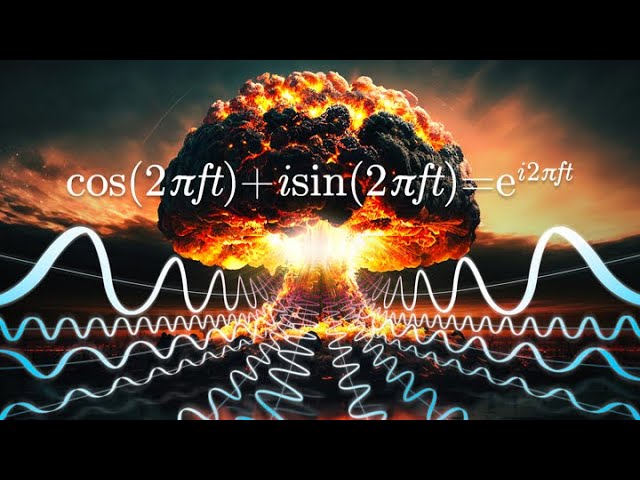
The Most Underrated Algorithm
Keywords
Summary
158 words
Critical Evaluation
Value of the Information & Strength of the Argument
The video provides substantial value by connecting a fundamental mathematical algorithm to a critical historical context, making the FFT’s significance tangible. The argumentation is solid: it clearly explains the computational bottleneck of the DFT, demonstrates the FFT’s efficiency gain with concrete examples, and supports the counterfactual claim about the nuclear test ban with expert testimony from Richard Garwin. The historical narrative is well-structured, and the technical explanation is accessible without oversimplifying the underlying mathematics.
Scientific Rigor, Source Quality, Title Accuracy
The video demonstrates high scientific rigor. It cites numerous peer-reviewed papers, historical documents, and expert interviews, all listed in the description. The sources are relevant and credible, covering seismology, nuclear policy, and the history of the FFT. The title accurately reflects the content, which highlights the FFT’s underappreciated historical impact and its pervasive modern applications. The video also acknowledges its sponsorship transparently.
151 words
Title / Content Match
The title accurately reflects the content, which highlights the FFT's underappreciated historical impact and its pervasive modern applications.
Quality & Reliability
9/10
High-quality production with rigorous sourcing: interviews with experts (Richard Garwin, seismologists), references to peer-reviewed literature and historical documents, and clear explanations of the FFT algorithm. The video is well-researched and transparent about its sources.
Key Moments
Markers derived by PSI from the transcript: the creator did not define chapters.
- Introduction to the FFT's ubiquity and its connection to nuclear test detection.
- Historical context: the Baruch Plan and the start of the nuclear arms race.
- Explanation of the Fourier transform and how it decomposes signals into frequencies.
- The computational challenge of the discrete Fourier transform (O(N^2)).
- The discovery of the FFT by Cooley and Tukey and its O(N log N) efficiency.
- Gauss's earlier discovery of the FFT and the missed opportunity for a test ban.
- Modern applications of the FFT, including image compression and wireless communication.
Cited Sources
- Status of World Nuclear Forces — Reference for nuclear stockpile data.
- Science and politics in early nuclear test ban negotiations — Historical analysis of test ban negotiations.
- In pursuit of a nuclear test ban treaty — Historical account of test ban efforts.
- Forensic seismology and the comprehensive nuclear-test-ban treaty — Scientific basis for seismic monitoring.
- How Often Do Earthquakes Occur? — Data on earthquake frequency.
- The Nuclear Testing Tally — Count of nuclear tests.
- Detection capability of the seismic network of the International Monitoring System — Technical details on seismic detection.
- The verification of a comprehensive nuclear test ban — Scientific article on verification methods.
- World-wide standardized seismograph network: a data users guide — Guide to seismograph network.
- Monitoring for nuclear explosions — Scientific American article on monitoring.
- The seismograph as a diplomatic object — Historical study of seismograph exchanges.
- The Hidden Costs Of Our Nuclear Arsenal — Cost analysis of nuclear arsenal.
- The Soviet Union: Military Spending — Data on Soviet military spending.
- Gauss and the history of the fast Fourier transform — Historical paper on Gauss's FFT.
- Richard Garwin - Session IV — Oral history interview with Garwin.
- Richard Garwin - Session I — Oral history interview with Garwin.
- James W. Cooley, an oral history — Oral history interview with Cooley.
- The 1968 Arden House workshop on fast Fourier transform processing — Workshop proceedings on FFT.
- 3Blue1Brown video on Fourier Transform — Complementary visual explanation of Fourier transform.
Concurring Sources
- Gauss and the history of the fast Fourier transform — Confirms Gauss's early discovery of the FFT.
- The verification of a comprehensive nuclear test ban — Supports the feasibility of seismic verification.
- Forensic seismology and the comprehensive nuclear-test-ban treaty — Provides scientific basis for detecting nuclear explosions.
External References
Contribution & Novelties
The video’s original contribution lies in weaving together the mathematical elegance of the FFT with a compelling historical counterfactual: that its earlier adoption could have prevented the nuclear arms race. It provides a clear, intuitive explanation of the algorithm’s efficiency gain and its critical role in enabling seismic verification. The inclusion of an interview with Richard Garwin adds a unique first-hand perspective.
Pour aller plus loin :
- Fast Fourier transform — Wikipedia article providing a comprehensive overview of the algorithm.
- Comprehensive Nuclear-Test-Ban Treaty — Background on the treaty and its verification regime.
- Seismic monitoring of nuclear explosions — Overview of the scientific methods used to detect nuclear tests.
108 words
Radar Profile
The radar profile shows high scores across all dimensions, with a slight dip in technical level relative to information quantity and quality. This reflects the video's success in making a complex topic accessible while maintaining scientific depth.
💬 Très positif. Sur les 30 commentaires analysés, les spectateurs expriment une admiration unanime pour la clarté de l'explication et la valeur pédagogique de la vidéo, soulignant souvent qu'elle comble une lacune de l'enseignement traditionnel.