Keywords
Summary
246 words
Critical Evaluation
Value of the Information & Strength of the Argument
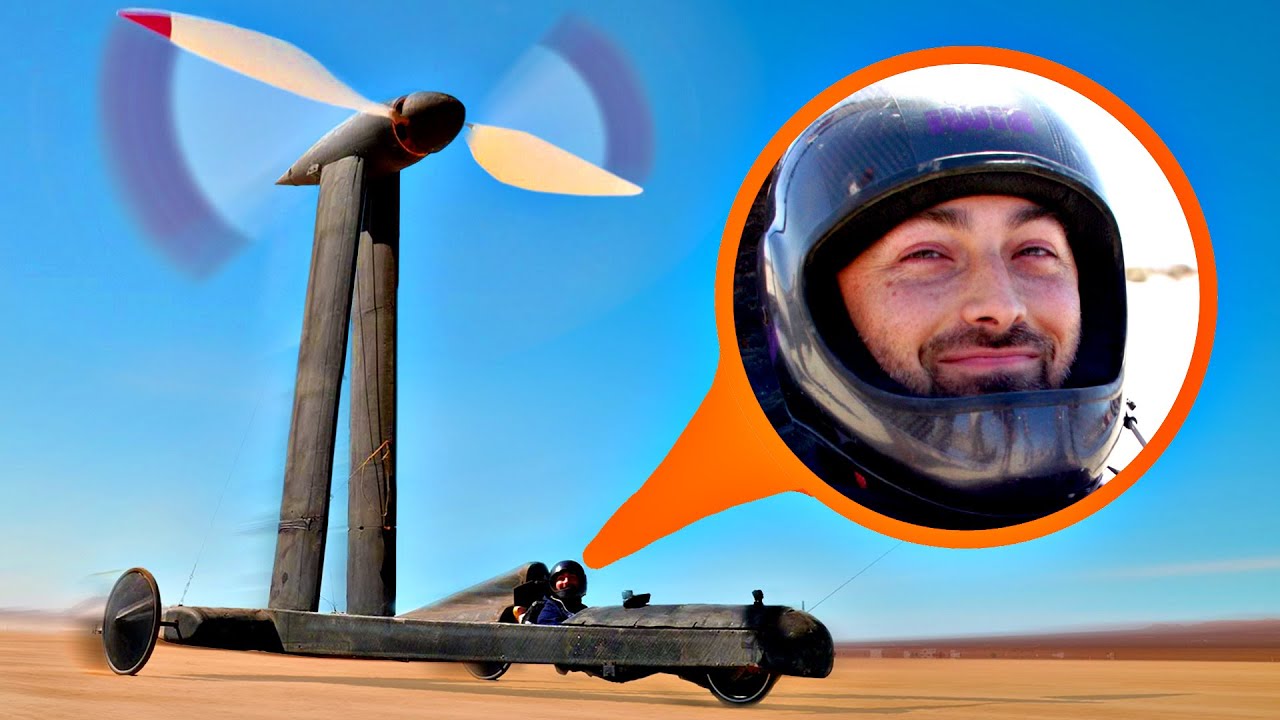
The video provides substantial value by offering a clear, empirical demonstration of a phenomenon that is often misunderstood. The argumentation is solid, building from a simple brain teaser to a full-scale test, and includes multiple levels of explanation: intuitive, analogical, and mathematical. The host acknowledges the counterintuitive nature and preemptively addresses common objections, such as the source of energy, by explaining the difference in relative velocities and the role of the tailwind. The use of the cylindrical Earth analogy is particularly effective in making the concept accessible. The video also includes expert commentary and references to academic literature, strengthening the credibility of the claims.
Scientific Rigor, Source Quality, Title Accuracy
The video demonstrates high scientific rigor by conducting a real-world experiment with careful controls, such as using a telltale to indicate apparent wind and a windsock for true wind direction. The sources cited include academic papers (e.g., Gaunaa et al., 2009) and online discussions, which are relevant and credible. The title accurately reflects the content, as the host indeed risks his life to settle the debate. The video also transparently addresses potential criticisms and provides a thorough explanation of the physics involved.
201 words
Title / Content Match
The title accurately reflects the content: the host risks driving a vehicle to settle a physics debate, and the video delivers on this promise.
Quality & Reliability
9/10
The video presents a rigorous empirical demonstration of a counterintuitive physics phenomenon, supported by theoretical explanations, references to academic papers, and multiple expert testimonies. The methodology is transparent, and the claims are consistent with established physics principles.
Key Moments
Markers derived by PSI from the transcript: the creator did not define chapters.
- Introduction: The challenge of going downwind faster than the wind.
- Explanation of why sailboats cannot exceed wind speed directly downwind.
- Arrival at El Mirage and preparation for the test.
- First attempt: The telltale drops, indicating near wind speed, but not enough wind.
- The cylindrical Earth analogy with two sailboats forming a propeller.
- Discussion of online skepticism and the treadmill demonstration.
- Second attempt: Chain breaks, but the vehicle is repaired.
- High winds cause concern, but Rick takes a test run.
- Final attempt: Derek drives and successfully exceeds wind speed, with telltale pointing backward.
- Detailed explanation of the physics, including energy transfer and apparent wind.
Cited Sources
- Gaunaa, M., Øye, S., & Mikkelsen, R. F. (2009). Theory and design of flow driven vehicles using rotors for energy conversion. — Cited in the video description as a reference for the theory behind the Blackbird.
- Md. Sadak Ali Khan et al. (2013). Analysis of Down-Wind Propeller Vehicle. — Cited in the video description as a reference for the analysis of downwind propeller vehicles.
- Rick's YouTube Channel — Mentioned in the video as a source for more in-depth explanations.
- Jack Goodman's YouTube video — Referenced in the video description as a related video.
- Rick's treadmill footage — Referenced in the video description as evidence of the vehicle's operation.
- Rick's multiple explanations of how Blackbird works — Referenced in the video description for further explanations.
- Forum discussions — Referenced in the video description as a source of debate.
- Blog — Referenced in the video description as a blog post.
- Blog retraction — Referenced in the video description as a retraction of a previous blog post.
Concurring Sources
- Gaunaa, M., Øye, S., & Mikkelsen, R. F. (2009). Theory and design of flow driven vehicles using rotors for energy conversion. — Academic paper supporting the theoretical feasibility of the vehicle.
- Md. Sadak Ali Khan et al. (2013). Analysis of Down-Wind Propeller Vehicle. — Academic paper analyzing the performance of downwind propeller vehicles.
External References
Contribution & Novelties
The video provides a clear, empirical demonstration of a phenomenon that is often misunderstood, and it offers a novel pedagogical approach using the cylindrical Earth analogy. It also contributes to the public understanding of physics by addressing common misconceptions and providing a step-by-step explanation of the energy transfer.
Pour aller plus loin :
- Apparent wind — Explains the concept of apparent wind, which is central to understanding the vehicle’s operation.
- Propeller — Provides background on how propellers generate thrust by pushing air backward.
- Conservation of energy — Addresses the principle that the vehicle does not violate, as it extracts energy from the wind.
- Wind-powered vehicle — Offers context on other types of wind-powered vehicles and their limitations.
117 words
Radar Profile
The radar profile shows high scores across all dimensions, indicating a well-rounded and reliable video. The high scores in information quantity and quality reflect the thorough explanation and demonstration, while the technical level is appropriate for the target audience. The overall reliability is strong, supported by empirical evidence and academic references.
💬 Très positif. Sur les 30 commentaires analysés, la grande majorité exprime admiration et enthousiasme pour la démonstration et l'explication, avec des commentaires humoristiques sur la sécurité et la détermination du créateur.