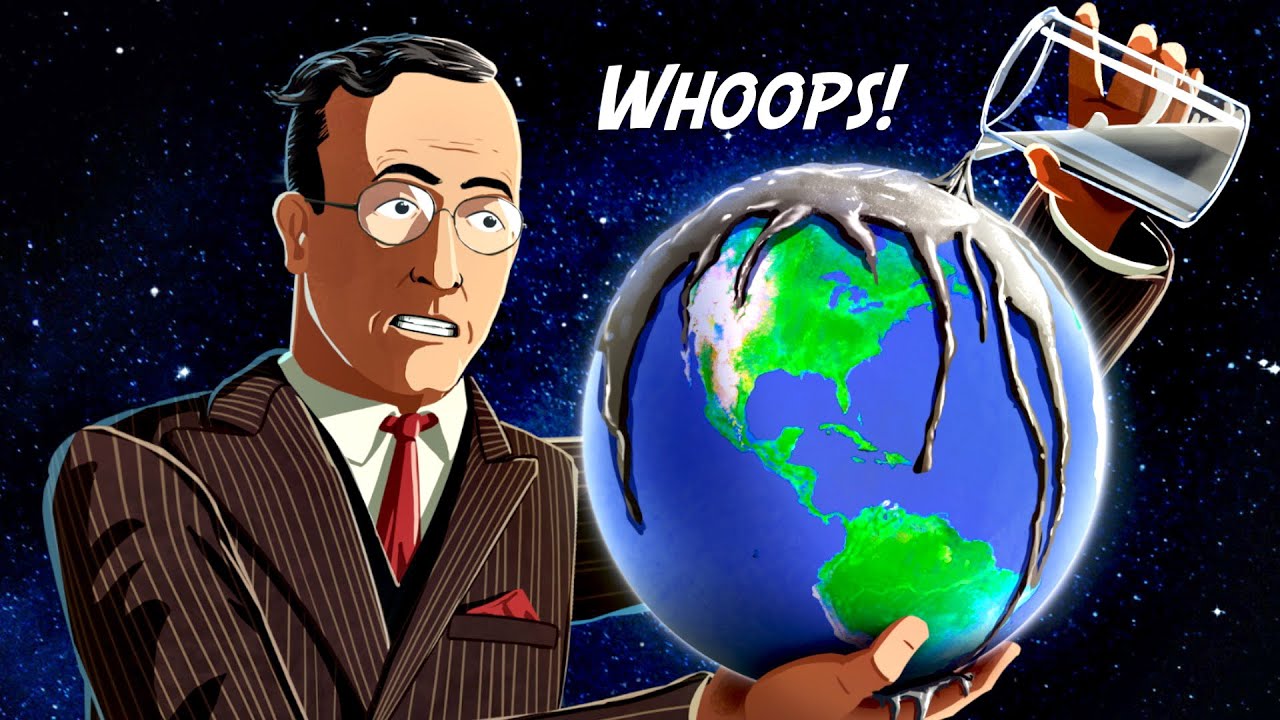
The Man Who Accidentally Killed The Most People In History
Keywords
Summary
138 words
Critical Evaluation
Value of the Information & Strength of the Argument
The video provides substantial value by connecting historical events to current environmental and health issues. It presents a compelling narrative that illustrates the unintended consequences of technological innovation. The argumentation is solid, using scientific studies and historical records to support claims. It effectively contrasts the actions of Midgley with the perseverance of Patterson, highlighting the importance of evidence-based decision-making. The video also addresses the lead-crime hypothesis with appropriate caution, presenting it as a correlation with plausible causal mechanisms.
Scientific Rigor, Source Quality, Title Accuracy
The video demonstrates high scientific rigor, citing numerous peer-reviewed studies, official reports, and historical documents. It clearly distinguishes between established facts and hypotheses. The title, while sensational, accurately reflects the content’s focus on Midgley’s impact. The video also acknowledges the complexity of attributing deaths and IQ loss to lead exposure, providing a balanced view. The inclusion of Patterson’s work adds depth and credibility to the narrative.
159 words
Title / Content Match
The title is somewhat sensationalist but accurately reflects the video's focus on Thomas Midgley Jr.'s inventions and their global impact.
Quality & Reliability
9/10
The video is well-researched, with references to peer-reviewed studies and official reports. It clearly distinguishes between established facts and hypotheses (e.g., lead-crime hypothesis). The narrative is engaging but maintains scientific accuracy.
Key Moments
Markers derived by PSI from the transcript: the creator did not define chapters.
- Introduction to Clair Patterson and his work on the Manhattan Project.
- Explanation of the problem of engine knocking and the search for an additive.
- Discovery of tetraethyl lead and its adoption despite known dangers.
- Patterson's efforts to build a clean lab and measure the age of the Earth.
- Patterson's research on lead pollution in oceans and ice cores.
- Evidence of lead's harmful effects on health and IQ.
- Discussion of the lead-crime hypothesis and its global correlation.
- Midgley's invention of CFCs and the ozone hole problem.
- The eventual ban on leaded gasoline and the legacy of these inventions.
Cited Sources
- UN News - End of leaded gasoline — Press release about the global phase-out of leaded gasoline.
- Rick Nevin's work on lead-crime hypothesis — Data and research on the link between lead exposure and crime rates.
- Boutron & Patterson (1986) - Lead in Antarctic ice — Study on lead concentration changes in Antarctic ice.
- Edelmann (2016) - Life and legacy of Thomas Midgley Jr. — Biographical paper on Midgley.
- Ericson et al. (1979) - Skeletal lead in ancient Peruvians — Study on lead levels in ancient bones.
- Kovarik (1993) - The ethyl controversy — Historical analysis of the leaded gasoline debate.
- Kovarik (2005) - Ethyl-leaded gasoline — Further historical research on leaded gasoline.
- Lanphear et al. (2018) - Low-level lead exposure and mortality — Study on lead exposure and mortality in US adults.
- McFarland et al. (2022) - PNAS study on lead exposure — Study on the population exposed to lead in the US.
- More et al. (2017) - Ice core technology and lead levels — Study on natural lead levels using ice cores.
- Needleman (2004) - Lead poisoning — Review of lead poisoning.
- Needleman (1991) - Human lead exposure — Book on human lead exposure.
- Needleman et al. (1979) - Dentine lead and classroom performance — Study on lead and cognitive deficits in children.
- Needleman et al. (1996) - Bone lead and delinquent behavior — Study on lead and delinquency.
- Nevin (2007) - Preschool lead exposure and crime trends — Study on lead exposure and crime.
- Patterson (1956) - Age of meteorites and the earth — Original paper on the age of the Earth.
- Patterson - Isotopic composition of lead and calcium — Patterson's thesis work.
- Schaule & Patterson (1981) - Lead in the northeast Pacific — Study on lead pollution in the ocean.
- UNICEF report on lead exposure — Report on children's lead exposure.
Concurring Sources
- WHO factsheet on lead poisoning — World Health Organization's official information on lead poisoning.
- UNEP - Leaded petrol phase-out — UNEP announcement on the end of leaded petrol.
Dissenting Sources
- Critique of the lead-crime hypothesis — Some researchers argue that the correlation between lead exposure and crime rates is not causal and may be confounded by other factors.
External References
Contribution & Novelties
The video provides a compelling synthesis of historical and scientific evidence, highlighting the dual legacy of Thomas Midgley Jr. and the crucial role of Clair Patterson in uncovering the dangers of lead. It brings together diverse sources to illustrate the far-reaching consequences of industrial decisions. The narrative emphasizes the importance of scientific integrity and the need for precautionary principles in technological development.
Pour aller plus loin :
- Lead poisoning - Wikipedia — Overview of lead poisoning, its mechanisms, and health effects.
- Ozone depletion - Wikipedia — Explanation of ozone depletion and the role of CFCs.
- Montreal Protocol - Wikipedia — International treaty to phase out ozone-depleting substances.
- Clair Patterson - Wikipedia — Biography of the geochemist who fought against lead pollution.
121 words
Radar Profile
The radar profile shows high scores in information quantity, quality, and reliability, with a slightly lower technical level due to the accessible presentation. This indicates a well-balanced, informative video that is both scientifically sound and engaging for a general audience.
💬 Très positif. Sur les 30 commentaires analysés, les spectateurs expriment une forte admiration pour le travail de Clair Patterson et une critique sévère de Thomas Midgley, tout en soulignant la responsabilité des entreprises.