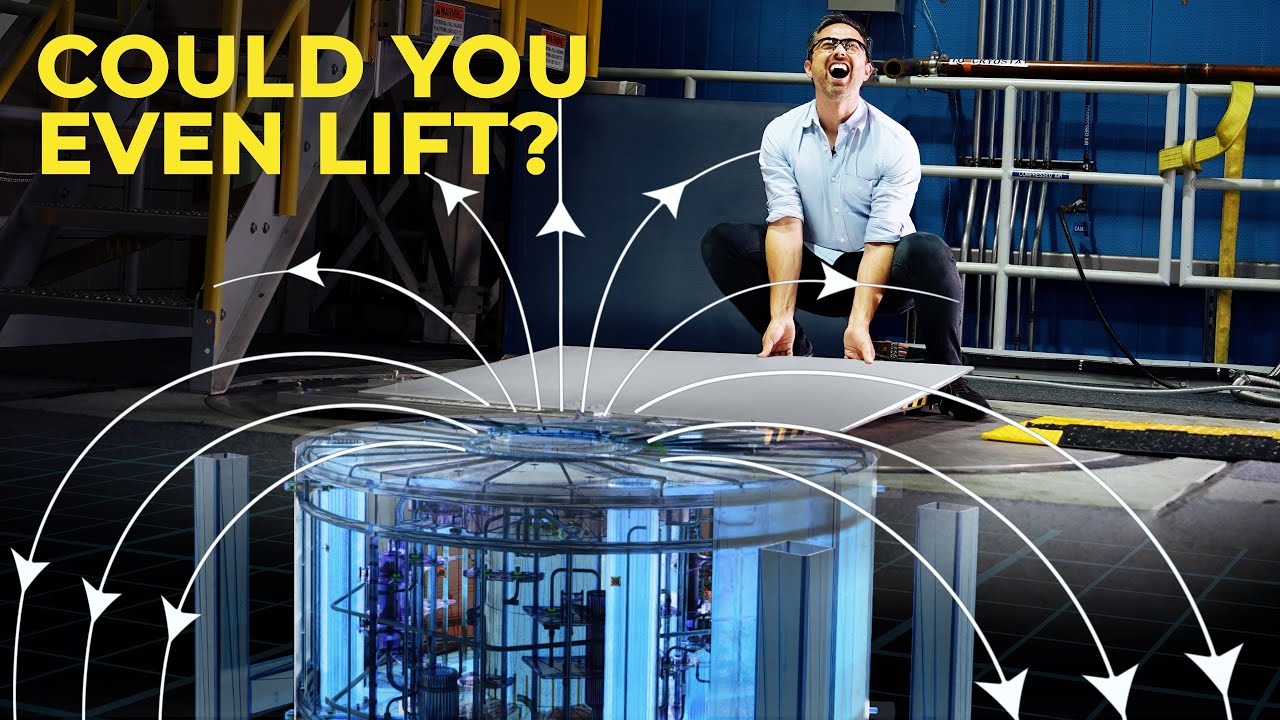
World's Strongest Magnet!
Keywords
Summary
130 words
Critical Evaluation
Value of the Information & Strength of the Argument
The video provides substantial educational value by explaining complex physical phenomena in an accessible manner. It uses clear demonstrations and analogies, such as the ‘No You Don’t’ law for Lenz’s law, to make concepts understandable. The argumentation is solid, grounded in direct observations and expert explanations from researchers at the lab. The video effectively builds from basic principles to advanced applications, making it valuable for both general audiences and those with some physics background.
Scientific Rigor, Source Quality, Title Accuracy
The scientific rigor is high, with the video featuring direct interviews with experts and references to peer-reviewed papers on magnetic levitation. The sources cited in the description are relevant and credible. The title accurately reflects the content, focusing on the world’s strongest magnet and its capabilities. The video maintains a clear distinction between sponsored content and editorial content, with the sponsorship segment clearly labeled. The demonstrations are well-designed and the explanations are consistent with established physics.
165 words
Title / Content Match
The title accurately reflects the video's focus on the world's strongest continuous magnetic field and its demonstrations.
Quality & Reliability
9/10
High-quality production with direct access to experts at the National High Magnetic Field Laboratory, clear explanations of physical principles, and references to peer-reviewed literature. The content is accurate and well-illustrated, though the sponsorship segment is clearly marked.
Key Moments
Markers derived by PSI from the transcript: the creator did not define chapters.
- Introduction to the world's strongest magnet and its capabilities.
- Explanation of the magnet's field strength compared to Earth's magnetic field.
- Safety precautions and the concept of the fringe field.
- Demonstration of ferromagnetic attraction with a Nerf football.
- Ferrofluid behavior in the magnetic field.
- Eddy currents and Lenz's law demonstrated with falling plates.
- Potato cannon projectiles and induced currents.
- Superconductors and the human levitator demonstration.
- Diamagnetic levitation of water and living organisms.
- Engineering of the hybrid magnet and its power requirements.
Cited Sources
- Magnet animations from MinutePhysics — Referenced for animations used in the video.
Concurring Sources
- Magnetic levitation of large water droplets and mice — Peer-reviewed paper on levitating water and mice, supporting the video's claims.
- Diamagnetic levitation: Flying frogs and floating magnets — Seminal paper on diamagnetic levitation, referenced in the video description.
- Of flying frogs and levitrons — Paper on levitation phenomena, cited in the description.
Contribution & Novelties
The video provides a unique behind-the-scenes look at the world’s strongest continuous magnet, combining spectacular demonstrations with clear scientific explanations. It offers original footage and interviews that are not commonly available, making complex concepts tangible. The video also highlights the engineering challenges and the importance of such facilities for materials science.
Pour aller plus loin :
- Diamagnetic levitation — Overview of the phenomenon demonstrated with water and living organisms.
- Lenz’s law — Fundamental principle behind eddy current demonstrations.
- Bitter electromagnet — The design used in the resistive part of the hybrid magnet.
- Superconducting magnet — Explanation of the outer superconducting component.
101 words
Radar Profile
The radar profile shows high scores across all dimensions, indicating a well-balanced and comprehensive video. The quantity and quality of information are excellent, with a high technical level that remains accessible. The reliability is strong due to expert input and peer-reviewed references.
💬 Très positif. Sur les 30 commentaires analysés, les spectateurs expriment un enthousiasme marqué pour les démonstrations et l'accessibilité des scientifiques, avec des remarques humoristiques sur la force physique du chercheur principal.