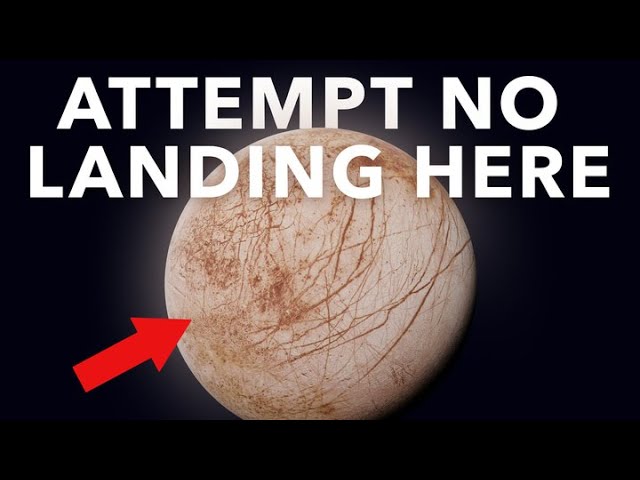
We Might Find Alien Life In 1,688 Days
Keywords
Summary
139 words
Critical Evaluation
Value of the Information & Strength of the Argument
The video provides a comprehensive and engaging overview of the Europa Clipper mission, combining scientific explanations with visual demonstrations and expert interviews. The argumentation is solid, building from the basic question of why Europa is interesting to the detailed engineering solutions for the mission. The use of analogies (e.g., rubber ball for tidal flexing) and clear graphics helps convey complex concepts. The inclusion of Dr. Pappalardo’s insights adds authority and depth. The video effectively argues for the importance of the mission and the potential for discovering extraterrestrial life.
Scientific Rigor, Source Quality, Title Accuracy
The video demonstrates high scientific rigor, citing peer-reviewed papers (e.g., Carr et al. 1998, Carlson & Hand 2015) and NASA sources. The title accurately reflects the content, focusing on the mission and the timeline for potential discovery. The video also acknowledges uncertainties, such as the inconclusive evidence for plumes on Europa, and presents balanced comparisons with Enceladus. The inclusion of a sponsor segment is clearly marked and does not detract from the scientific content.
177 words
Title / Content Match
The title accurately reflects the content, focusing on the Europa Clipper mission and the timeline for potential discovery of alien life.
Quality & Reliability
9/10
High-quality production with expert interviews (Dr. Robert Pappalardo), references to peer-reviewed papers and NASA sources, and clear explanations of scientific concepts.
Chapters
Cited Sources
- Europa Clipper via Wikipedia — General information about the Europa Clipper mission.
- Magnetosphere of Jupiter via Wikipedia — Background on Jupiter's magnetic field and radiation belts.
- Europa Clipper (2024) via Nasa.gov — Official NASA page for the Europa Clipper mission.
- Extraterrestrial Cycloids - Why Are They on Europa? via minutephysics — Explanation of cycloid features on Europa's surface.
- Hand, K. P. & Carlson, R. W. (2015). Europa’s surface color suggests an ocean rich with sodium chloride. Geophysical research letters — Peer-reviewed paper on Europa's surface composition.
- Dalton, J. B. et al. (2003). Near-Infrared Detection of Potential Evidence for Microscopic Organisms on Europa. Astrobiology — Peer-reviewed paper on potential evidence for life on Europa.
- Europa Clipper: Exploring Jupiter's Ocean World (2024, May 24) via Youtube — Lecture by Dr. Robert Pappalardo on Europa Clipper.
- Carr, M., Belton, M., Chapman, C. et al. (1998). Evidence for a subsurface ocean on Europa. Nature 391, 363–365 — Key paper providing evidence for Europa's subsurface ocean.
- New Findings Support Prospect of Life on Jupiter’s Moon Europa (2024) via Nasa.gov — NASA article on recent findings supporting life potential on Europa.
- Meitzler, R., Jun, I., Blase, R. et al. (2023). Investigating Europa’s Radiation Environment with the Europa Clipper Radiation Monitor. Space Sci Rev 219, 61 — Peer-reviewed paper on radiation environment measurements for Europa Clipper.
Concurring Sources
- NASA Europa Clipper Mission — Official NASA page confirming mission details and objectives.
- Europa (moon) - Wikipedia — General information about Europa, consistent with the video's content.
External References
Contribution & Novelties
The video provides an up-to-date overview of the Europa Clipper mission, including recent launch details and expert insights. It synthesizes information from multiple sources, making it accessible to a broad audience. The inclusion of Dr. Pappalardo’s commentary adds unique value.
Pour aller plus loin :
- NASA Europa Clipper Mission — Official mission page with detailed information.
- Europa (moon) - Wikipedia — Comprehensive overview of Europa’s characteristics.
- Hydrothermal vent - Wikipedia — Background on hydrothermal vents and their role in supporting life.
81 words
Radar Profile
The radar profile shows high scores across all dimensions, indicating a well-rounded and reliable video. The strongest aspects are the quantity and quality of information, while the technical level is slightly lower, reflecting the accessible presentation style.
💬 Très positif. Sur les 30 commentaires analysés, le public exprime un enthousiasme marqué pour la mission et la qualité de la vidéo, avec des remerciements pour la clarté des explications et l'émotion suscitée par la perspective de découvrir une vie extraterrestre.