How Imaginary Numbers Were Invented
Keywords
Summary
122 words
Critical Evaluation
Value of the Information & Strength of the Argument
The video provides high-value information by connecting mathematical concepts to their historical context, making the material engaging and accessible. The argumentation is solid, building logically from the geometric interpretation of quadratic equations to the algebraic solution of cubics and the eventual acceptance of imaginary numbers. The narrative is compelling and well-supported by historical evidence and expert commentary.
Scientific Rigor, Source Quality, Title Accuracy
The video demonstrates strong scientific rigor by citing primary sources such as Cardano’s ‘Ars Magna’ and Bombelli’s ‘L’Algebra’, as well as modern historical analyses. The sources are credible and directly support the claims made. The title accurately reflects the content, which focuses on the invention of imaginary numbers through the solution of cubic equations.
126 words
Title / Content Match
The title accurately reflects the content, which traces the historical invention of imaginary numbers through the solution of cubic equations.
Quality & Reliability
9/10
The video is well-researched, with references to primary sources and historical documents, and features expert consultations. The mathematical explanations are accurate and clearly presented.
Key Moments
Markers derived by PSI from the transcript: the creator did not define chapters.
- Introduction to the problem of cubic equations and the historical context.
- Explanation of how ancient mathematicians solved quadratic equations geometrically.
- Introduction of Scipione del Ferro and his secret solution to the depressed cubic.
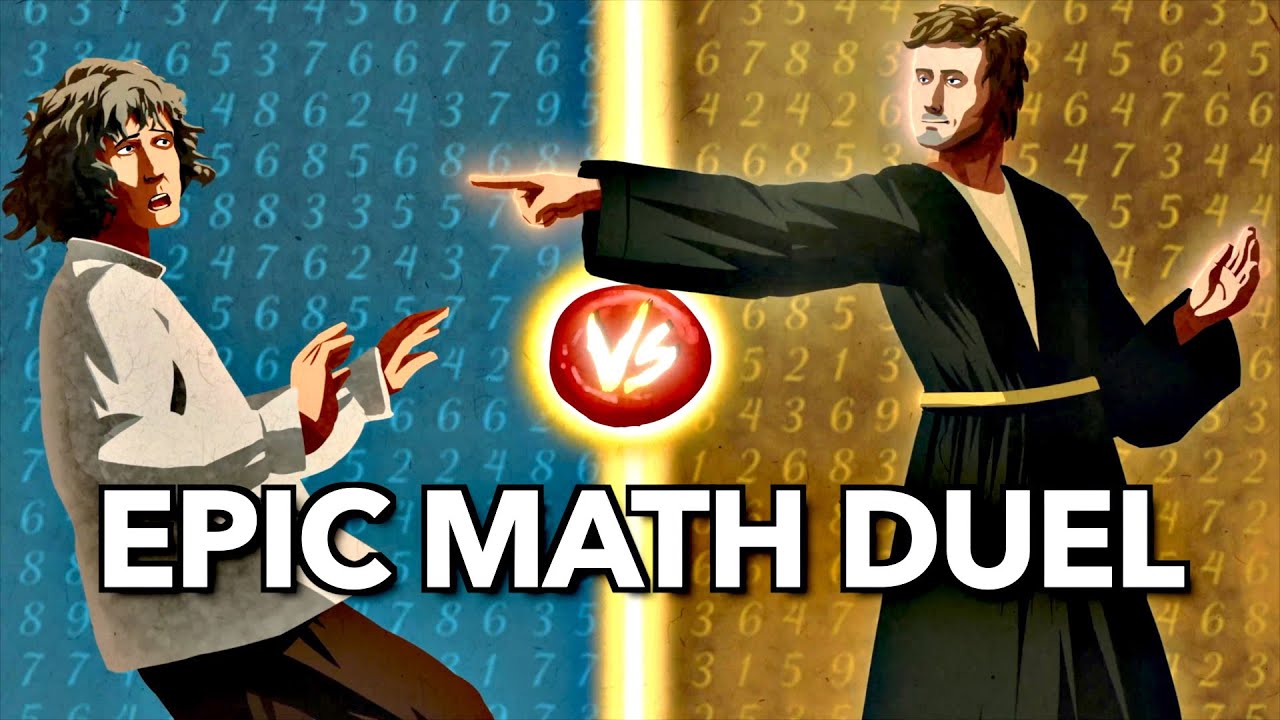
- The mathematical duel between Tartaglia and Fior, and Tartaglia's discovery of the solution.
- Cardano's publication of Ars Magna and the controversy with Tartaglia.
- Bombelli's work with imaginary numbers and the resolution of the casus irreducibilis.
- The development of complex numbers and their geometric interpretation.
- The role of imaginary numbers in Schrödinger's equation and quantum mechanics.
Cited Sources
- Brilliant — Sponsor of the video, offering a course on complex numbers.
- Bochner, S. (1963). The significance of some basic mathematical conceptions for physics. Isis, 54(2), 179-205. — Referenced for the historical significance of mathematical concepts in physics.
- Bombelli, R. (1579). L'Algebra. — Primary source for Bombelli's work on imaginary numbers.
- Branson, W. Solving the cubic with Cardano. — Reference for the method of solving cubic equations.
- Dunham, W. (1990). Journey through genius: The great theorems of mathematics. — Referenced for historical context on mathematical theorems.
- Merino, O. (2006). A short history of complex numbers. University of Rhode Island. — Referenced for the history of complex numbers.
- Muroi, K. (2019). Cubic equations of Babylonian mathematics. arXiv preprint arXiv:1905.08034. — Referenced for Babylonian mathematics and cubic equations.
- Rothman, T. (2013). Cardano v Tartaglia: The Great Feud Goes Supernatural. arXiv preprint arXiv:1308.2181. — Referenced for the feud between Cardano and Tartaglia.
- Siadat, M. V., & Tholen, A. (2021). Omar Khayyam: Geometric Algebra and Cubic Equations. Math Horizons, 28(1), 12-15. — Referenced for Omar Khayyam's work on cubic equations.
- Toscano, F. (2020). The Secret Formula. Princeton University Press. — Referenced for the history of the cubic formula.
- Manim Community Developers. (2021). Manim – Mathematical Animation Framework. — Software used for animations.
- 500 years of not teaching the cubic formula — Related video on the cubic formula.
- Imaginary Numbers are Real — Related video on imaginary numbers.
Concurring Sources
- Dunham, W. (1990). Journey through genius — Supports the historical narrative of the cubic equation and the role of Cardano and Tartaglia.
- Toscano, F. (2020). The Secret Formula — Provides detailed historical account of the discovery of the cubic formula.
- Merino, O. (2006). A short history of complex numbers — Supports the development of complex numbers and their acceptance.
Contribution & Novelties
The video provides a compelling narrative that connects the historical development of imaginary numbers to their modern applications in physics, offering a fresh perspective that is often missing in traditional math education. It emphasizes the importance of abandoning the requirement for mathematics to reflect reality, which was a crucial step in the discovery of complex numbers.
Pour aller plus loin :
- Complex number — Wikipedia article providing a comprehensive overview of complex numbers.
- Cubic equation — Wikipedia article on cubic equations, including historical methods of solution.
- Schrödinger equation — Wikipedia article on the fundamental equation of quantum mechanics, which relies on imaginary numbers.
103 words
Radar Profile
The radar profile shows high scores in information quantity, quality, and reliability, with a slightly lower score in technical level, indicating that the video is accessible to a general audience while maintaining scientific accuracy.
💬 Très positif. Sur les 30 commentaires analysés, les spectateurs expriment une admiration unanime pour la clarté de l'explication et l'approche historique, beaucoup regrettant que les mathématiques ne soient pas enseignées de cette manière à l'école.