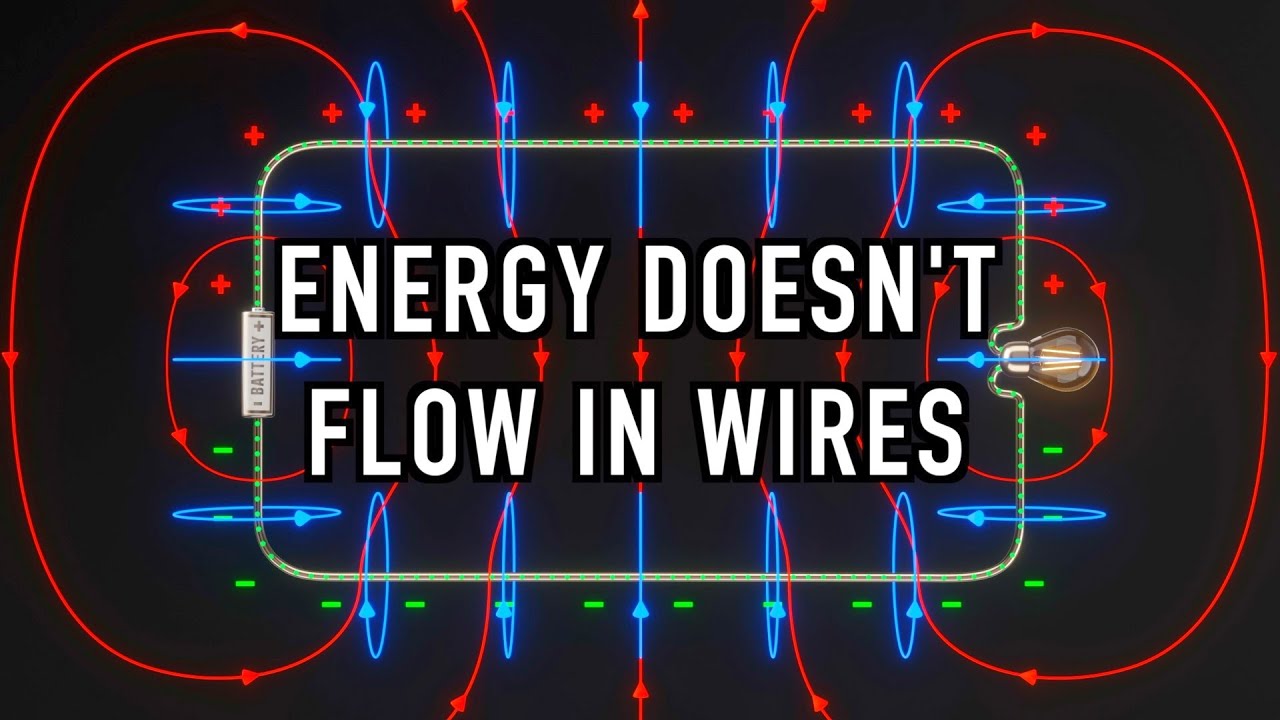
The Biggest Misconception About Electricity
Keywords
Summary
106 words
Critical Evaluation
Value of the Information & Strength of the Argument
The video provides a valuable correction to a widespread misconception, supported by clear explanations and visual demonstrations. The argumentation is solid, building from Maxwell’s equations to the Poynting vector and applying it to circuits. The thought experiment is engaging and effectively illustrates the key point. However, some simplifications (e.g., assuming ideal wires) and the specific experimental setup have been criticized by experts for potentially misleading viewers, though the core physics is correct.
Scientific Rigor, Source Quality, Title Accuracy
The video cites several peer-reviewed papers and books, including works by Feynman, Müller, and Galili, and features interviews with experts. The description provides links to these sources. The title accurately reflects the content. The video’s claims are consistent with established electromagnetic theory, though some nuances are simplified for a general audience. The presence of a sponsor (Lutron) is disclosed, and the sponsored segment is clearly separated from the educational content.
157 words
Title / Content Match
The title accurately reflects the core message: debunking the common misconception that electrons carry energy in circuits.
Quality & Reliability
8/10
The video presents a well-established scientific concept (Poynting vector) with references to peer-reviewed literature and expert consultations. However, some simplifications and the controversial experiment setup have drawn criticism from experts, slightly reducing the score.
Key Moments
Markers derived by PSI from the transcript: the creator did not define chapters.
- Introduction: The giant circuit thought experiment and the question of how long the bulb takes to light.
- Common explanation of electricity using the water pipe analogy, which is then debunked.
- Introduction of Maxwell's equations and the Poynting vector as the correct framework for energy transfer.
- Application of the Poynting vector to a simple circuit, showing energy flows from battery to bulb via fields.
- Explanation of how AC power transmission works using fields, not electron flow.
- Historical example: Transatlantic cable failures due to misunderstanding field propagation.
- Answer to the thought experiment: bulb lights in ~1/c seconds, with caveats about impedance.
- Expert opinions and discussion of the experiment's validity.
- Conclusion and sponsor segment for Lutron smart switches.
Cited Sources
- Lutron Caséta — Sponsor of the video, smart lighting control.
- Deno, D. W. (1976). Transmission line fields. IEEE Transactions on Power Apparatus and Systems. — Reference for transmission line fields.
- Feynman, R. P., Leighton, R. B., & Sands, M. (1965). The Feynman Lectures on Physics, Vol. II, Chapter 27. — Reference for the Poynting vector and field energy.
- Galili, I., & Goihbarg, E. (2005). Energy transfer in electrical circuits: A qualitative account. American Journal of Physics. — Reference for energy transfer in circuits.
- Müller, R. (2012). A semiquantitative treatment of surface charges in DC circuits. American Journal of Physics. — Reference for surface charges in DC circuits.
- Olsen, R. (2018). Transmission Lines. — Book by expert Robert Olsen on transmission lines.
- Sefton, I. M. (2002). Understanding electricity and circuits: What the text books don’t tell you. — Reference for common misconceptions in electricity education.
- Universe 2021 book by Geraint Lewis and Chris Ferrie — Book by experts consulted for the video.
- Further analysis of the large circuit — Additional analysis of the thought experiment.
- Science Asylum video on Poynting vector — Complementary video on the Poynting vector.
Concurring Sources
- Feynman Lectures Vol. II, Ch. 27 — Supports the Poynting vector explanation.
- Müller (2012) — Supports the role of surface charges in creating fields.
- Galili & Goihbarg (2005) — Supports the qualitative account of energy transfer.
Dissenting Sources
- Comment by UCSD physics professor — Claims the video contains misleading statements and that the experiment results are not as described, though the core theory is correct.
External References
Contribution & Novelties
The video’s original contribution is its clear, accessible explanation of a concept often misunderstood even by physics students: that electrical energy is carried by electromagnetic fields, not by electrons. It uses a compelling thought experiment and historical examples to illustrate this. The video also addresses common misconceptions and provides a framework for understanding energy transfer in circuits.
Pour aller plus loin :
- Poynting vector — Wikipedia article providing a detailed mathematical and physical description.
- Maxwell’s equations — Wikipedia article on the fundamental equations governing electromagnetism.
- Transatlantic telegraph cable — Wikipedia article on the historical context of the cable failures mentioned in the video.
- Transmission line — Wikipedia article on the theory of transmission lines, relevant to the discussion of power lines.
121 words
Radar Profile
The radar profile shows high scores in information quantity, quality, and technical level, indicating a well-researched and informative video. The reliability score is slightly lower due to expert criticisms, but overall the video is a valuable educational resource.
💬 Positif. Sur les 30 commentaires analysés, la majorité exprime une appréciation de la clarté et de la valeur éducative de la vidéo, bien que plusieurs experts aient soulevé des nuances ou des critiques sur certains points techniques.