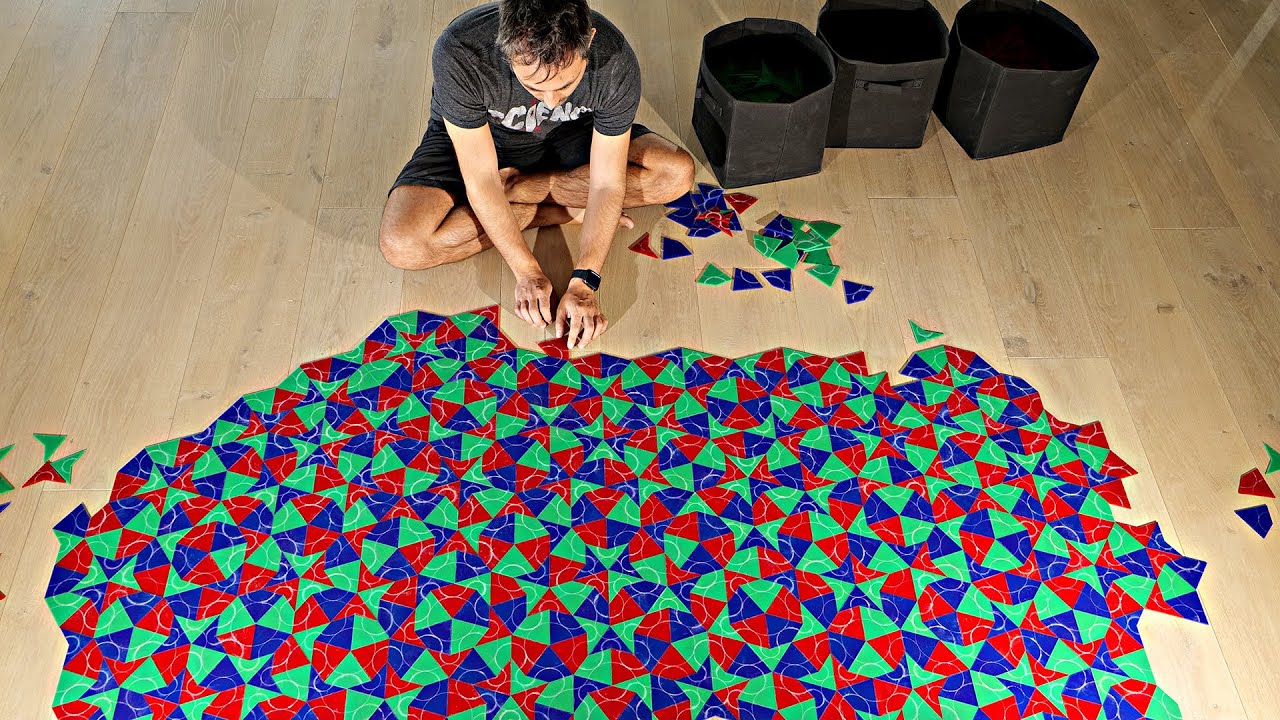
The Infinite Pattern That Never Repeats
Keywords
Summary
174 words
Critical Evaluation
Value of the Information & Strength of the Argument
The video provides a high value of information, covering both the mathematical foundations and the physical implications of aperiodic tilings. The argumentation is solid, building a coherent narrative from historical observations to modern discoveries. The use of visual demonstrations, such as the moiré pattern and laser-cut tiles, effectively illustrates the concepts. The interview with Paul Steinhardt adds credibility and depth. The explanation of the golden ratio and Fibonacci sequence in the context of Penrose tilings is particularly insightful. The video also addresses potential objections, such as the need for long-range coordination in crystal growth, and explains how quasicrystals overcome this. Overall, the argumentation is rigorous and well-supported.
Scientific Rigor, Source Quality, Title Accuracy
The video demonstrates high scientific rigor, referencing key historical papers and figures, including Kepler, Wang, Berger, Penrose, and Shechtman. The interview with Paul Steinhardt provides primary source material. The description includes a link to LastPass (sponsor) but also mentions Steinhardt’s book ‘The Second Kind of Impossible’ and Martin Gardner’s ‘Penrose Tiles to Trapdoor Ciphers’ as further reading. The title accurately reflects the content. The video does not overstate claims and clearly distinguishes between established facts and conjectures. The only minor issue is the lack of explicit citations for some specific claims, but the overall presentation is trustworthy.
219 words
Title / Content Match
The title accurately reflects the content, focusing on aperiodic tilings and quasicrystals.
Quality & Reliability
9/10
The video presents a well-researched historical and mathematical narrative, featuring an interview with physicist Paul Steinhardt and referencing key publications. The content is accurate and aligns with established scientific knowledge, though some simplifications are made for a general audience.
Key Moments
Markers derived by PSI from the transcript: the creator did not define chapters.
- Introduction to the story and Kepler's connection to Prague.
- Kepler's conjecture on sphere packing and its proof in 2017.
- Explanation of periodic tilings and the impossibility of five-fold symmetry.
- Wang's conjecture and Berger's discovery of aperiodic tilings.
- Penrose's development of the two-tile aperiodic tiling.
- Demonstration of the moiré pattern and the non-repeating nature of Penrose tilings.
- The golden ratio and Fibonacci numbers in Penrose tilings.
- Discussion of the possibility of quasicrystals and the 'forbidden' icosahedral symmetry.
- Shechtman's discovery of quasicrystals and the controversy.
- Conclusion and sponsorship message.
Cited Sources
- LastPass (sponsor) — Sponsor link in the video description.
Concurring Sources
- Penrose tiling - Wikipedia — Confirms the properties and history of Penrose tilings.
- Quasicrystal - Wikipedia — Confirms the discovery and properties of quasicrystals.
Contribution & Novelties
The video provides a comprehensive and accessible overview of Penrose tilings and quasicrystals, connecting historical mathematical discoveries with modern materials science. It offers a clear explanation of why these patterns are significant and how they challenge conventional notions of symmetry and periodicity. The inclusion of an interview with Paul Steinhardt adds a personal and expert perspective. The video also highlights the golden ratio and Fibonacci sequence in a tangible way, making abstract concepts more concrete.
Pour aller plus loin :
- Penrose tiling - Wikipedia — Comprehensive overview of Penrose tilings, including history and properties.
- Quasicrystal - Wikipedia — Detailed article on quasicrystals, their discovery, and applications.
- Golden ratio - Wikipedia — Background on the golden ratio and its appearances in mathematics and nature.
- The Second Kind of Impossible by Paul Steinhardt — Book by Paul Steinhardt detailing the search for quasicrystals.
141 words
Radar Profile
The radar profile shows high scores across all dimensions, indicating a well-balanced and high-quality video. The strongest aspects are the quantity and quality of information, as well as the reliability. The technical level is slightly lower, reflecting the accessible presentation style.
💬 Très positif. Sur les 30 commentaires analysés, les spectateurs expriment un fort enthousiasme et une appréciation pour la clarté et la fascination du contenu, avec de nombreux commentaires humoristiques et des références à des applications pratiques.