Informe de Gestión de la Administración 2019-2024
Keywords
Summary
150 words
Critical Evaluation
Value of the Information & Strength of the Argument
The video provides valuable information on Panama’s energy policies and achievements, with specific quantitative data and references to official documents. The argumentation is coherent and structured, presenting a clear narrative of progress and commitment to sustainability. However, it is a self-reported account from the institution, lacking independent evaluation or critical analysis. The presentation is persuasive, aiming to showcase successes, but it does not address potential challenges or criticisms in depth.
Scientific Rigor, Source Quality, Title Accuracy
The video is an official government report, which lends it a certain authority, but it does not cite external sources in the video itself. The description mentions the presentation of the management report, but no specific sources are listed. The title accurately reflects the content. The information is presented as a summary of the institution’s work, and while it references international collaborations and documents, the lack of detailed references reduces its scientific rigor. The video does not include any public comments, so no analysis of public reception is possible.
174 words
Title / Content Match
The title accurately reflects the content, which is a management report of the 2019-2024 administration.
Quality & Reliability
7/10
The video is an official government report, providing specific data and referencing official documents and international collaborations. However, it lacks independent verification and detailed methodology, and is presented from a single institutional perspective.
Key Moments
Markers derived by PSI from the transcript: the creator did not define chapters.
- Introduction and welcome by Guadalupe González, Director of Electricity.
- Overview of the institution's mission and general achievements.
- Presentation of key energy indicators: increase in self-consumption, EV chargers, solar and wind capacity.
- Discussion on the diversification of the electricity matrix and reduction of coal generation.
- Introduction of the Energy Transition Agenda 2020-2030 and its five strategies.
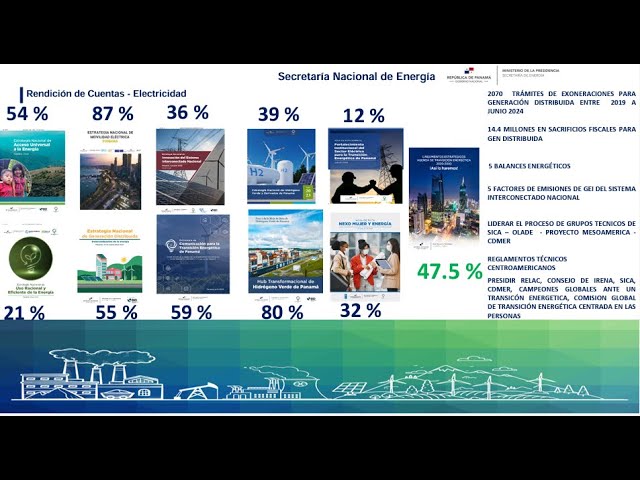
- Progress update on each strategy and roadmap, with average implementation at 47.5%.
- Details on the draft law to reform the electricity sector and the national electrification plan.
- Financial aspects: loans received from international organizations and investment needs.
- International recognition and collaborations, including the International Day of Clean Energy.
- Conclusion and thanks to partners and stakeholders.
Cited Sources
- Energy Transition Agenda 2020-2030 — Mentioned as the main policy framework guiding the sector.
- National Electrification Plan — Launched to achieve universal energy access by 2030.
- Draft Law for Electricity Sector Reform — Proposed to democratize energy and strengthen institutional capacity.
Concurring Sources
- IRENA — Panama's participation and leadership in IRENA aligns with the video's claims of international engagement.
- United Nations — Panama's role as a global champion for energy transitions is consistent with UN initiatives.
Contribution & Novelties
The video provides an official summary of Panama’s energy sector achievements and policy developments over a five-year period, offering specific data and progress percentages. It highlights the country’s commitment to energy transition and international collaborations. The report is valuable for understanding Panama’s energy policy direction and the implementation status of its strategies.
Pour aller plus loin :
- Energy Transition Agenda 2020-2030 — Official document detailing Panama’s energy transition plans.
- International Day of Clean Energy — UN page explaining the significance of this day, co-authored by Panama.
- IRENA — International Renewable Energy Agency, with which Panama has collaborated.
97 words
Radar Profile
The radar profile shows high scores in quantity of information and technical level, indicating a data-rich presentation. However, the lower score in reliability reflects the lack of independent verification. The overall profile suggests a comprehensive but institutionally biased report.