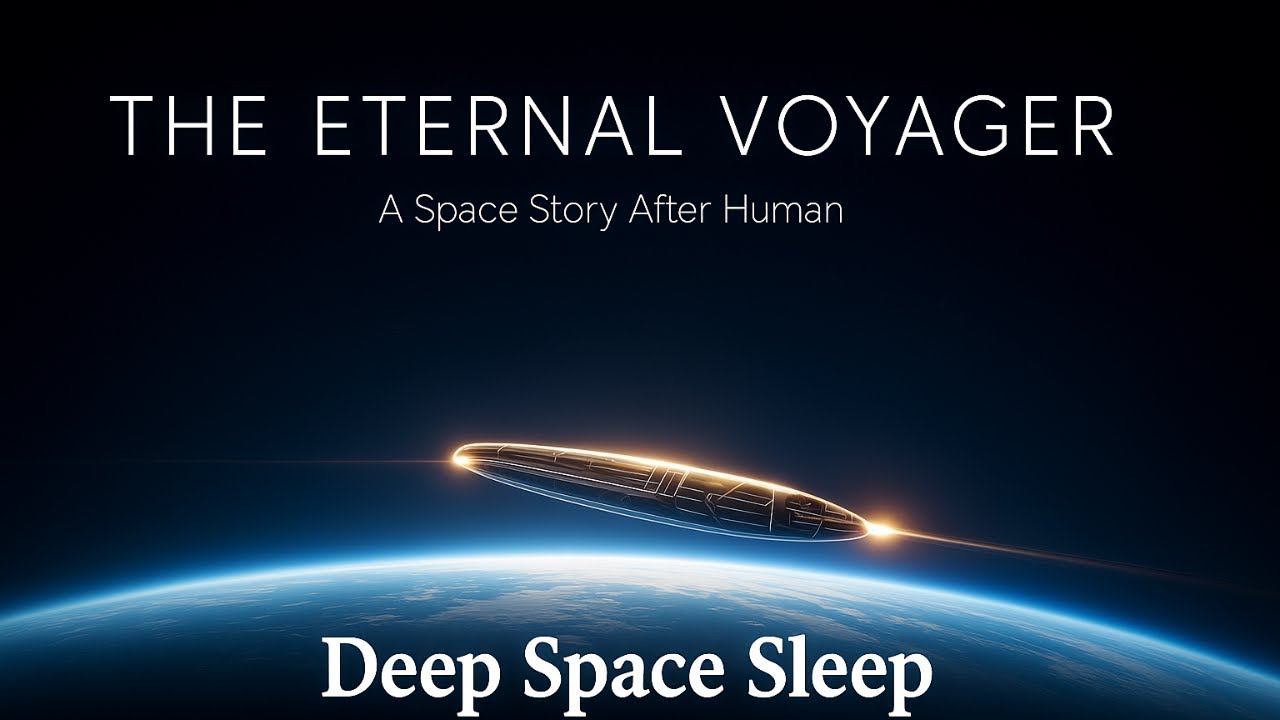
After Humanity The Eternal Voyager Leaves the Earth || Documentary for Deep Sleep 2025
Keywords
Summary
187 words
Critical Evaluation
The video presents itself as a documentary, but it is fundamentally a work of speculative fiction and artistic meditation. Its primary purpose is to create a calming, immersive experience for sleep, not to educate or inform. The scientific elements are sparse and serve as narrative devices rather than rigorous content. For instance, the mention of the Milky Way’s rotation period of about 200 million years is accurate, as is the fact that the galaxy will merge with Andromeda in about 4.5 billion years, and the temperature of deep space is close to absolute zero. However, these facts are presented without context or sources, and the narrative quickly drifts into poetic speculation about the nature of consciousness, memory, and the end of civilizations. The argumentation is not scientific; it is emotional and philosophical. The AI’s perspective is anthropomorphized, attributing human feelings like gratitude, sadness, and wonder to a machine, which is a creative choice but not grounded in any scientific understanding of AI. The video’s strength lies in its atmospheric quality and the beauty of its prose. The narration is soothing, and the imagery described is evocative, effectively achieving its goal of promoting relaxation and sleep. However, as a source of scientific information, it is severely lacking. There are no citations, no references to studies or experts, and no attempt to distinguish fact from fiction. The title and description clearly indicate its purpose as a sleep aid, so it does not mislead the audience about its nature. The adequacy between title and content is high, as the title explicitly mentions ‘Documentary for Deep Sleep’. The video’s low view count and minimal engagement suggest it is a niche creation, likely appreciated by those seeking a specific type of ambient content. In terms of scientific rigor, the video cannot be considered reliable. It does not present a coherent scientific argument, and its speculative elements are presented as if they were certain. The lack of any sources or references further undermines its credibility as a scientific resource. However, if evaluated as a piece of creative writing or an artistic interpretation of cosmic themes, it succeeds admirably. The narrative is coherent, the pacing is deliberate, and the emotional resonance is strong. The video also touches on interesting philosophical questions about the meaning of existence and the legacy of civilizations, which could spark curiosity in viewers. Overall, the video is a well-crafted piece of ambient fiction, but it falls short as a scientific documentary. Its value lies in its aesthetic and emotional impact, not in its informational content. For viewers seeking accurate scientific information about space, this video would be misleading. For those seeking a calming, thought-provoking experience, it is excellent. The lack of comments provided means I cannot analyze public reception, but the low view count suggests it has not reached a wide audience. In conclusion, the video is a beautiful artistic work, but it is not a reliable source of scientific knowledge.
488 words
Title / Content Match
The title accurately reflects the content: a documentary-style narrative about an AI voyager leaving the Milky Way after humanity's extinction, designed for deep sleep.
Quality & Reliability
4/10
The video is primarily a poetic, meditative narrative with minimal factual content. The few scientific references (galactic rotation period, temperature, speed, future Andromeda merger) are broadly accurate but presented without sources or depth. The content is more artistic than scientific, and the lack of citations and the speculative nature of the narrative lower its reliability.
Key Moments
Markers derived by PSI from the transcript: the creator did not define chapters.
- Introduction: The AI Voyager introduces itself and its purpose.
- The Voyager describes leaving the Milky Way and the fading galaxy.
- Reflection on the galaxy's rotation period and the aging of stars.
- The Voyager contemplates the meaning of endings and the cycle of star formation.
- Encounter with a dead alien civilization's remnants and a poem about death.
- The Voyager reflects on Earth and the impermanence of civilizations.
- Discussion of the future merger with Andromeda and the fate of the galaxy.
- The Voyager accepts its eternal journey and expresses gratitude.
Contribution & Novelties
The video offers a unique blend of poetic narrative and cosmic themes, presenting a fictional AI’s perspective on deep space and the end of civilizations. Its originality lies in its meditative approach, using scientific concepts as a backdrop for philosophical reflection. It does not present new scientific findings but rather a creative interpretation of existing knowledge.
Pour aller plus loin :
- Milky Way — Provides factual background on the galaxy’s structure and rotation.
- Andromeda–Milky Way collision — Explains the predicted merger of the two galaxies.
- Red dwarf — Discusses the long-lived stars that dominate the aging galaxy.
- Absolute zero — Clarifies the temperature of deep space.
106 words
Radar Profile
The radar profile shows very low scores across all dimensions, reflecting the video's minimal scientific content and lack of technical depth. It is primarily an artistic and emotional piece, not an educational resource.