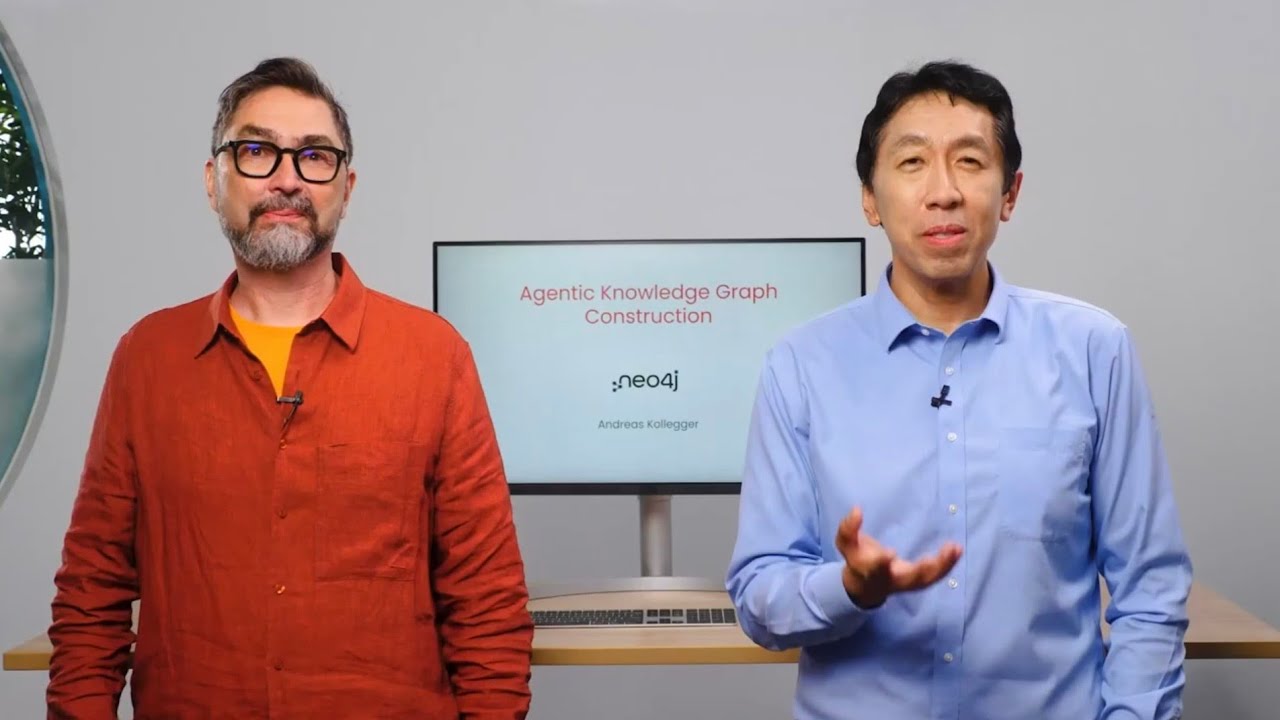
Building Agentic Knowledge Graph from Scratch
Keywords
Summary
160 words
Critical Evaluation
Value of the Information & Strength of the Argument
The video provides substantial value by offering a clear, step-by-step tutorial on building agentic knowledge graphs, a topic of growing importance in AI. The argumentation is solid, as it logically progresses from foundational concepts (relational vs. graph databases) to practical implementation details (multi-agent system design). The explanation of the multi-agent architecture is thorough, with each agent’s role and output clearly defined. The video effectively demonstrates how to leverage LLMs and graph databases to handle complex data integration tasks, making it a valuable resource for practitioners. However, the argumentation could be strengthened by including more concrete examples or case studies beyond the furniture manufacturer scenario, and by addressing potential limitations or alternative approaches in more depth.
Scientific Rigor, Source Quality, Title Accuracy
The video is based on a course by Andrew Ng and Neo4j, which lends credibility to the content. The technical explanations are accurate and well-structured, with references to specific tools like Google ADK and Neo4j. The title accurately reflects the content, as the video indeed focuses on building agentic knowledge graphs from scratch. However, the video does not cite external academic sources, and the information is presented in a tutorial format rather than as a peer-reviewed study. The description mentions the course but does not provide direct links to additional resources. Overall, the scientific rigor is adequate for an educational tutorial, but it lacks formal citations and peer-reviewed validation.
239 words
Title / Content Match
The title accurately reflects the content, which focuses on building agentic knowledge graphs from scratch.
Quality & Reliability
8/10
The video is a tutorial based on a course by Andrew Ng and Neo4j, with clear explanations and practical demonstrations. The content is well-structured and technically sound, though it lacks peer-reviewed sources and is primarily instructional.
Key Moments
Markers derived by PSI from the transcript: the creator did not define chapters.
- Introduction to knowledge graphs and comparison with relational databases.
- Explanation of graph query language Cypher and pattern matching.
- Overview of the multi-agent system architecture for knowledge graph construction.
- Detailed walkthrough of the structured data workflow, including user intent and schema proposal agents.
- Discussion of the unstructured data workflow and entity/fact extraction.
- Integration of structured and unstructured data into a unified knowledge graph.
- Demonstration of using the knowledge graph for root cause analysis.
- Explanation of the graph construction tool and its internal components.
- Recap of the course structure and lessons covered.
Cited Sources
- Neo4j — Mentioned as the partner and provider of the graph database used in the course.
- Google Agent Development Kit (ADK) — Referenced as the framework for building the multi-agent system.
Concurring Sources
- Neo4j Documentation — Official documentation for Neo4j, which aligns with the graph database concepts discussed.
- Google ADK Documentation — Official documentation for Google ADK, supporting the multi-agent framework used.
Contribution & Novelties
The video provides a practical, hands-on approach to building agentic knowledge graphs, combining multi-agent systems with graph databases. It offers a clear methodology for automating the extraction of entities and relationships from both structured and unstructured data, which is a novel integration. The tutorial’s emphasis on using LLMs for schema design and entity extraction is particularly innovative, as it reduces manual effort and adapts to diverse data sources.
Pour aller plus loin :
- Knowledge graph — Provides foundational concepts and applications.
- Multi-agent system — Explains the broader field of multi-agent systems.
- Graph database — Overview of graph databases and their advantages.
- Retrieval-augmented generation — Related technique for enhancing LLM responses with external knowledge.
113 words
Radar Profile
The radar profile shows high scores in quantity and quality of information, with a slightly lower technical level, indicating a well-balanced tutorial that is accessible yet detailed. The overall reliability is strong, reflecting the credibility of the course and the clarity of the presentation.
💬 No comments were provided for analysis.