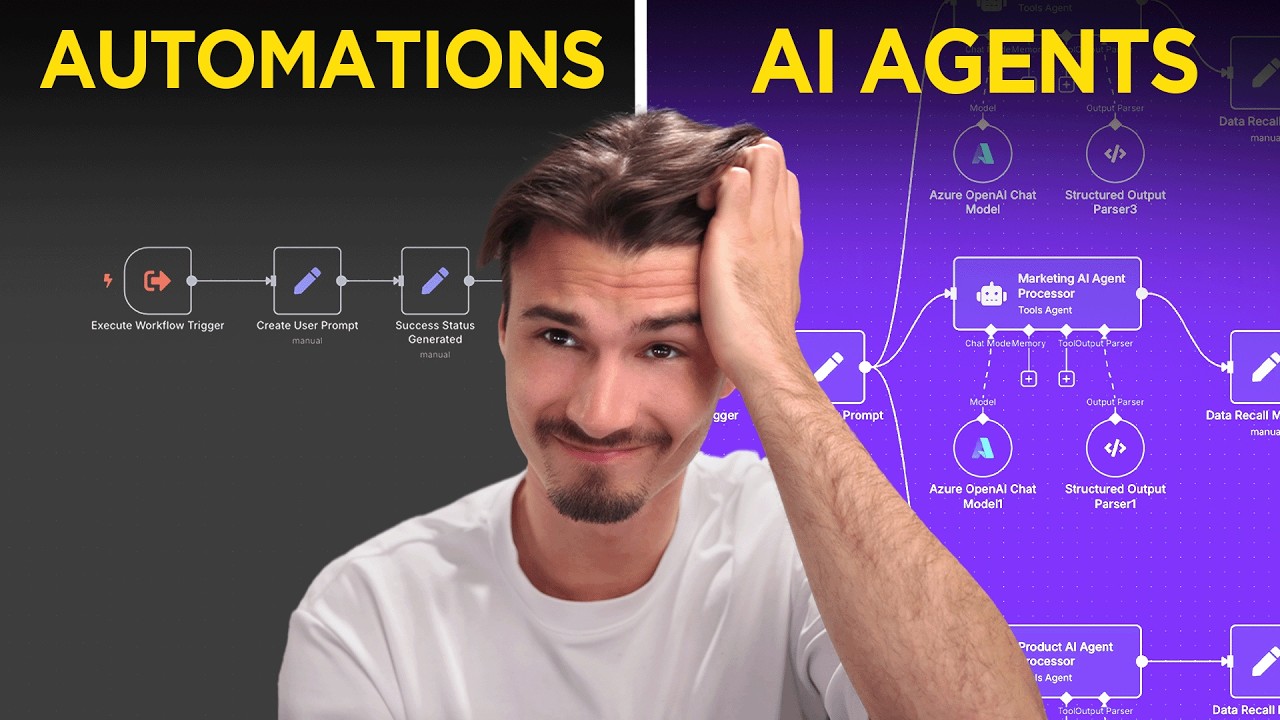
AI Agents & Automations Explained in 19 Minutes
Keywords
Summary
165 words
Critical Evaluation
Value of the Information & Strength of the Argument
The video provides valuable, actionable information for understanding and building AI workflows and agents. The theoretical framework is well-argued, using authoritative sources (OpenAI, Google Cloud) to establish definitions, and the presenter clearly explains his own criterion for distinguishing workflows from agents. The practical demonstrations are detailed and reproducible, showing step-by-step how to build a workflow and an agent on VectorShift. The argumentation is coherent and progressive, moving from theory to practice, and the final advice to start with prompts and workflows before agents is sensible. However, the content is platform-specific (VectorShift) and sponsored, which may limit its generalizability, though the concepts are transferable.
Scientific Rigor, Source Quality, Title Accuracy
The video demonstrates scientific rigor by referencing official definitions from OpenAI and Google Cloud, and it provides a link to OpenAI’s practical guide to building agents in the description. The sources are credible and relevant. The title accurately reflects the content, which is an explainer and tutorial on AI agents and automations. The video is sponsored by VectorShift, and the sponsor is mentioned at the beginning and throughout, but this does not detract from the educational value. The practical examples are clear and the presenter acknowledges the existence of other platforms, though the focus remains on VectorShift.
215 words
Title / Content Match
The title accurately reflects the content: the video explains AI agents and automations in about 19 minutes, covering theory and practical examples.
Quality & Reliability
7/10
The video provides a clear and practical tutorial on building AI workflows and agents using VectorShift, with a solid theoretical foundation based on definitions from OpenAI and Google Cloud. The content is accurate and well-structured, though it is sponsored and focuses on a specific platform, which may introduce bias. The practical demonstrations are reproducible and the explanations are technically sound.
Chapters
Cited Sources
- A Practical Guide to Building Agents (OpenAI) — Referenced in the video to define AI agents and distinguish them from workflows.
- VectorShift — The platform used throughout the tutorial for building workflows and agents.
Concurring Sources
- A Practical Guide to Building Agents (OpenAI) — The video's definition of agents aligns with OpenAI's guide, which emphasizes LLM-controlled workflow execution.
External References
Contribution & Novelties
The video offers a clear, practical distinction between AI workflows and agents, emphasizing the role of LLM-driven decision-making in defining agents. It provides a step-by-step tutorial on building a workflow and an agent using VectorShift, including the integration of dynamic knowledge bases and external tools. The recommendation to progress from prompts to workflows to agents is a useful framework for beginners.
Pour aller plus loin :
- OpenAI Agents Guide — Official guide referenced in the video, providing a comprehensive definition of agents.
- Google Cloud AI agents documentation — Official documentation on AI agents, including definitions and capabilities.
- LangChain — A popular framework for building AI agents, offering tools and abstractions for orchestration.
112 words
Radar Profile
The radar profile shows high scores in information quality and fiabilité, with moderate scores in quantity and technical level. This indicates a well-structured and reliable tutorial, though it may not cover an exhaustive range of topics or require advanced technical expertise.