Lecture 6 | MIT 6.881 (Robotic Manipulation), Fall 2020 | Geometric Perception (Part 1)
Keywords
Summary
165 words
Critical Evaluation
This lecture provides a solid introduction to geometric perception for robotic manipulation, focusing on depth sensing technologies and their simulation. The instructor, Russ Tedrake, is a renowned expert in the field, and his explanations are clear and well-structured. The lecture is part of a formal MIT course, which lends it credibility. The content is technically accurate, covering key sensor types (lidar, stereo, structured light, active stereo) and their characteristics. The discussion of sensor noise and its impact on manipulation tasks is particularly valuable, as it highlights real-world challenges. The lecture also introduces the Drake simulation environment, which is a powerful tool for robotics research. However, the lecture is primarily an overview, and it does not delve deeply into the mathematical or algorithmic aspects of geometric perception. Some claims, such as the performance of specific sensors, are based on anecdotal experience rather than rigorous benchmarking. The lecture also assumes prior knowledge of robotics and computer vision, making it less accessible to beginners. Overall, the lecture is a valuable resource for students and researchers interested in robotic manipulation, providing a strong foundation for further study. The title accurately reflects the content, and the lecture is well-paced, with a clear structure. The use of visual aids and demonstrations enhances understanding. The main limitation is the lack of in-depth technical detail, but this is appropriate for an introductory lecture.
225 words
Title / Content Match
The title accurately describes the content: a lecture on geometric perception for robotic manipulation, part of a series.
Quality & Reliability
8/10
Lecture from MIT OpenCourseWare by a leading expert in robotic manipulation. Content is technically rigorous, well-structured, and based on established principles. The lecture is part of a formal course, and the instructor demonstrates deep knowledge. However, it is a single lecture, not peer-reviewed, and some claims (e.g., about sensor performance) are anecdotal.
Key Moments
Markers derived by PSI from the transcript: the creator did not define chapters.
- Introduction and overview of the lecture's goals: moving from perception oracle to real sensors.
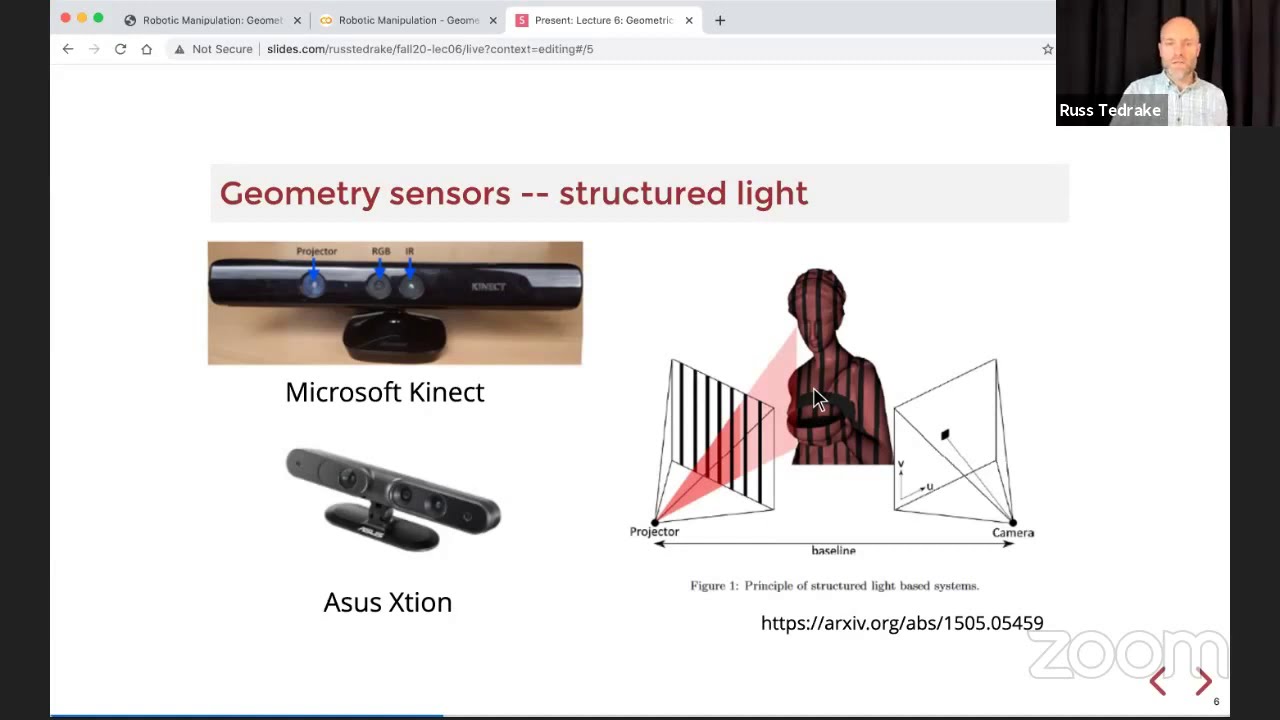
- Discussion of various depth sensors: lidar, stereo vision, structured light, and active stereo.
- Comparison of sensor characteristics, including cost, outdoor suitability, and texture sensitivity.
- Introduction to the Intel RealSense camera and its use of projected infrared patterns for textureless scenes.
- Simulation of RGB-D cameras in Drake, including rendering engines and the use of the scene graph.
- Introduction to the YCB object dataset and its importance for manipulation research.
- Demonstration of a simulated camera view of YCB objects, highlighting sensor noise and challenges.
Cited Sources
- Robotic Manipulation textbook website — Course textbook and resources for the lecture.
- Live slides for Lecture 6 — Slides used during the lecture.
Concurring Sources
- YCB Object and Model Set — The dataset mentioned in the lecture for standardized manipulation objects.
- Drake: Model-Based Design and Verification for Robotics — The simulation environment used in the lecture.
Contribution & Novelties
This lecture provides a clear and accessible introduction to geometric perception for robotic manipulation, emphasizing the importance of depth sensing and its simulation. It bridges the gap between theoretical concepts and practical implementation using the Drake simulator. The discussion of sensor characteristics and noise is particularly valuable for practitioners.
Pour aller plus loin :
- YCB Object and Model Set — The dataset mentioned in the lecture for standardized manipulation objects.
- Drake: Model-Based Design and Verification for Robotics — The simulation environment used in the lecture.
- Intel RealSense Technology — Official page for the depth cameras discussed.
- Point Cloud Library (PCL) — A library for processing 3D point clouds, relevant to geometric perception.
- Kinect Sensor — Wikipedia article on the Kinect, a structured light sensor mentioned.
125 words
Radar Profile
The radar profile shows high scores in quality of information and technical level, indicating a rigorous and detailed lecture. The quantity of information is also high, but the global reliability is slightly lower due to the anecdotal nature of some claims. Overall, the lecture is well-balanced and suitable for an advanced audience.