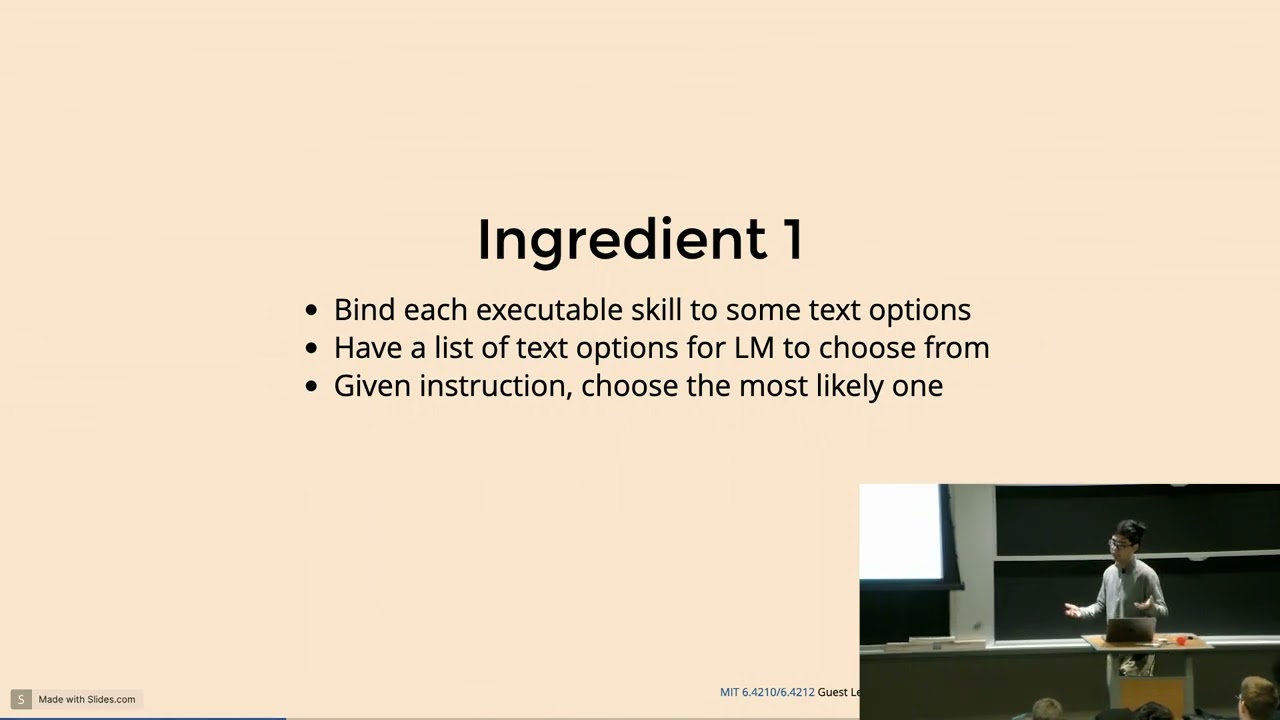
6.4210 Fall 2023 Lecture 22: Foundational Models for Decision Making
Keywords
Summary
162 words
Critical Evaluation
The lecture provides a comprehensive and well-structured overview of the emerging field of foundation models for decision making. The speaker, Boyuan Chen, demonstrates a deep understanding of the subject, presenting both the potential and the limitations of current approaches. The content is scientifically sound, with references to key papers and concepts, and the explanations are clear, making complex ideas accessible to a graduate-level audience. The argumentation is logical, moving from the problem of connecting unstructured language to structured algorithms, to specific solutions like combining LLMs with affordance models, and then to broader challenges and future directions. The use of concrete examples, such as the coffee-making scenario and the Google robot demonstration, helps to illustrate the concepts effectively. The lecture also touches on important open problems, such as grounding, safety, and the need for better evaluation methods. While the lecture is not a peer-reviewed publication, it is part of a formal academic course and reflects the state of the art in the field. The adéquation between the title and content is excellent, as the lecture indeed covers foundational models for decision making. Overall, this is a high-quality educational resource that provides valuable insights for anyone interested in the intersection of AI and robotics.
202 words
Title / Content Match
The title accurately reflects the content: the lecture covers foundational models for decision making, including large language models and vision foundation models.
Quality & Reliability
8/10
Lecture by a researcher (Boyuan Chen) at MIT, part of a formal course. Content is well-structured, references multiple papers and concepts, and provides a balanced overview of the field. However, it is a single lecture and not peer-reviewed, and some claims are simplified for a student audience.
Key Moments
Markers derived by PSI from the transcript: the creator did not define chapters.
- Introduction to the lecture and agenda
- Motivation: connecting unstructured instructions to structured algorithms
- Explanation of large language models and their capabilities
- Using LLMs for task planning and generating structured plans
- Case study: combining LLMs with affordance models for grounding
- Real-world demonstration of a robot executing instructions
- Challenges and opportunities in foundation models for decision making
- Introduction to vision foundation models and their role
- Discussion of future directions and open problems
Cited Sources
- Google paper on grounding LLMs with affordances — Referenced in the case study section
- Extended readings on LLM + planning — Mentioned at the end of the first section
Concurring Sources
- SayCan: Do as you can, not as you say — The case study presented in the lecture is based on this paper.
- PaLM-E: An Embodied Multimodal Language Model — Related work on embodied language models.
Dissenting Sources
- On the Opportunities and Risks of Foundation Models — This paper discusses risks and limitations of foundation models, which are not deeply covered in the lecture.
Contribution & Novelties
The lecture provides a clear and up-to-date synthesis of the use of foundation models for decision making, highlighting both LLMs and vision foundation models. It offers a unique perspective by emphasizing the connection between unstructured language and structured algorithms, and by presenting concrete examples from recent research. The lecture also discusses challenges and opportunities, making it a valuable resource for students and researchers.
Pour aller plus loin :
- Large language models — Overview of LLMs.
- Reinforcement learning — Background for affordance models.
- Vision transformer — Key architecture for vision foundation models.
91 words
Radar Profile
The radar profile shows high scores in quantity and quality of information, reflecting the lecture's comprehensive and well-structured content. The technical level is also high, indicating that the lecture is suitable for an advanced audience. The overall reliability is strong, given the academic context and references to recent research.
💬 No comments were provided for analysis.