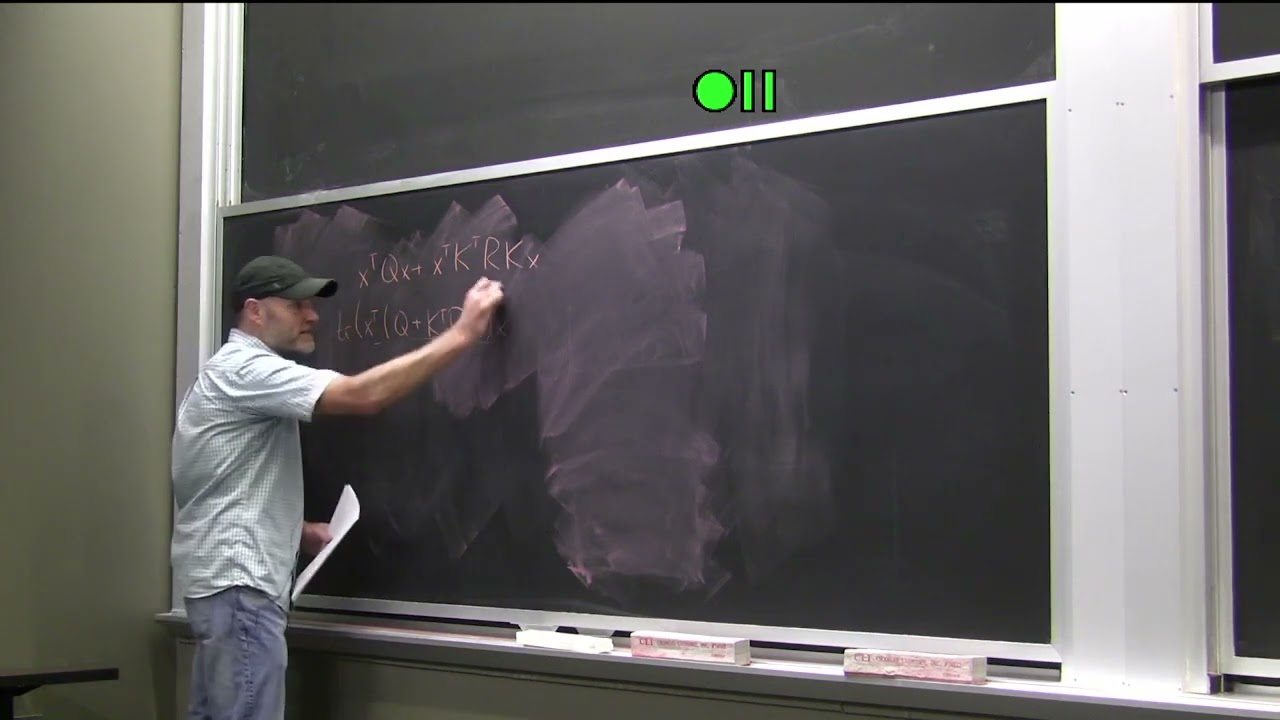
6.8210 Spring 2023 Lecture 22: Policy Search
Keywords
Summary
133 words
Critical Evaluation
The lecture provides a rigorous and insightful exploration of policy search in the context of stochastic LQR, effectively bridging control theory and reinforcement learning. The instructor’s derivation of the expected cost using the Lyapunov equation is elegant and highlights the power of linear systems theory. He clearly explains the non-convexity of the stabilizing set, which is a crucial insight for understanding the challenges of direct policy search. The connection to reinforcement learning is well-motivated, and the discussion of robust control (H2 and H-infinity) adds depth. However, the lecture is highly technical and assumes a strong background in control theory and linear algebra. The presentation is clear, but the lack of visual aids or concrete examples might make it challenging for some viewers. The sources are not explicitly cited, but the content is based on established theory. Overall, this is a high-quality academic lecture that offers valuable insights for advanced students and researchers.
152 words
Title / Content Match
The title accurately reflects the content: the lecture focuses on policy search methods in the context of stochastic LQR and robust control.
Quality & Reliability
8/10
The lecture is part of a graduate-level MIT course (6.8210) taught by an expert in underactuated robotics. It presents rigorous mathematical derivations and connects control theory with reinforcement learning. The content is well-structured and based on established theory, though it is a lecture rather than peer-reviewed research.
Key Moments
Markers derived by PSI from the transcript: the creator did not define chapters.
- Introduction and recap of stochastic control
- Motivation for policy search in reinforcement learning
- Derivation of expected cost for stochastic LQR
- Use of Lyapunov equation to compute expected cost exactly
- Discussion of non-convexity of stabilizing gains
- Introduction to robust control and H-infinity
- Comparison of H2 and H-infinity approaches
- Extension to robust trajectory optimization
- Summary and connections to reinforcement learning
Contribution & Novelties
This lecture provides a clear and rigorous connection between classical stochastic LQR and modern policy search methods in reinforcement learning. It demonstrates that for linear systems, the expected cost can be computed exactly, avoiding the need for sampling, and highlights the non-convexity of the stabilizing set. This offers a theoretical foundation for understanding when policy gradient methods may or may not work.
Pour aller plus loin :
- Lyapunov equation — Fundamental to the derivation of expected cost.
- Policy gradient methods — Core to reinforcement learning, directly related to the lecture’s topic.
- H-infinity methods in control theory — Relevant to the robust control discussion.
103 words
Radar Profile
The radar profile shows high scores in technical level and information quality, reflecting the advanced and rigorous nature of the lecture. The lower score in information quantity is due to the focused scope, while the fiabilite_globale is high given the academic context.