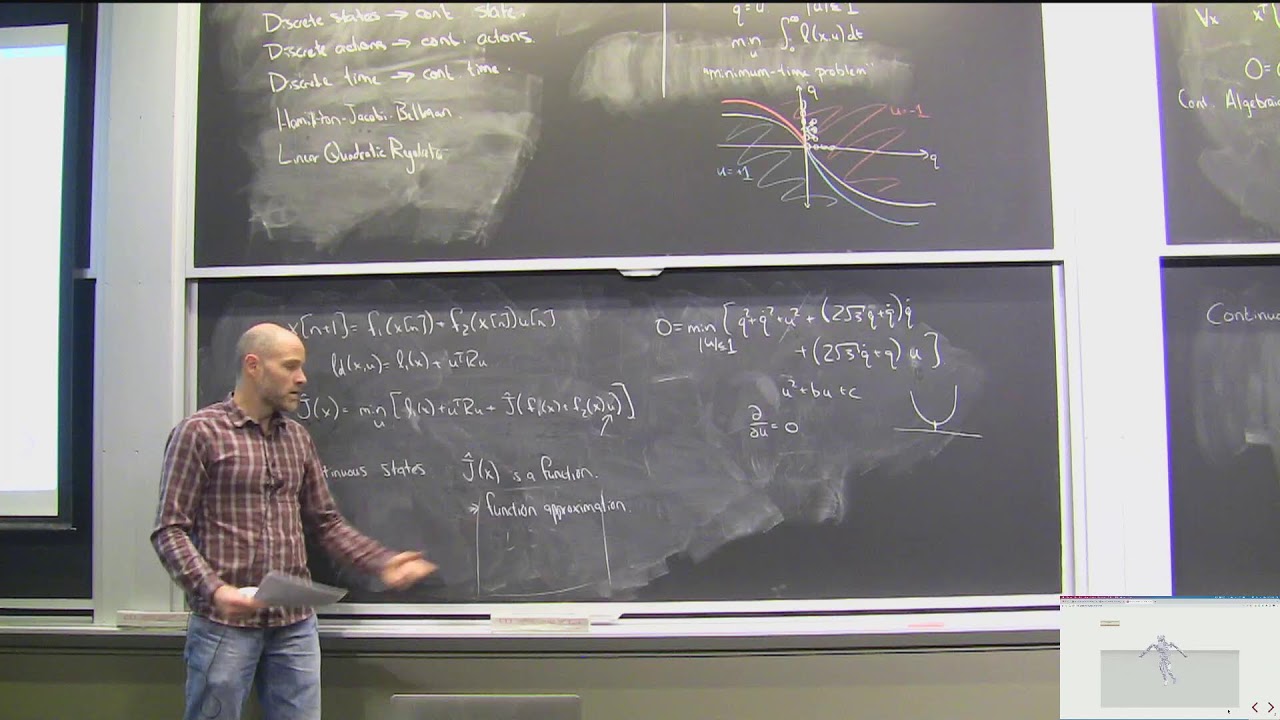
Lecture 4: MIT 6.832 Underactuated Robotics (Spring 2022) | "Dynamic Programming II"
Keywords
Summary
142 words
Critical Evaluation
The lecture provides a rigorous and insightful derivation of the Hamilton-Jacobi-Bellman equation, bridging the gap between discrete and continuous time dynamic programming. Tedrake’s pedagogical approach is effective, starting with a review of discrete-time concepts and then smoothly transitioning to the continuous-time formulation. The mathematical derivations are clear and well-motivated, with careful attention to notation and assumptions. The connection to physics, particularly Hamiltonian mechanics, adds depth and helps students appreciate the fundamental nature of the HJB equation. The lecture also addresses practical challenges, such as the non-smoothness of value functions and the computational difficulties in solving HJB equations, which is valuable for students aiming to apply these methods. The use of examples, such as the pendulum and double integrator, helps illustrate the concepts. The lecture is well-structured and suitable for an advanced undergraduate or graduate-level audience. The only minor criticism is that the lecture could benefit from more concrete numerical examples or visualizations to reinforce the theoretical concepts. Overall, this is an excellent lecture that provides a solid foundation for understanding continuous-time optimal control.
173 words
Title / Content Match
The title accurately reflects the content, which focuses on dynamic programming in continuous time, building on the previous lecture.
Quality & Reliability
9/10
Lecture from MIT OpenCourseWare by a renowned professor in robotics, with rigorous mathematical derivations and references to course materials. The content is well-structured and aligns with established theory in optimal control and dynamic programming.
Key Moments
Markers derived by PSI from the transcript: the creator did not define chapters.
- Introduction and recap of discrete-time dynamic programming
- Motivation for continuous-time formulation and limitations of discrete methods
- Derivation of the Hamilton-Jacobi-Bellman equation from discrete-time Bellman equation
- Intuition behind the HJB equation and its connection to physics
- Discussion on the challenges of solving HJB equations, including non-smooth solutions
- Introduction to viscosity solutions and level set methods
- Examples and applications of HJB in underactuated robotics
- Preview of future topics: LQR and trajectory optimization
Cited Sources
- Lecture slides — Slides used in the lecture, providing visual aids and additional details.
Concurring Sources
- Underactuated Robotics textbook — Companion textbook by Russ Tedrake, covering related topics in depth.
Contribution & Novelties
This lecture provides a clear and rigorous derivation of the Hamilton-Jacobi-Bellman equation, emphasizing its connection to physics and its role in continuous-time optimal control. It bridges the gap between discrete and continuous dynamic programming, offering insights into the challenges and solutions for solving HJB equations in practice.
Pour aller plus loin :
- Hamilton-Jacobi-Bellman equation — Overview and applications.
- Viscosity solution — Concept for handling non-smooth solutions.
- Level-set method — Numerical technique for solving HJB equations.
75 words
Radar Profile
The radar profile shows high scores across all dimensions, indicating a well-balanced and comprehensive lecture. The strong emphasis on mathematical rigor and technical depth is balanced by clear explanations and practical insights.