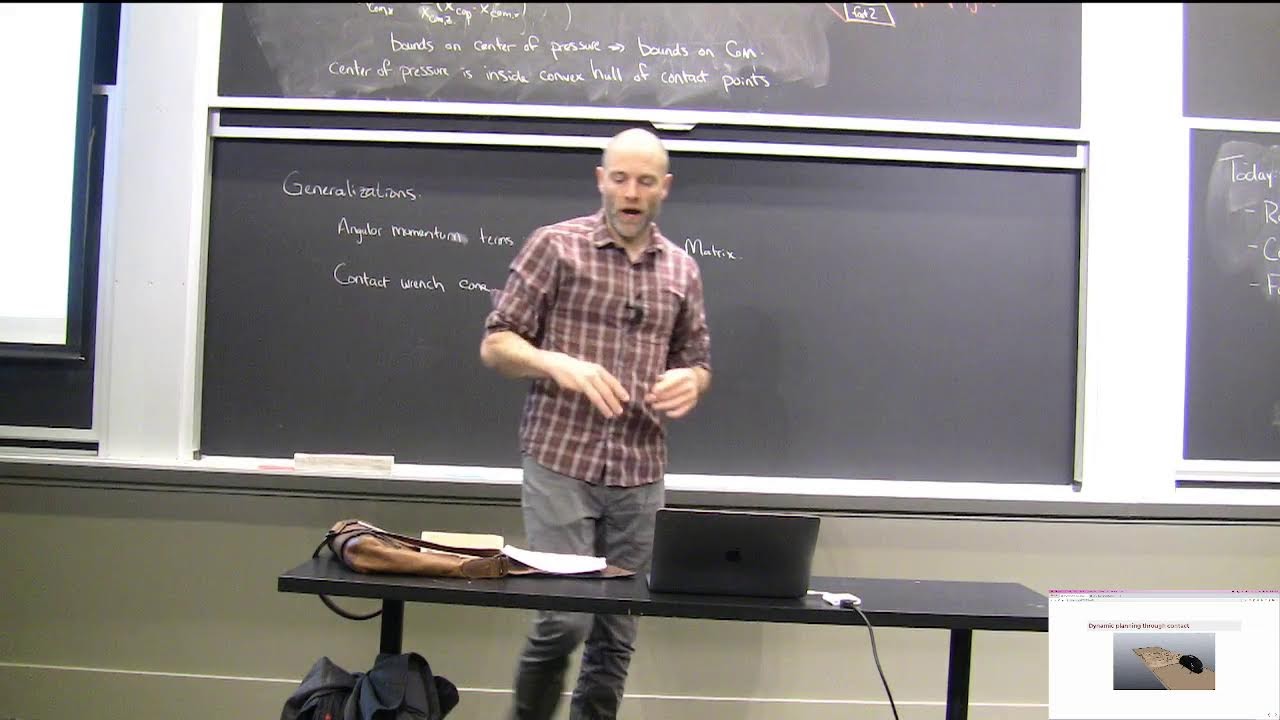
Lecture 18: MIT 6.832 Underactuated Robotics (Spring 2022) | "Humanoid Robots"
Keywords
Summary
123 words
Critical Evaluation
The lecture provides a comprehensive overview of the state of the art in humanoid and quadrupedal robotics, with a focus on the application of reinforcement learning. The instructor effectively connects theoretical concepts from the course to practical examples, particularly the work of Marco Hutter’s group at ETH Zurich. The discussion is scientifically rigorous, with appropriate caveats about the limitations of current methods, such as the lack of formal guarantees and the reliance on extensive simulation. The lecture is well-structured, starting with a recap of previous material and then delving into specific case studies. The instructor encourages critical thinking by posing questions about the viability of sim-to-real transfer and the role of model-based control. The sources cited are credible, including recent publications in Science Robotics and the MIT Robotics Seminar. The title accurately reflects the content, which is focused on humanoid robots but also covers quadrupeds as a related example. Overall, the lecture is highly informative and provides valuable insights for students and researchers in the field.
166 words
Title / Content Match
The title accurately reflects the content, which focuses on humanoid robots and their control, with a significant portion dedicated to recent advances in quadrupedal locomotion and reinforcement learning.
Quality & Reliability
8/10
Lecture from MIT OpenCourseWare, presented by an expert in the field, with references to recent research and discussions of methodologies. The content is well-structured and scientifically grounded, though it is a lecture rather than a peer-reviewed publication.
Key Moments
Markers derived by PSI from the transcript: the creator did not define chapters.
- Introduction and recap of previous lectures on walking robots.
- Discussion of Marco Hutter's seminar on quadrupedal robots using reinforcement learning.
- Explanation of the importance of high-fidelity simulators for sim-to-real transfer.
- Discussion on the role of model-based vs. model-free reinforcement learning.
- Q&A session on the robustness of the controller and the use of domain randomization.
- Discussion on the challenges of reward engineering and the benefits of physics-based optimization.
- Further Q&A on the scalability of reinforcement learning approaches and the future of the field.
Cited Sources
- MIT Robotics Seminar — Referenced as a source of talks on robotics, including the one by Marco Hutter.
- ANYmal robot series — Mentioned as the quadruped robots developed by Marco Hutter's group at ETH Zurich.
- Science Robotics publication — Referenced as the journal where recent work on ANYmal was published.
Concurring Sources
- ANYmal robot series — The ANYmal robots are a concrete example of the concepts discussed in the lecture.
- Science Robotics publication — The publication in Science Robotics supports the claims about the performance of the ANYmal robots.
Contribution & Novelties
The lecture provides a unique perspective on the application of reinforcement learning to legged robots, emphasizing the importance of simulation and domain randomization. It bridges the gap between theoretical concepts and practical implementation, offering insights into the challenges and opportunities in the field.
Pour aller plus loin :
- Reinforcement Learning — Overview of RL concepts.
- Sim-to-Real Transfer — Explanation of the transfer of policies from simulation to reality.
- Domain Randomization — Technique used to improve robustness in sim-to-real transfer.
79 words
Radar Profile
The radar profile shows high scores across all dimensions, indicating a well-rounded and informative lecture. The high scores in quantity and quality of information reflect the depth of content, while the technical level is appropriate for an advanced audience. The overall reliability is strong, given the academic context and references to recent research.