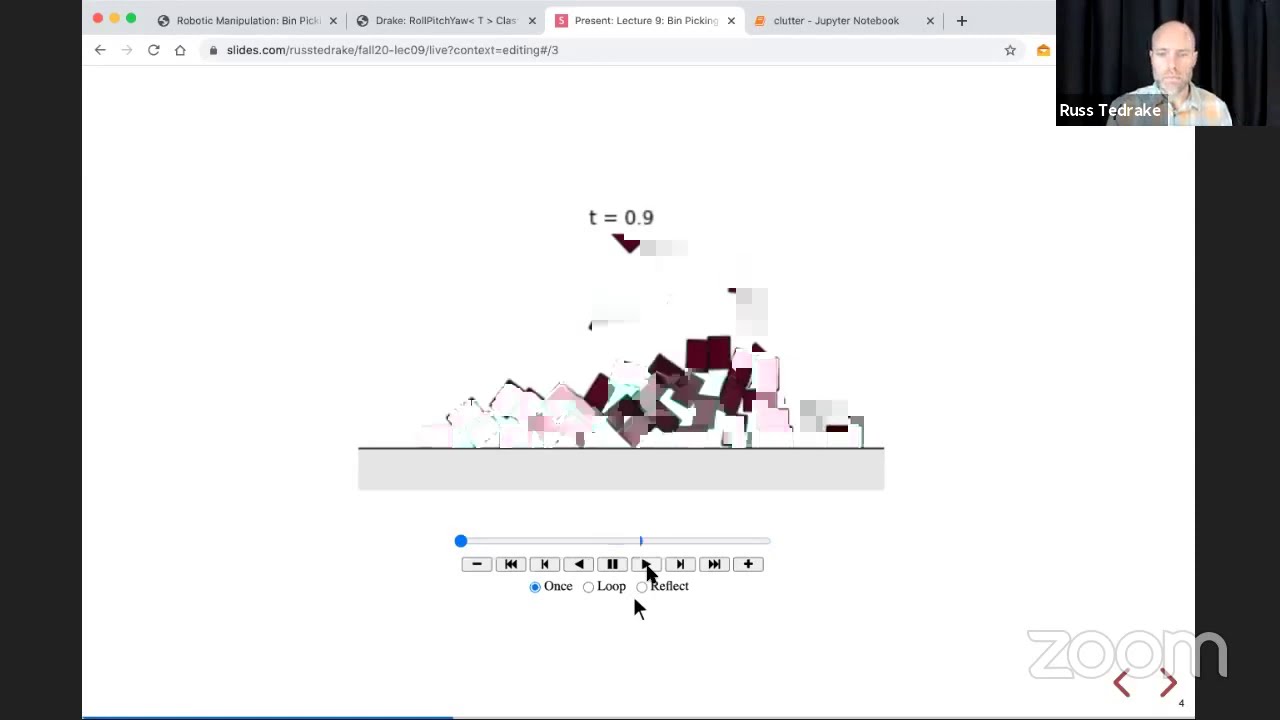
Lecture 9 | MIT 6.881 (Robotic Manipulation), Fall 2020 | Bin Picking (part 1)
Keywords
Summary
138 words
Critical Evaluation
The lecture provides a solid introduction to using simulation for generating training data in robotic manipulation. Tedrake’s expertise is evident, and he effectively communicates the rationale behind the bin picking setup. The content is technically accurate, referencing standard tools like Drake and the YCB dataset. The argumentation is clear: geometric perception has limitations, deep learning needs data, and simulation offers a scalable solution. However, the lecture is part of a course, so it assumes prior knowledge of robotics and simulation concepts. The focus is on practical implementation rather than theoretical depth. The sources cited are the course textbook and slides, which are authoritative. The title accurately reflects the content. Overall, the lecture is valuable for students and practitioners, but it may not offer novel insights for experts. The public comments, if any, were not provided, so no analysis of audience reception is included.
143 words
Title / Content Match
Title accurately reflects the content: a lecture on bin picking, part 1, covering simulation and data generation.
Quality & Reliability
8/10
Lecture from MIT's Robotic Manipulation course by Russ Tedrake, a leading expert. Content is technically rigorous, based on established simulation and perception methods, and references open-source resources (Drake, YCB dataset).
Key Moments
Markers derived by PSI from the transcript: the creator did not define chapters.
- Introduction to bin picking and motivation for using it as a data source.
- Demonstration of a real bin picking setup at TRI generating data.
- Proposal of the 'falling things' simulation approach for data generation.
- Discussion of simulation details: contact models, time stepping, and penetration.
- Explanation of the YCB dataset and its use in simulation.
- Live notebook demonstration of the falling objects simulation.
- Discussion on the challenges of simulating diverse real-world scenarios.
- Comparison of physics simulation vs. optimization for generating configurations.
- Introduction to the dynamics of contact simulation and static equilibrium.
Cited Sources
- Robotic Manipulation Textbook — Course textbook referenced for further study.
- Lecture Slides (Live) — Slides used during the lecture.
Concurring Sources
- Drake Documentation — Supports the simulation approach described.
- YCB Benchmark — Provides the object models used in the simulation.
Contribution & Novelties
The lecture provides a practical approach to generating large-scale training data for robotic manipulation using physics simulation. It emphasizes the importance of simulation fidelity and the trade-offs involved. The ‘falling things’ method is a straightforward yet effective technique for creating diverse datasets.
Pour aller plus loin :
- Drake: Model-Based Design and Verification for Robotics — Official documentation for the simulation tool used.
- YCB Object and Model Set — Dataset of everyday objects for benchmarking.
- Deep Learning for Robotic Manipulation — Survey of deep learning methods in manipulation.
87 words
Radar Profile
The radar profile shows high scores across all dimensions, indicating a well-rounded lecture with substantial information, technical depth, and reliability. The balance between quantity and quality suggests a comprehensive introduction to the topic.