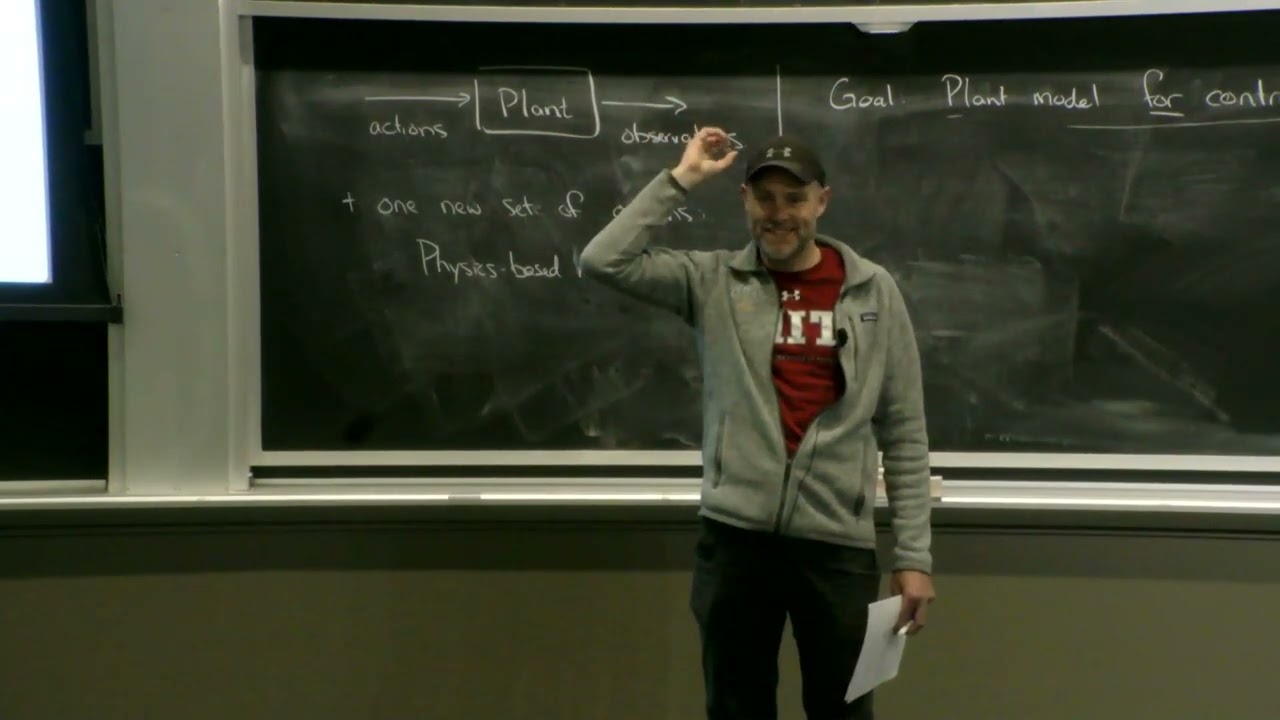
6.4210 Fall 2023 Lecture 21: Multibody Parameter Estimation
Keywords
Summary
160 words
Critical Evaluation
The lecture is a masterclass in connecting classical system identification with modern machine learning, delivered by a leading expert in the field. Tedrake’s pedagogical approach is clear and rigorous, starting with a high-level motivation and progressively diving into mathematical details. He effectively uses historical and contemporary examples (WHAM, TossingBot) to illustrate the practical relevance of the concepts. The argumentation is solid: he justifies the use of physics-based models by highlighting their advantages for control, such as the availability of powerful tools like LQR and trajectory optimization, and the ability to generalize with few data points. The lecture is well-structured, with a logical flow from problem formulation to solution methods, including the derivation of the regressor form and the concept of base parameters. Tedrake also addresses important nuances, such as the need for exciting trajectories and the impact of model mismatch. The sources cited are credible, including classic papers by Slotine and Atkeson, and the lecture is consistent with established literature. The only minor weakness is that the lecture is part of a course and assumes prior knowledge, but this does not detract from its quality. Overall, this is an excellent resource for anyone interested in system identification for robotics.
199 words
Title / Content Match
The title accurately reflects the lecture's focus on multibody parameter estimation, with a clear connection to control and learning.
Quality & Reliability
9/10
Lecture by a leading MIT professor, based on established multibody dynamics and system identification theory, with clear derivations and references to classic and modern works.
Key Moments
Markers derived by PSI from the transcript: the creator did not define chapters.
- Introduction and connection between machine learning and physics-based modeling.
- Discussion on behavior cloning and the importance of plant models for control.
- Motivation with TossingBot and WHAM examples.
- Formulation of the parameter estimation problem using manipulator equations.
- Introduction of the regressor form and linearity in parameters.
- Discussion on base parameters and identifiability.
- Least squares estimation and recursive methods.
- Practical considerations: sensor noise, model mismatch, and excitation.
- Trade-offs between model complexity and control performance.
- Conclusion and future directions.
Cited Sources
- TossingBot: Learning to Throw Arbitrary Objects with Residual Physics — Mentioned as a modern example of learning-based throwing with residual physics.
- The Whole-Arm Manipulator (WHAM) — Historical example of a robot that estimates inertial parameters of unknown objects.
Concurring Sources
- TossingBot: Learning to Throw Arbitrary Objects with Residual Physics — Supports the idea that physics-based priors improve learning and generalization.
Contribution & Novelties
The lecture provides a clear synthesis of classical multibody parameter estimation and modern learning-based approaches, emphasizing the benefits of physics-based structure for control and generalization. It highlights the regressor form and base parameters as key tools for efficient estimation.
Pour aller plus loin :
- System identification — Overview of the field.
- Recursive least squares — Algorithm for online estimation.
- Underactuated Robotics — Course materials and further reading.
67 words
Radar Profile
The radar profile shows high scores across all dimensions, indicating a well-balanced and comprehensive lecture. The strongest aspects are the quality and quantity of information, with a slightly lower but still high score for technical depth, reflecting the advanced nature of the content.
💬 No comments were provided for analysis.