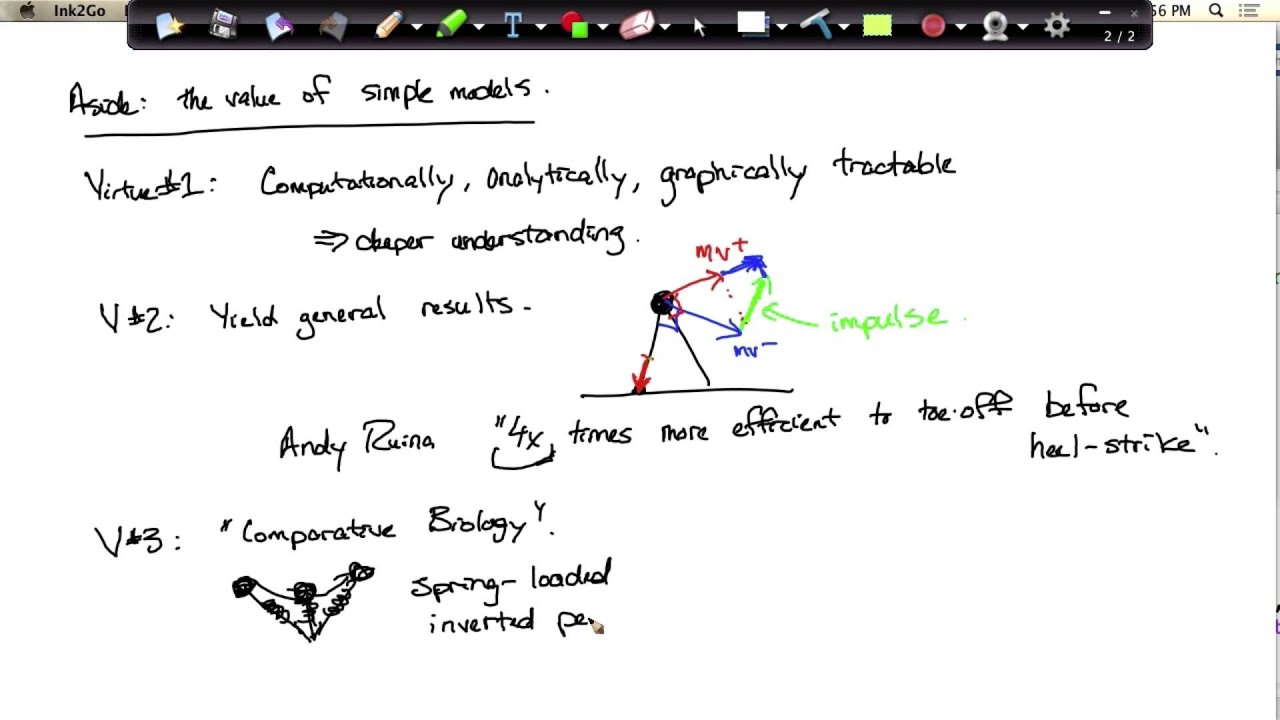
lecture13 final clip2 simple models
Keywords
Summary
166 words
Critical Evaluation
The lecture provides a compelling argument for the utility of simple models in robotics and biology. The instructor, presumably Russ Tedrake, is a leading expert in underactuated robotics, and his presentation is clear and well-structured. The content is scientifically sound, referencing established research such as Ruina’s work on walking energetics and Full’s comparative biology studies. The examples are illustrative and effectively demonstrate the power of simple models to generate insights that might be obscured in more complex simulations. The discussion of the SLIP model’s predictive validity across diverse species is particularly strong, highlighting its significance in understanding fundamental principles of locomotion. The lecture also appropriately acknowledges the limitations and open questions, such as whether simple models should serve as templates for complex robot control. The sources cited are credible and relevant, though the lecture does not provide explicit citations within the video; the description lacks links, so the sources are inferred from the content. The title accurately reflects the content, and the lecture is suitable for an audience with some background in robotics or biomechanics. Overall, the lecture is informative and rigorous, though it is a segment of a larger course and may not stand alone for a general audience. The lack of visual aids in the transcript limits the assessment of the presentation, but the verbal content is strong. The lecture does not include any advertising or sponsored content. The public comments are not provided, so no analysis of audience reception is possible.
244 words
Title / Content Match
The title accurately reflects the content: a lecture segment on simple models for running, specifically the spring-loaded inverted pendulum.
Quality & Reliability
8/10
The lecture is part of an academic course (Underactuated Robotics) by a recognized expert (Russ Tedrake, MIT). It presents established concepts in legged locomotion, referencing peer-reviewed work (e.g., Ruina, Full). The content is technically sound and well-structured, though it is a lecture segment and not a peer-reviewed publication.
Key Moments
Markers derived by PSI from the transcript: the creator did not define chapters.
- Introduction to the value of simple models for running.
- Virtue 1: Simple models are analytically and computationally tractable.
- Virtue 2: Simple models can yield general insights, example of toe-off timing.
- Discussion of Andy Ruina's work on toe-off efficiency.
- Virtue 3: Simple models are predictive in biology, introduction of comparative biology.
- SLIP model predicts center-of-mass dynamics across animals.
- Data showing relative leg stiffness constant across species.
- Virtue 4: Simple models as templates for complex robots, open question.
- Transition to dynamic analysis of SLIP model using Poincaré maps.
Cited Sources
- Ruina et al. on walking energetics (inferred) — Mentioned in the lecture as Andy Ruina's work on toe-off timing and efficiency.
- Full and colleagues on comparative biology (inferred) — Mentioned as Bob Full's work at Berkeley on simple models in biology.
Concurring Sources
- Wikipedia: Spring-loaded inverted pendulum — Provides background on the SLIP model, consistent with the lecture's description.
Contribution & Novelties
The lecture synthesizes existing knowledge on simple models in legged locomotion, emphasizing their value in generating insights and predictions. It highlights the SLIP model’s success in comparative biology, which is a notable contribution to understanding locomotion principles across species. The discussion of using simple models as templates for complex robots is a forward-looking perspective.
Pour aller plus loin :
- Spring-loaded inverted pendulum — Overview of the SLIP model and its applications.
- Passive dynamics — Related concept in legged locomotion.
- Comparative biology — Field that uses simple models to find principles across species.
92 words
Radar Profile
The radar profile shows high scores in information quantity, quality, and reliability, with a slightly lower technical level, indicating a well-balanced lecture that is accessible yet rigorous.