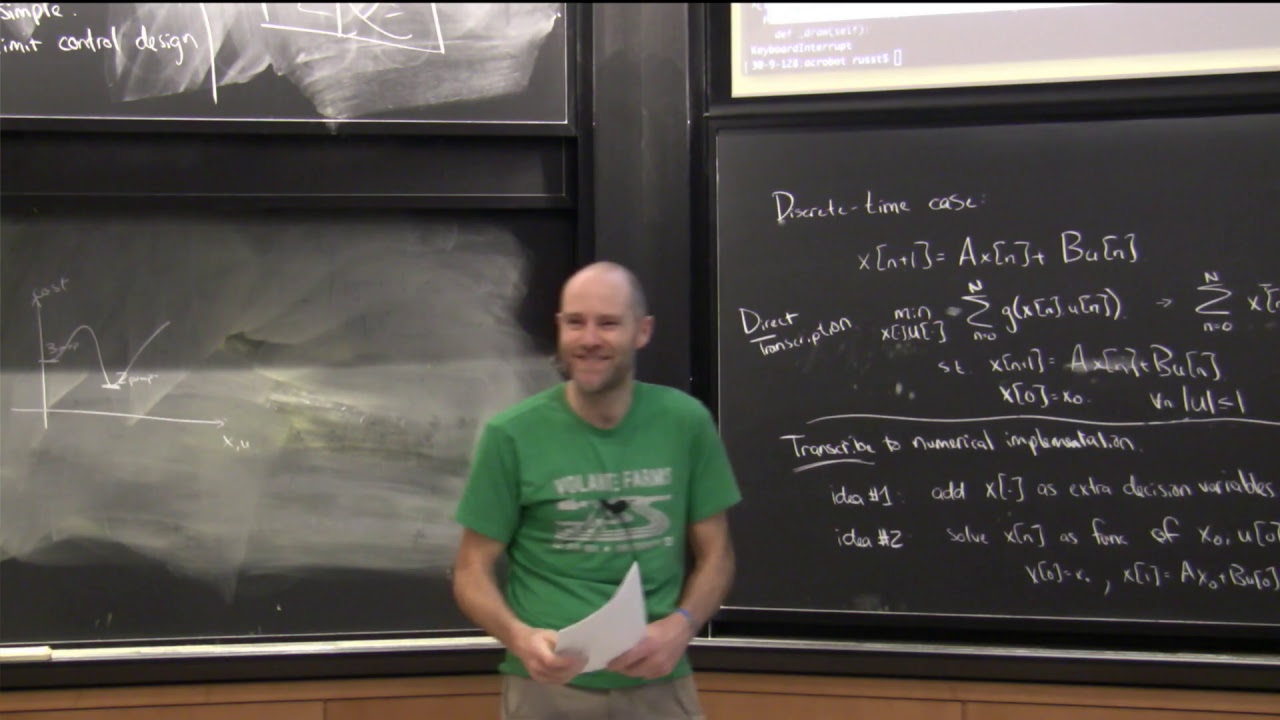
Lecture 10 | MIT 6.832 (Underactuated Robotics), Spring 2019
Keywords
Summary
162 words
Critical Evaluation
The lecture provides a solid conceptual foundation for trajectory optimization, situating it within the broader landscape of control methods. The instructor’s pedagogical approach is effective: he contrasts trajectory optimization with global methods, clearly articulating the trade-offs between scalability and guarantees. The content is technically accurate and aligns with standard robotics literature. However, the lecture is introductory and does not delve into specific algorithms or mathematical derivations, which may leave advanced viewers wanting more depth. The sources cited are primarily the course website, which is appropriate for a lecture. The title accurately reflects the content, and the lecture is well-structured. The main strength is the clear motivation for trajectory optimization as a response to the curse of dimensionality. The main weakness is the lack of concrete examples or case studies to illustrate the concepts. Overall, this is a valuable resource for students and practitioners seeking to understand the rationale behind trajectory optimization.
151 words
Title / Content Match
The title accurately reflects the content: a lecture on underactuated robotics, specifically covering trajectory optimization.
Quality & Reliability
8/10
The lecture is from MIT OpenCourseWare, a reputable academic source. The content is presented by an expert in the field, with clear explanations and references to course materials. The information is consistent with established knowledge in robotics and control theory.
Key Moments
Markers derived by PSI from the transcript: the creator did not define chapters.
- Introduction and overview of previous topics
- Discussion of dynamic programming limitations
- Review of LQR and Lyapunov methods
- Introduction to trajectory optimization concept
- Formulation of trajectory optimization problem
- Discussion of constraints and discretization
- Comparison with global methods and scalability
- Examples and potential applications
- Conclusion and preview of next topics
Cited Sources
- Underactuated Robotics Course Website — Course materials and additional resources
Concurring Sources
- Underactuated Robotics Course Website — Course materials and additional resources
Contribution & Novelties
The lecture provides a clear conceptual bridge between global control methods and trajectory optimization, emphasizing the practical benefits of focusing on single trajectories to overcome the curse of dimensionality. It offers a high-level perspective that is often missing in more technical treatments.
Pour aller plus loin :
- Trajectory Optimization — Overview of the field and common methods.
- Model Predictive Control — A related approach that uses trajectory optimization in a receding horizon.
- Direct Collocation — A specific numerical method for trajectory optimization.
82 words
Radar Profile
The radar profile shows balanced scores across all dimensions, indicating a well-rounded lecture with strong technical content and reliability. The high scores in information quality and technical level suggest it is suitable for an audience with some background in control theory.