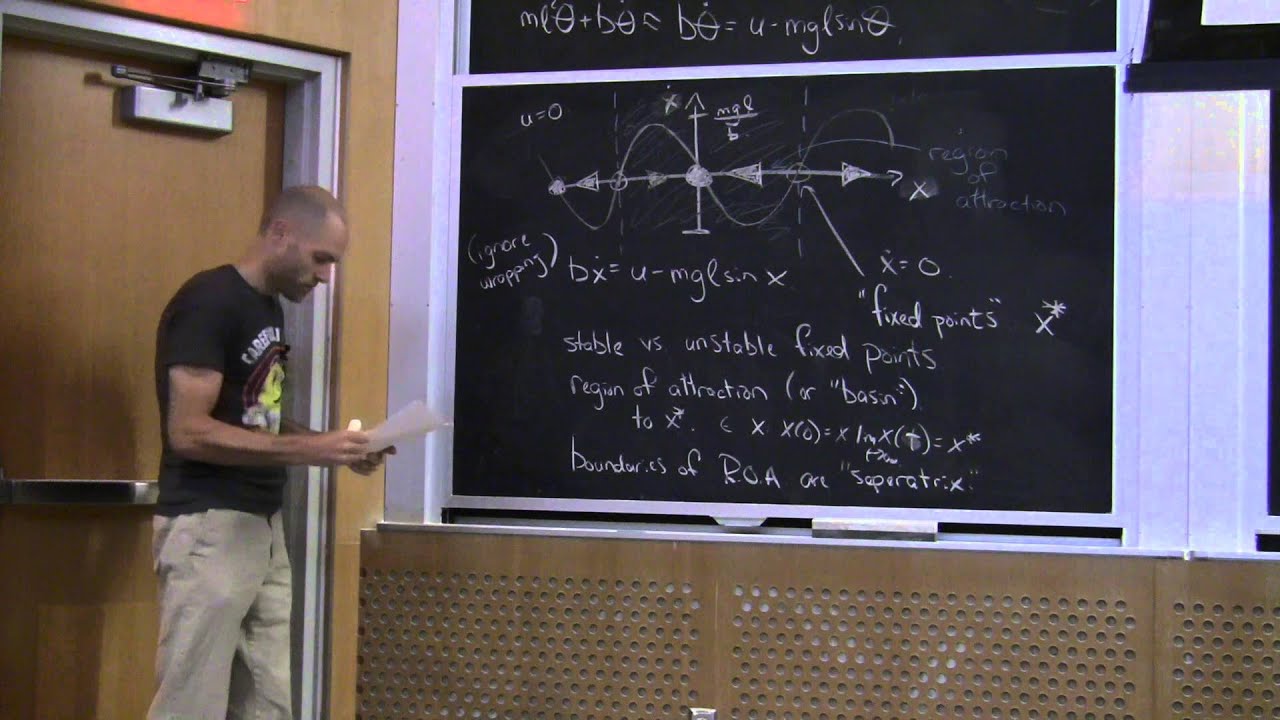
Lecture 2 for MIT 6.832 (Underactuated Robotics) 2015
Keywords
Summary
144 words
Critical Evaluation
The lecture provides a solid foundation in nonlinear dynamics, tailored for students of robotics. Tedrake’s pedagogical approach is effective: he starts with a simple pendulum, a system everyone can relate to, and progressively introduces more complex concepts. The emphasis on graphical analysis (phase portraits) is particularly valuable, as it offers an intuitive understanding of system behavior without relying on analytical solutions. The lecture is well-structured, with clear explanations of the overdamped approximation and its validity. The reference to Strogatz’s book is appropriate and adds credibility. However, the lecture is introductory and does not delve deeply into advanced topics like bifurcations or chaos, which are mentioned but not explored. The mathematical derivations are kept at a level accessible to graduate students, but some steps are glossed over. The quality of the video and audio is adequate, though the lecture was recorded in 2015 and may lack some modern production values. Overall, the content is accurate and aligns with established theory. The title accurately reflects the content, and the lecture fulfills its stated objectives. The main limitation is its brevity, as it covers a vast topic in a single session, but it serves as an excellent primer for the course.
198 words
Title / Content Match
The title accurately reflects the content: a lecture on nonlinear dynamics within the context of underactuated robotics.
Quality & Reliability
8/10
Lecture from MIT OpenCourseWare by a recognized expert in robotics. Content is rigorous, well-structured, and based on established nonlinear dynamics theory. No commercial bias.
Key Moments
Markers derived by PSI from the transcript: the creator did not define chapters.
- Introduction and overview of the lecture on nonlinear dynamics.
- Derivation of the simple pendulum equations of motion.
- Discussion on the difficulty of solving nonlinear differential equations analytically.
- Introduction of the overdamped pendulum approximation and simplification to first-order system.
- Graphical analysis: plotting theta dot vs theta to understand system behavior.
- Discussion on fixed points and stability in the phase portrait.
- Effects of damping and external torques on the pendulum dynamics.
- Introduction of the concept of underactuated systems and their relevance.
- Summary and preview of upcoming topics in the course.
Cited Sources
- Nonlinear Dynamics and Chaos — Recommended by the lecturer as a reference for nonlinear dynamics.
Concurring Sources
- Nonlinear Dynamics and Chaos — The lecture's approach aligns with Strogatz's textbook, which is a standard reference.
Contribution & Novelties
The lecture provides a clear and accessible introduction to nonlinear dynamics, emphasizing graphical methods for understanding system behavior. It bridges the gap between classical linear control theory and the complexities of underactuated robotics. The use of the pendulum as a recurring example helps solidify intuition.
Pour aller plus loin :
- Nonlinear Dynamics and Chaos by Steven Strogatz — A comprehensive textbook on nonlinear dynamics, highly relevant to the lecture’s content.
- Phase portrait — A graphical tool used in the lecture to analyze system behavior.
- Underactuated robotics — The broader field of robotics that this course focuses on.
97 words
Radar Profile
The radar profile shows high scores in quality and quantity of information, with a strong technical level. The reliability is also high, reflecting the academic nature of the lecture. The overall balance indicates a well-rounded educational resource.