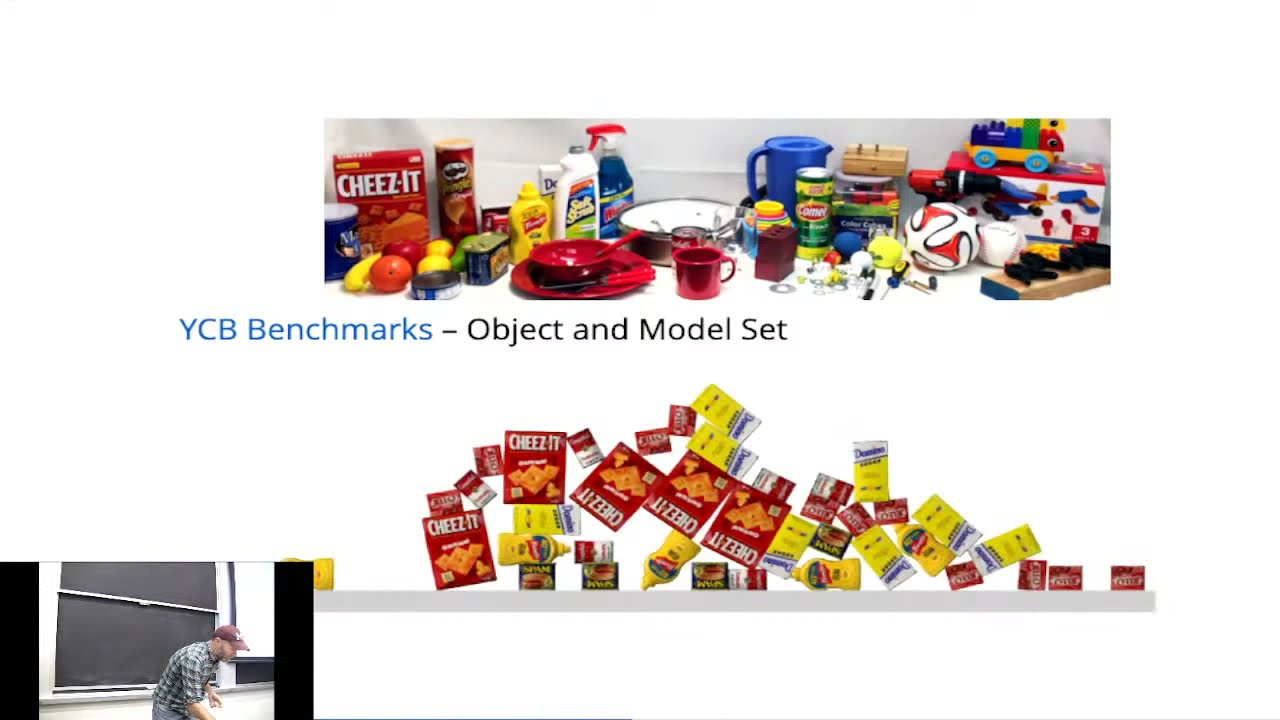
Lecture 9: MIT 6.800/6.843 Robotics Manipulation (Fall 2021) | "Manipulation in Clutter (Part 2)"
Keywords
Summary
173 words
Critical Evaluation
The lecture provides a solid overview of grasp analysis in the context of robotic manipulation in cluttered scenes. Russ Tedrake, a renowned expert in robotics, delivers the content with clarity and depth. He effectively bridges classical methods and modern learning-based approaches, offering a balanced perspective. The discussion on simulation and static equilibrium is insightful, though it may be more relevant to advanced students. The lecture is well-structured, with clear objectives and references to course materials. However, it lacks detailed mathematical derivations and specific algorithmic implementations, which are likely covered in the accompanying slides and problem sets. The reliance on the instructor’s expertise and course materials is appropriate for a university lecture, but the absence of external citations limits its standalone credibility. The content is highly technical and assumes prior knowledge of robotics and optimization. Overall, the lecture is valuable for students and practitioners seeking a conceptual understanding of grasp selection, but it is not a comprehensive tutorial. The title accurately reflects the content, and the lecture successfully prepares students for further study in manipulation.
174 words
Title / Content Match
The title accurately describes the lecture content, which focuses on manipulation in cluttered environments, specifically grasp analysis and selection.
Quality & Reliability
8/10
Lecture from MIT professor Russ Tedrake, part of a formal course. Content is technically rigorous, based on established robotics research and the instructor's expertise. Slides are provided. No external sources cited beyond the course materials, but the content is well-structured and pedagogically sound.
Key Moments
Markers derived by PSI from the transcript: the creator did not define chapters.
- Introduction and roadmap for the lecture
- Discussion on simulation and static equilibrium
- Transition to grasp analysis and selection
- Overview of traditional grasp analysis from the Springer Handbook
- Introduction to deep learning approaches for grasping
- Geometric approach: antipodal grasps and point cloud processing
- Basic strategy for grasp selection: point cloud acquisition and cleaning
Cited Sources
- Lecture slides — Slides accompanying the lecture, containing detailed figures and algorithms.
Concurring Sources
- Springer Handbook of Robotics — Referenced as a key resource for traditional grasp analysis.
Contribution & Novelties
The lecture provides a contemporary perspective on grasp analysis, contrasting classical methods with modern learning-based approaches. It emphasizes the practicality of geometric methods, such as antipodal grasps, which can be effective without deep learning. The discussion on simulation and static equilibrium offers insights into the challenges of generating realistic initial conditions for manipulation tasks.
Pour aller plus loin :
- Springer Handbook of Robotics — Comprehensive reference on robotics, including chapters on grasping.
- Robotic Grasping and Manipulation — Review article on recent advances in robotic grasping.
- Antipodal Grasp Detection — Paper on learning antipodal grasps from depth images.
97 words
Radar Profile
The radar profile shows high scores across all dimensions, indicating a well-rounded and informative lecture. The balance between theoretical concepts and practical considerations is strong, with a slight emphasis on technical depth.