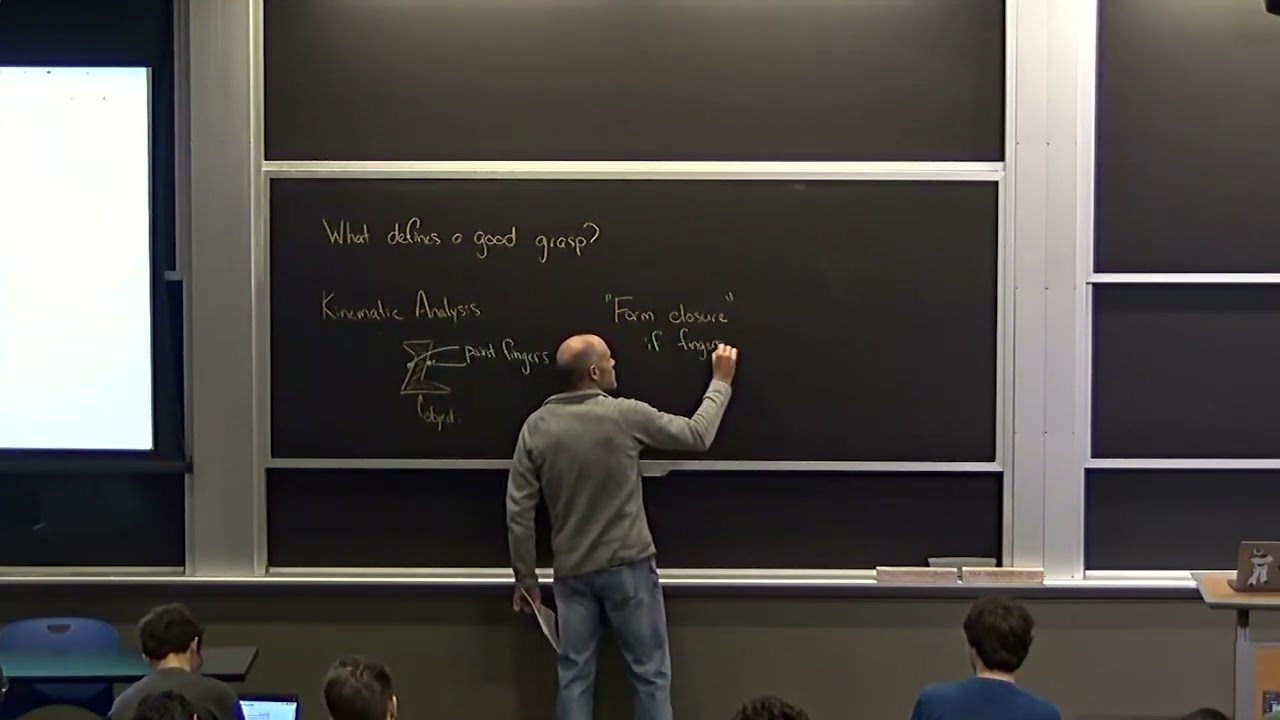
6.4210 Fall 2023 Lecture 9: Manipulation in Clutter- Grasp Selection
Keywords
Summary
158 words
Critical Evaluation
The lecture provides a solid theoretical foundation for grasp analysis, covering both kinematic and static aspects. The instructor’s explanations are clear and well-structured, with mathematical derivations that are accessible to an advanced undergraduate or graduate audience. The content is scientifically rigorous, drawing on established concepts from robotics and mechanics. However, the lecture lacks explicit citations to external sources, which limits its utility for further research. The discussion of form closure and force closure is thorough, but the instructor could have provided more concrete examples or case studies to illustrate the concepts. The lecture also touches on the limitations of classical grasp analysis and the shift towards learning-based methods, which is valuable context. Overall, the lecture is informative and well-presented, but it would benefit from more references and practical applications.
129 words
Title / Content Match
The title accurately reflects the lecture's focus on grasp selection for manipulation in cluttered environments.
Quality & Reliability
8/10
Lecture from MIT OpenCourseWare, presented by an expert in robotics, with rigorous mathematical derivations and references to established literature. The content is well-structured and technically accurate, though it lacks explicit citations to external sources.
Key Moments
Markers derived by PSI from the transcript: the creator did not define chapters.
- Introduction and recap of previous lecture on contact simulation.
- Introduction to grasp analysis and its history in robotics.
- Explanation of form closure and its mathematical conditions.
- Discussion of limitations of form closure and higher-order analysis.
- Introduction to force closure and friction cones.
- Analysis of wrench space and grasp resistance.
- Discussion of practical grasp selection for unknown objects.
- Conclusion and summary of key concepts.
Contribution & Novelties
The lecture provides a comprehensive overview of classical grasp analysis techniques, including form closure and force closure, and their application to robotic manipulation. It bridges the gap between theoretical concepts and practical implementation, offering insights into how these principles can be extended to unknown objects. The lecture also highlights the historical context and the shift towards learning-based approaches in manipulation research.
Pour aller plus loin :
- Grasping (Robotics) — Overview of grasping concepts and techniques.
- Form Closure — Detailed explanation of form closure and its mathematical basis.
- Friction Cone — Explanation of friction cones and their role in contact mechanics.
100 words
Radar Profile
The radar chart shows a balanced profile with high scores in technical level and information quality, indicating a rigorous and informative lecture. The lower score in information quantity suggests that the lecture could have covered more examples or applications.