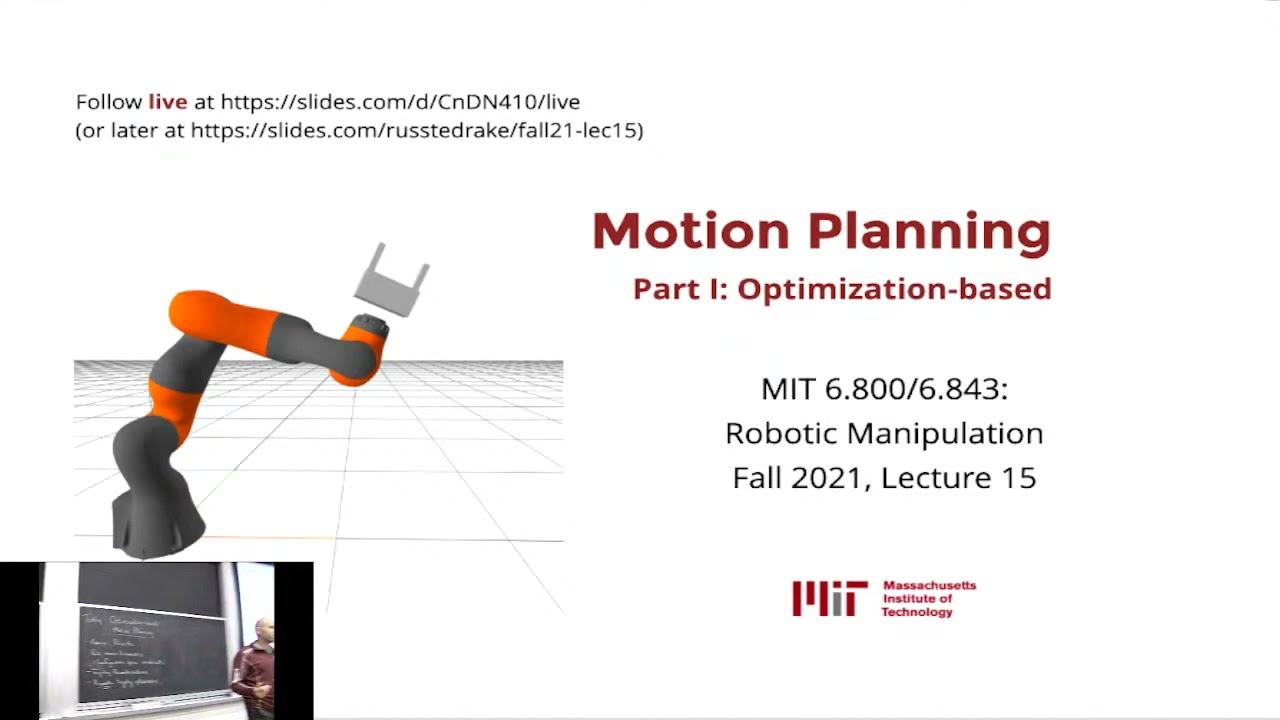
Lecture 15: MIT 6.800/6.843 Robotics Manipulation (Fall 2021) | "Motion Planning Optimization-based"
Keywords
Summary
151 words
Critical Evaluation
This lecture provides a solid, rigorous introduction to optimization-based motion planning, a core topic in robotics. The content is well-structured, starting from inverse kinematics and building up to trajectory optimization. The instructor, Russ Tedrake, is a leading expert in the field, and his explanations are clear and technically precise. The lecture is part of a formal MIT course, ensuring a high level of academic rigor. The material is presented with a focus on practical implementation, referencing the Drake toolkit and providing slides for further study. The argumentation is sound, with logical progression from simple IK to more complex optimization problems. The lecture does not shy away from mathematical details, such as the polynomial nature of kinematics, which adds depth. However, it assumes a certain level of prior knowledge in robotics and optimization, which may be challenging for beginners. The sources are limited to the provided slides, but the content is based on established literature in the field. The title accurately reflects the content, and the lecture fulfills its promise of covering optimization-based methods. Overall, this is a high-quality educational resource for advanced students or practitioners in robotics.
187 words
Title / Content Match
The title accurately describes the lecture content, focusing on optimization-based motion planning.
Quality & Reliability
8/10
Lecture by MIT professor Russ Tedrake, part of a formal course. Content is technically rigorous, based on established optimization and kinematics methods. Slides are provided. No external sources cited beyond the slides, but the material is well-founded.
Key Moments
Markers derived by PSI from the transcript: the creator did not define chapters.
- Introduction and administrative updates on projects.
- Discussion of inverse kinematics and its role in motion planning.
- Explanation of polynomial formulation of kinematics and algebraic geometry.
- Introduction to trajectory optimization and direct transcription.
- Discussion of non-convexity and sequential convex programming.
- Examples and practical considerations in optimization-based planning.
- Comparison with sampling-based methods and preview of next lecture.
Cited Sources
- Lecture slides — Slides used in the lecture, containing detailed content and references.
Concurring Sources
- MIT OpenCourseWare: Underactuated Robotics — Related course material by the same instructor.
Contribution & Novelties
This lecture provides a comprehensive overview of optimization-based motion planning, emphasizing the connection between inverse kinematics and trajectory optimization. It offers practical insights into using optimization tools like Drake for real-world manipulation tasks. The lecture’s contribution lies in its clear exposition of complex topics, making them accessible to advanced students.
Pour aller plus loin :
- Trajectory Optimization — Overview of trajectory optimization methods.
- Inverse kinematics — Detailed explanation of inverse kinematics and its challenges.
- Sequential convex programming — Technique used in non-convex optimization.
- Drake — Robotics toolkit used in the lecture.
91 words
Radar Profile
The radar profile shows high scores across all dimensions, indicating a well-rounded and technically deep lecture. The balance between information quantity, quality, technical level, and reliability suggests a highly educational resource.