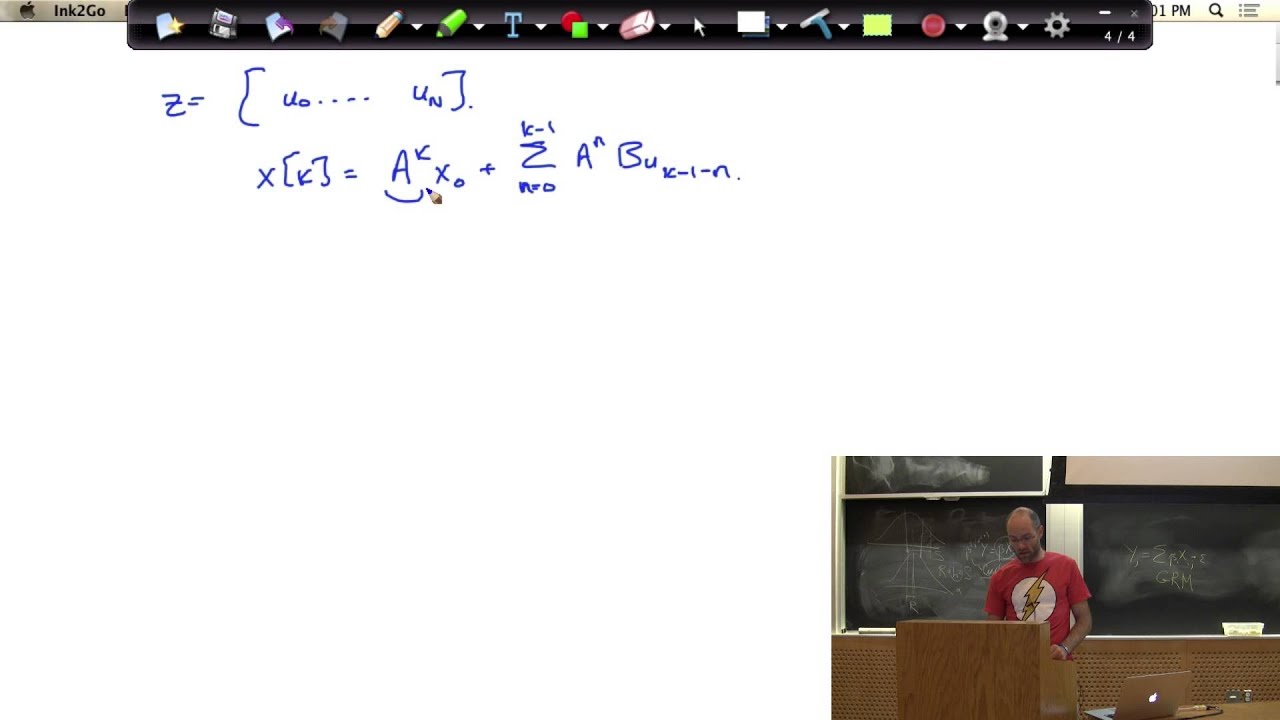
lecture18 final clip1 modelpredictivecontrol
Keywords
Summary
197 words
Critical Evaluation
The lecture provides a solid introduction to the use of convex optimization, specifically quadratic programming, for trajectory optimization and model predictive control. The instructor clearly explains the mathematical formulation, starting from the definition of a QP and then showing how finite-horizon LQR can be cast as a QP. The explanation of the direct transcription approach is detailed, with the cost function and dynamics expressed as a large quadratic objective and linear constraints. The discussion of model predictive control is practical, highlighting the receding horizon implementation and the benefits of guaranteed convergence. The lecture also addresses important nuances, such as the handling of long-term goals via final cost terms and the linearization of nonlinear systems. The content is technically rigorous, suitable for an advanced undergraduate or graduate-level audience in robotics or control. However, the lecture lacks explicit citations to external sources, which is common in lecture settings but limits the ability to verify claims. The instructor’s informal style, including interruptions and questions from the audience, adds authenticity but may be distracting for some viewers. Overall, the lecture is highly informative and well-structured, providing a strong foundation for understanding QP-based trajectory optimization. The adéquation between the title and content is adequate, though the title is not very descriptive. The main strength is the clear explanation of how convex optimization can provide guarantees in trajectory optimization, which is a key advantage over non-convex methods. The main weakness is the lack of references and the somewhat unstructured presentation due to audience interactions.
248 words
Title / Content Match
The title is somewhat cryptic but accurately reflects the content: a lecture on model predictive control, specifically focusing on convex optimization for trajectory optimization.
Quality & Reliability
8/10
The lecture is part of an academic course (likely MIT's Underactuated Robotics) and presents rigorous mathematical formulations of trajectory optimization as quadratic programs, with clear explanations of convexity and guarantees. The content is technically accurate and well-structured, though it lacks explicit citations to external sources.
Key Moments
Markers derived by PSI from the transcript: the creator did not define chapters.
- Introduction to trajectory optimization with convex optimization, contrasting with RRTs.
- Definition of quadratic programs and their convexity properties.
- Formulation of finite-horizon LQR as a quadratic program.
- Discussion of direct transcription and shooting methods for QP formulation.
- Introduction to model predictive control and receding horizon implementation.
- Handling long-term goals with final cost terms and infinite horizon cost-to-go.
- Discussion on linearization of nonlinear systems and local validity.
- Questions about robustness and noise in MPC.
Contribution & Novelties
The lecture provides a clear pedagogical explanation of how trajectory optimization can be formulated as a quadratic program, emphasizing the guarantees of convex optimization. It bridges the gap between theoretical LQR and practical MPC, showing how constraints can be incorporated. The discussion of receding horizon control and the use of final cost terms is particularly insightful.
Pour aller plus loin :
- Model Predictive Control — Overview of MPC, its variants, and applications.
- Quadratic programming — Mathematical definition and solution methods.
- Linear–quadratic regulator — Background on LQR and its relation to QP.
91 words
Radar Profile
The radar profile shows high scores in technical level and information quality, indicating a technically dense and accurate lecture. The quantity of information is also high, but the lack of external sources slightly reduces the reliability score. Overall, the lecture is well-balanced and suitable for an advanced audience.