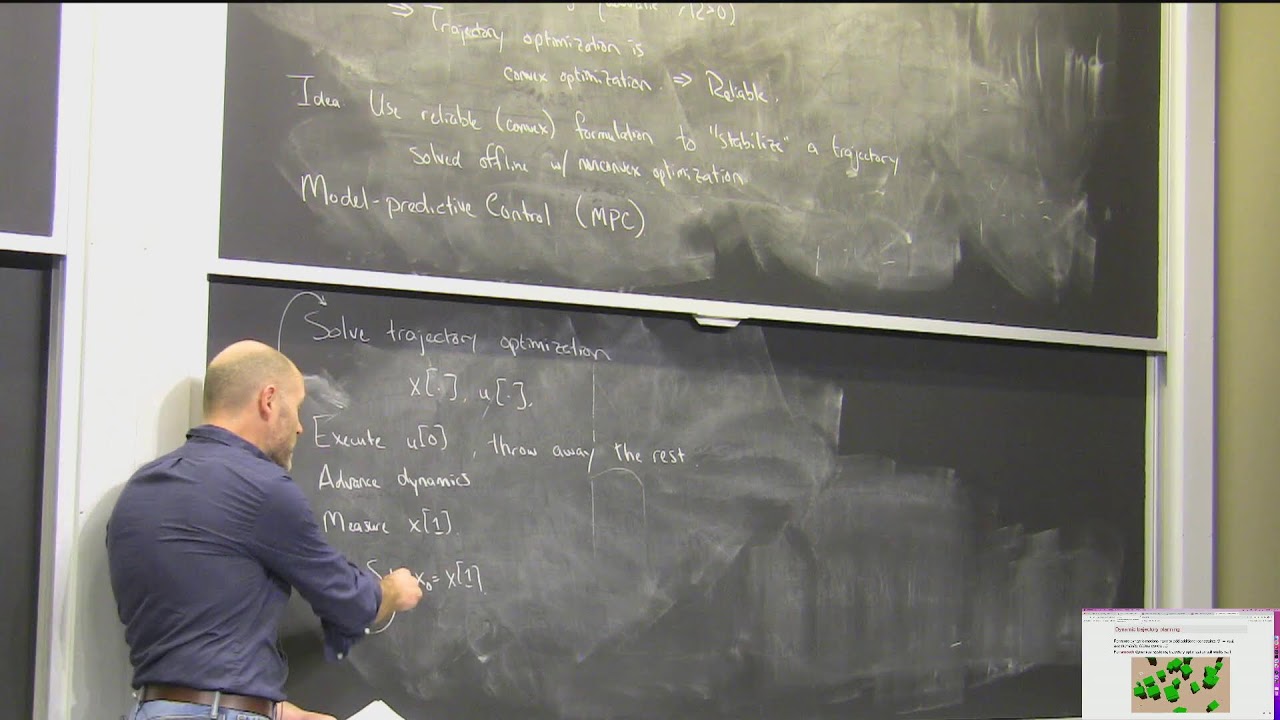
Lecture 12: MIT 6.832 Underactuated Robotics (Spring 2022) | "Trajectory Stabilization"
Keywords
Summary
157 words
Critical Evaluation
The lecture provides a rigorous and comprehensive treatment of trajectory stabilization, a key topic in underactuated robotics. The instructor, likely Professor Russ Tedrake, demonstrates deep expertise and pedagogical clarity. The content builds logically on previous lectures, starting with a review of trajectory optimization and then transitioning to the stabilization problem. The derivation of the finite-horizon LQR is thorough, with careful attention to the mathematical details, including the Riccati equation and the handling of time-varying dynamics. The lecture effectively bridges theory and practice by discussing implementation in Drake and addressing common pitfalls, such as the need for good initial guesses and the use of finite differences. The argumentation is solid, with clear explanations of why the time-varying LQR provides local exponential stability. The sources are not explicitly cited in the video, but the material is based on established control theory and the instructor’s own research. The title accurately reflects the content, and the lecture is well-structured, with appropriate pacing and interactive Q&A. Overall, this is an excellent educational resource for advanced students and researchers in robotics and control.
177 words
Title / Content Match
The title accurately reflects the content: the lecture focuses on trajectory stabilization, building on previous trajectory optimization concepts.
Quality & Reliability
8/10
Lecture from MIT OpenCourseWare, presented by a professor (likely Russ Tedrake) with deep expertise in robotics. Content is rigorous, based on established methods in trajectory optimization and control. No external sources cited in the video, but the academic context and institutional backing ensure high reliability.
Key Moments
Markers derived by PSI from the transcript: the creator did not define chapters.
- Introduction and administrative announcements about midterm and project proposals.
- Review of trajectory optimization: direct transcription vs. shooting methods.
- Discussion on solver interfaces and the importance of gradients and Hessians.
- Introduction to trajectory stabilization and the concept of time-varying LQR.
- Derivation of finite-horizon LQR and Riccati equation.
- Discussion on local exponential stability and practical implementation in Drake.
- Example: stabilizing the perching maneuver and handling nonlinearities.
- Q&A session addressing questions about gradients and solver choices.
- Further discussion on limitations and extensions of the approach.
- Wrap-up and preview of next lecture.
Concurring Sources
- Underactuated Robotics — The course textbook by Russ Tedrake, which covers trajectory optimization and stabilization in detail.
Contribution & Novelties
The lecture provides a clear and detailed exposition of trajectory stabilization using time-varying LQR, a fundamental technique in underactuated robotics. It bridges the gap between trajectory optimization and feedback control, offering practical insights for implementation. The emphasis on solver interfaces and the use of Drake adds practical value.
Pour aller plus loin :
- Finite-horizon LQR — Provides background on LQR and its finite-horizon formulation.
- Riccati equation — Mathematical foundation for the Riccati equation used in LQR.
- Underactuated Robotics textbook — Companion textbook by Russ Tedrake, covering related topics in depth.
90 words
Radar Profile
The radar profile shows high scores in technical level and information quality, indicating a dense, expert-level lecture. The lower score in information quantity relative to the others suggests a focused, in-depth treatment rather than a broad overview.