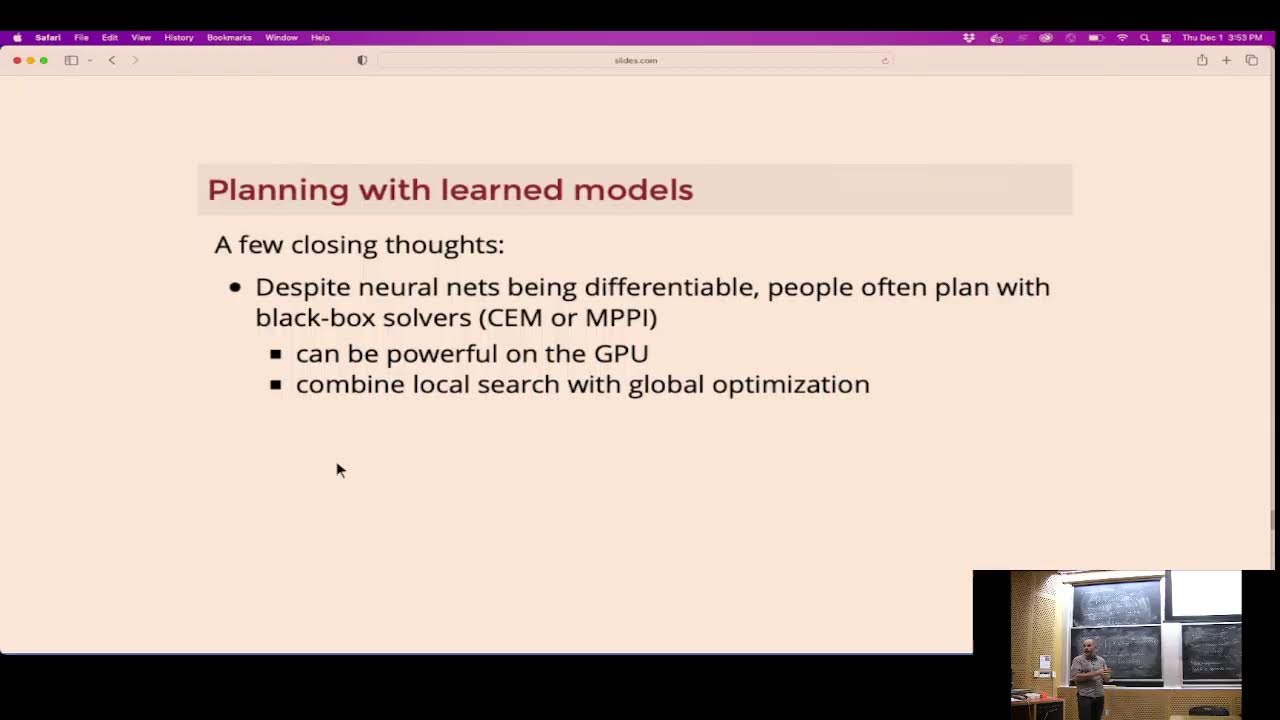
Fall 2022 6.4210/2 Lecture 20: Intuitive physics (part 2)
Keywords
Summary
128 words
Critical Evaluation
The lecture provides a comprehensive overview of system identification in the context of intuitive physics, effectively bridging control theory and machine learning. Tedrake’s presentation is clear and well-structured, starting with a general formulation and then exploring specific examples and trade-offs. The content is scientifically rigorous, grounded in established principles of dynamics and estimation, and he appropriately acknowledges the limitations of different model classes. The discussion of the spectrum of models is particularly valuable, as it helps students understand the design choices involved in model learning. The lecture does not delve into experimental validation or comparative studies, but it serves as a solid theoretical foundation. The use of slides and references to ongoing research enhances credibility. The title accurately reflects the content, and the lecture is well-suited for an advanced audience. Overall, this is a high-quality educational resource that stimulates critical thinking about model representation and learning.
146 words
Title / Content Match
The title accurately reflects the content, which is a lecture on intuitive physics focusing on system identification and model learning.
Quality & Reliability
8/10
Lecture from MIT OpenCourseWare, presented by an expert in the field, with clear technical content and references to slides. The content is well-structured and based on established principles of system identification and model learning.
Key Moments
Markers derived by PSI from the transcript: the creator did not define chapters.
- Introduction and overview of the lecture topic: intuitive physics as system identification.
- General formulation of system identification: given data, find parameters to minimize prediction error.
- Discussion of the spectrum of models from structured to general, and the trade-offs.
- Comparison of perception and system identification, and the role of online vs. batch estimation.
- Limitations of multibody parameterizations, including lack of uncertainty over geometry.
- Examples of model classes and their capabilities, such as Lagrangian neural networks.
- Discussion of the importance of structure in models for generalization and algorithmic efficiency.
- Conclusion and outlook on future directions in intuitive physics research.
Cited Sources
- Lecture slides — Slides used in the lecture, containing detailed content and references.
Concurring Sources
- System identification — General concept of system identification, aligning with the lecture's topic.
- Lagrangian neural networks — A model class discussed in the lecture, showing the use of physics-based priors.
Contribution & Novelties
The lecture provides a clear framework for understanding system identification in the context of intuitive physics, emphasizing the trade-offs between model structure and algorithmic power. It highlights the importance of choosing the right model class and the potential of hybrid approaches.
Pour aller plus loin :
- System identification — Overview of the field.
- Lagrangian neural networks — A specific model class mentioned.
- Neural ODEs — Related approach for learning dynamics.
70 words
Radar Profile
The radar profile shows high scores across all dimensions, indicating a well-balanced and comprehensive lecture. The high technical level and information quality are balanced by good reliability and clarity.