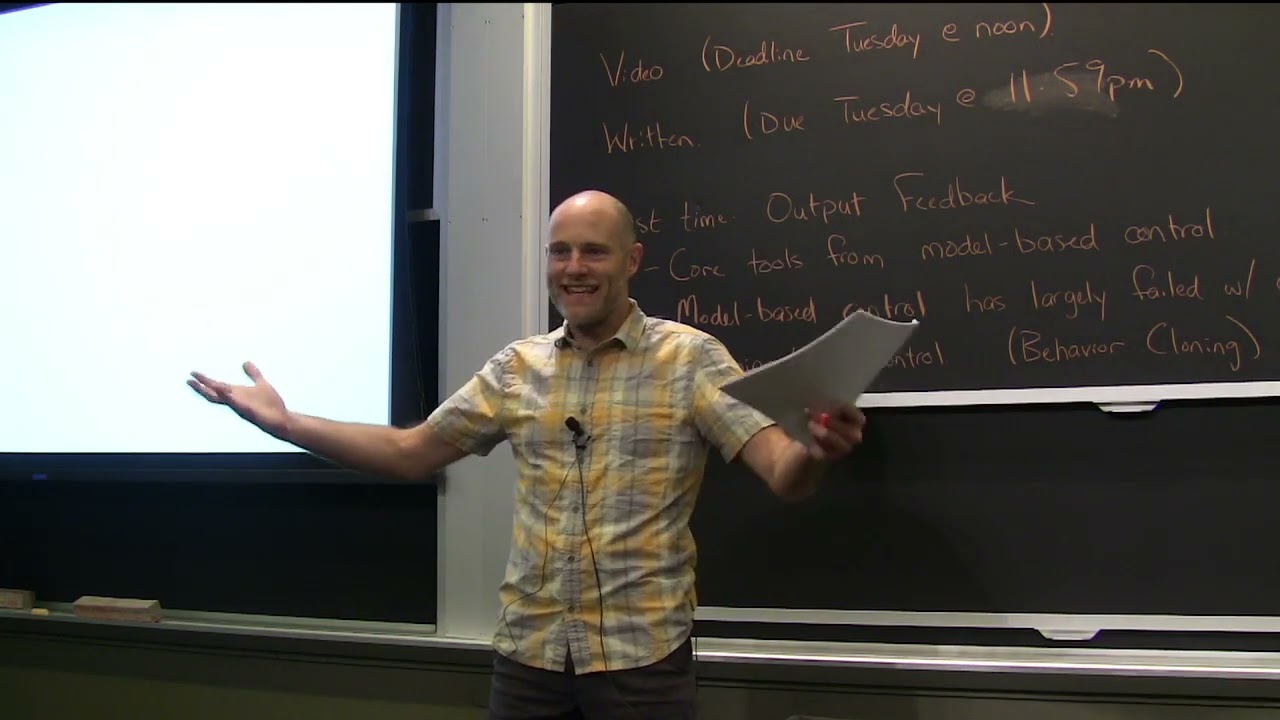
6.8210 Spring 2023 Lecture 24: Feedback motion planning
Keywords
Summary
166 words
Critical Evaluation
The lecture provides a comprehensive overview of feedback motion planning, a critical topic in robotics. Russ Tedrake, a renowned expert, delivers the content with clarity and depth, making it accessible to an advanced audience. The discussion is well-structured, starting with a review of previous material and then building up to the main topic. The instructor effectively contrasts different approaches, such as model-based control, behavior cloning, and LQR trees, highlighting their strengths and limitations. He uses concrete examples from his own research, such as the dishwasher loading robot, to illustrate theoretical concepts. The argumentation is solid, grounded in established control theory and recent developments in learning-based control. However, the lecture lacks explicit citations to specific papers or sources, which would enhance its scientific rigor. The adéquation between title and content is excellent, as the lecture indeed focuses on feedback motion planning. The technical level is high, requiring prior knowledge of control theory and robotics. Overall, the lecture is highly informative and thought-provoking, offering valuable insights into the state of the art and future directions. The main weakness is the absence of formal references, but the instructor’s authority and the academic context mitigate this concern.
193 words
Title / Content Match
The title accurately reflects the content: the lecture focuses on feedback motion planning, discussing both classical and modern approaches to integrating planning and control for robustness.
Quality & Reliability
8/10
Lecture from MIT course 6.8210 by Russ Tedrake, a leading expert in robotics and control. Content is technically rigorous, grounded in established control theory and recent research, and presented with appropriate nuance. Sources are not explicitly cited in the video, but the instructor's authority and the academic context support high reliability.
Key Moments
Markers derived by PSI from the transcript: the creator did not define chapters.
- Administrative details about final project presentations and deadlines.
- Review of output feedback lecture and discussion on importance of perception in control.
- Comparison of behavior cloning vs model-based control for manipulation tasks.
- Introduction to feedback motion planning and the idea of building a library of controllers.
- Discussion on task planning and the use of PDDL/STRIPS, and the role of LLMs.
- Explanation of LQR trees and their advantages for robust feedback control.
- Discussion on the limitations of replanning and the need for precomputed feedback policies.
- Examples of LQR trees applied to acrobot and other systems.
- Conclusion and summary of key concepts, with emphasis on combining model-based and learning-based approaches.
Contribution & Novelties
This lecture provides a clear and insightful synthesis of feedback motion planning, bridging classical control theory with modern learning-based approaches. The main contribution is the emphasis on LQR trees as a powerful tool for achieving robustness with formal guarantees, contrasting with the more ad-hoc replanning strategies. The lecture also highlights the importance of integrating multiple control skills into a coherent architecture, a topic of growing relevance in robotics.
Pour aller plus loin :
- LQR Trees — Original paper by Tedrake on LQR trees, providing the theoretical foundation.
- Model Predictive Control — Overview of MPC, a key concept discussed in the lecture.
- Behavior Cloning — Overview of behavior cloning, a learning-based approach contrasted with model-based control.
115 words
Radar Profile
The radar profile shows high scores across all dimensions, indicating a well-rounded and reliable lecture. The technical depth is high, and the information is both substantial and credible, making it a valuable resource for advanced students and researchers.