Lecture 15 for MIT 6.832 (Underactuated Robotics)
Keywords
Summary
165 words
Critical Evaluation
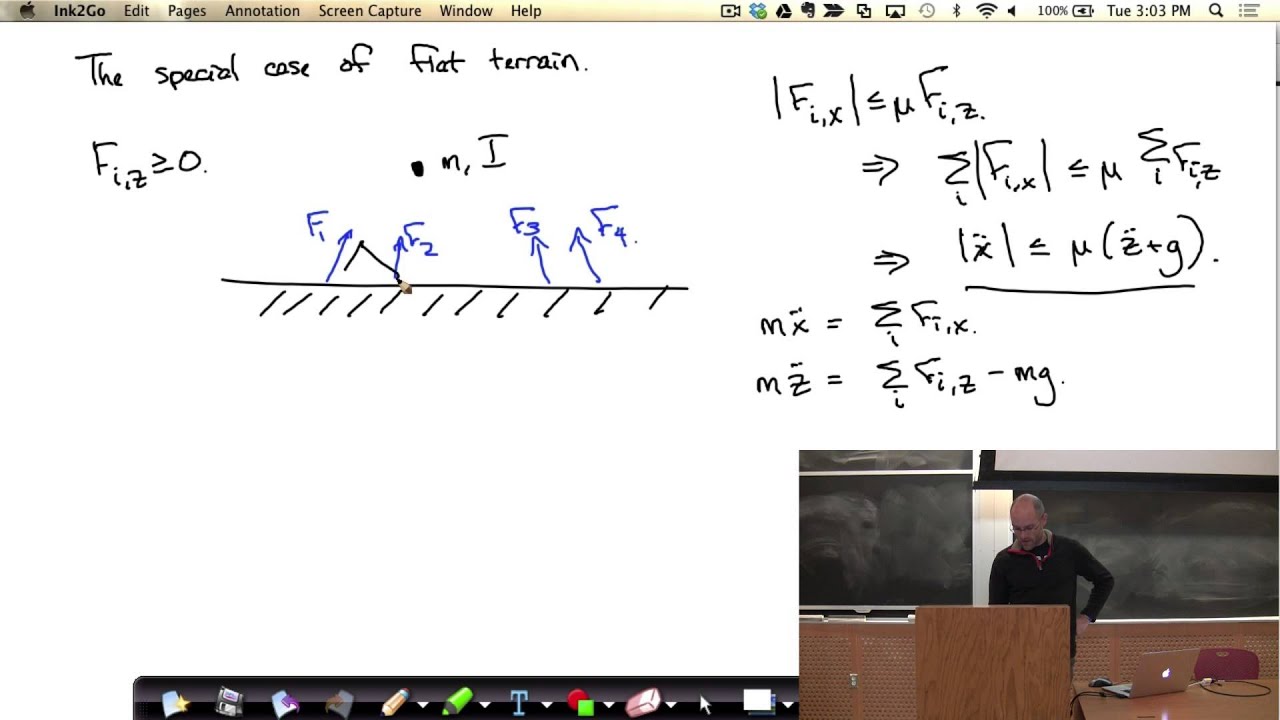
The lecture provides a rigorous and insightful introduction to the control of humanoid robots, bridging the gap between fundamental dynamics and practical algorithms. The instructor’s use of a simplified ‘hovercraft’ model is effective in isolating the core challenges of locomotion: managing the center of mass and angular momentum under constraints on foot placement and ground reaction forces. This abstraction helps clarify why walking is fundamentally a problem of underactuation and contact constraints.
The mathematical formulation is clear and precise, with the dynamics of the rigid body presented in a way that is accessible to students with a background in mechanics and control. The introduction of the Zero Moment Point (ZMP) is well-motivated, and the instructor correctly emphasizes its role in simplifying the planning problem by reducing it to a linear inverted pendulum model. However, the lecture also acknowledges the limitations of ZMP-based methods, particularly for dynamic motions where angular momentum becomes significant. This balanced perspective is commendable.
The lecture excels in connecting theoretical concepts to practical algorithms, such as trajectory optimization and model predictive control. The instructor’s emphasis on the importance of contact forces and friction cones is crucial for understanding the physical constraints that govern walking. The references to the literature, including the work of Kajita and others, provide a solid foundation for further study.
One potential weakness is the lack of detailed examples or case studies, which might help students visualize the application of these concepts. Additionally, the lecture assumes a certain level of familiarity with optimization and control theory, which might be challenging for beginners. Nevertheless, the content is technically accurate and well-presented, making it a valuable resource for advanced students and researchers in robotics.
The title accurately reflects the content, and the lecture is well-structured, with clear transitions between topics. The use of a simple model to illustrate complex ideas is effective, and the instructor’s teaching style is engaging. Overall, this is a high-quality lecture that provides a solid foundation for understanding the control of humanoid robots.
331 words
Title / Content Match
The title accurately reflects the content: a lecture on underactuated robotics focusing on humanoid walking.
Quality & Reliability
8/10
Lecture from MIT OpenCourseWare by a recognized expert in robotics, presenting rigorous mathematical formulations and references to established literature. The content is well-structured and technically sound, though it is a lecture rather than peer-reviewed research.
Key Moments
Markers derived by PSI from the transcript: the creator did not define chapters.
- Introduction and announcements
- Introduction to the hovercraft model
- Dynamics of the hovercraft model
- Constraints on thrusters and foot placement
- Connection to walking robots
- Introduction to Zero Moment Point (ZMP)
- ZMP and center of mass dynamics
- Angular momentum and its importance
- Trajectory optimization for walking
- Model predictive control and ZMP
- Summary and conclusion
Cited Sources
- Underactuated Robotics course materials — Course website for MIT 6.832, providing lecture notes and additional resources.
Concurring Sources
- Underactuated Robotics course materials — The course materials align with the lecture content, providing further details on the topics discussed.
Contribution & Novelties
The lecture provides a clear and accessible explanation of the Zero Moment Point (ZMP) and its application to humanoid robot control, connecting it to the broader framework of underactuated robotics and optimization. It emphasizes the importance of angular momentum and the limitations of ZMP-based methods for dynamic motions.
Pour aller plus loin :
- Zero Moment Point - Wikipedia — Provides a comprehensive overview of the ZMP concept and its history.
- Kajita et al., ‘Biped Walking Pattern Generation by using Preview Control of Zero-Moment Point’ — A seminal paper on ZMP-based walking pattern generation.
- Model Predictive Control - Wikipedia — Overview of MPC, a key technique mentioned in the lecture for trajectory optimization.
112 words
Radar Profile
The radar profile shows high scores across all dimensions, indicating a well-rounded lecture with strong technical depth, clear explanations, and reliable content. The balance between theory and practice is particularly notable.