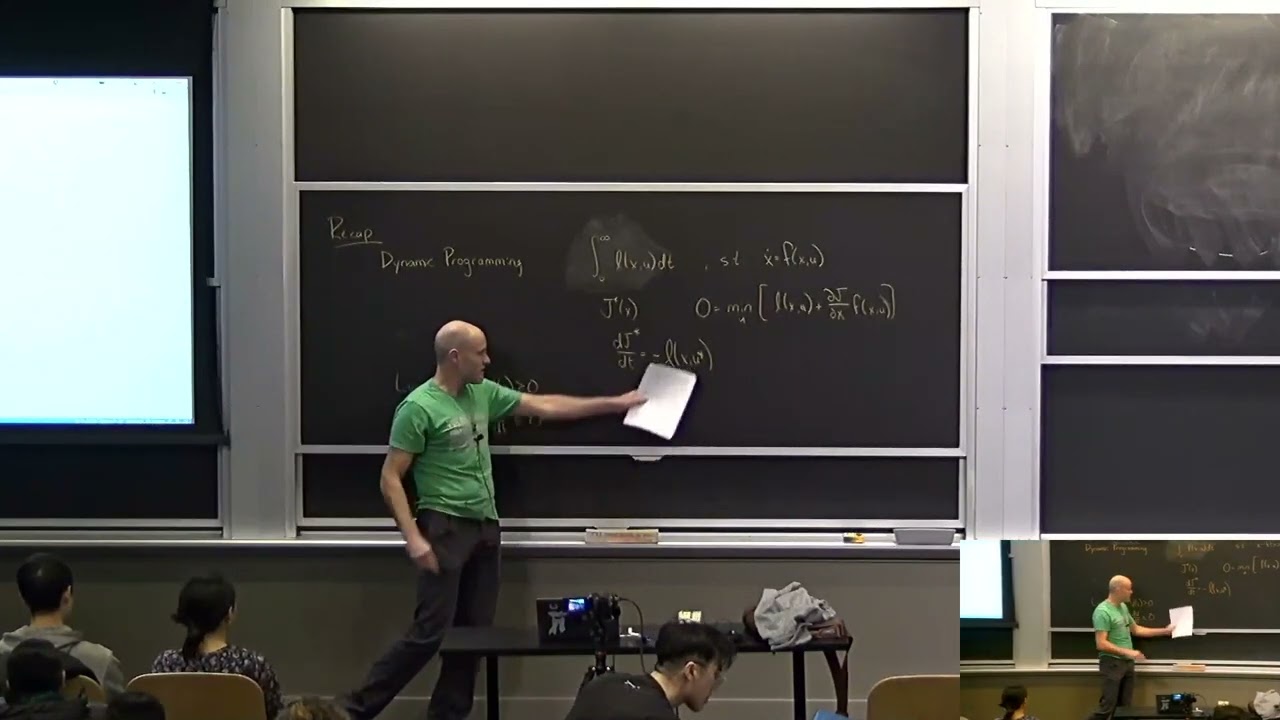
Underactuated March 7 2023 Lecture
Keywords
Summary
156 words
Critical Evaluation
The lecture provides a solid introduction to computational Lyapunov analysis, a key topic in nonlinear control. The instructor, presumably Russ Tedrake, is a leading expert in the field, and the content is rigorous and well-structured. The live demonstration of the solver finding a Lyapunov function for a pendulum is particularly effective, illustrating the power of convex optimization. The explanation of convex optimization is clear, though it assumes some familiarity with the topic. The lecture does not cite specific sources, but the material is standard and can be found in textbooks and research papers. The main limitation is that the lecture is part of a course and may not be self-contained for viewers without background in control theory. The title accurately reflects the content. Overall, this is a high-quality educational resource for advanced students and researchers in robotics and control.
139 words
Title / Content Match
The title accurately describes the content: a lecture from the Underactuated Robotics course, dated March 7, 2023.
Quality & Reliability
8/10
Lecture from a university course (MIT 6.832) by a recognized expert in robotics and control theory. Content is rigorous, mathematically grounded, and includes live demonstrations. Sources are not explicitly cited in the video, but the material is standard and well-established.
Key Moments
Markers derived by PSI from the transcript: the creator did not define chapters.
- Introduction and setup
- Recap of dynamic programming and Lyapunov view
- Motivation: automatic discovery of Lyapunov functions
- Live demonstration: solver finds Lyapunov function for pendulum
- Introduction to convex optimization
- Convex optimization examples: linear programming, quadratic programming
- Sum-of-squares programming as a tool for Lyapunov functions
Contribution & Novelties
The lecture demonstrates a computational approach to finding Lyapunov functions using convex optimization, specifically sum-of-squares programming. This is a significant advancement over manual Lyapunov function construction, as it can automatically discover certificates of stability for nonlinear systems. The live example of the pendulum shows that the solver can find a Lyapunov function that is even better than the mechanical energy, providing asymptotic stability without additional arguments.
Pour aller plus loin :
- Sum-of-squares optimization — Relevant for understanding the computational method used.
- Lyapunov stability — Foundational concept for the lecture.
- Convex optimization — Key mathematical tool discussed.
96 words
Radar Profile
The radar profile shows high scores in information quantity, quality, and technical level, with a slightly lower but still strong score in reliability. This indicates a technically dense and reliable lecture, suitable for an advanced audience.