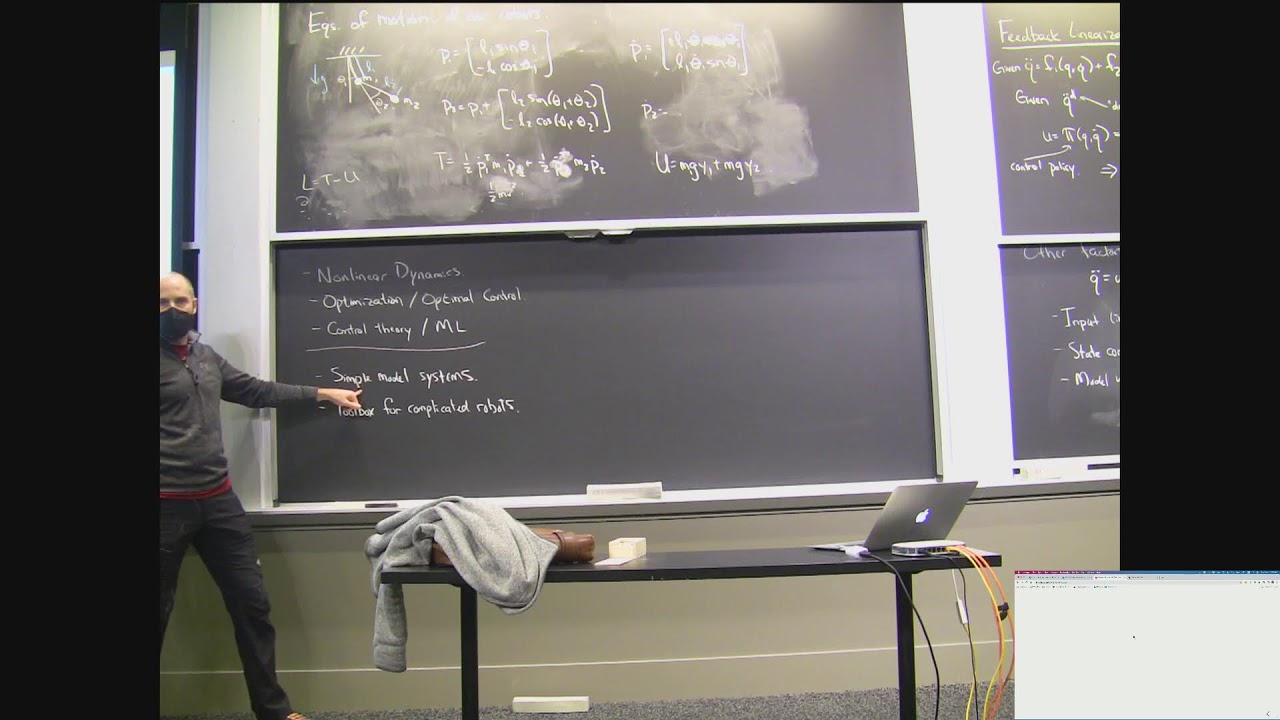
Lecture 1: MIT 6.832 Underactuated Robotics (Spring 2022) | "Robot dynamics and model-based control"
Keywords
Summary
157 words
Critical Evaluation
The lecture provides a solid foundation for the course, clearly defining key concepts and motivating the study of underactuated systems. The instructor, Russ Tedrake, is a leading expert in robotics and control, and his explanations are both rigorous and accessible. The content is well-structured, starting with motivation and then moving to formal definitions and mathematical formulations. The discussion of what makes control hard is comprehensive, covering stability, dimensionality, stochasticity, observability, and delayed rewards, which sets the stage for the course’s focus on underactuated systems. The definition of underactuation is presented with mathematical clarity, and the instructor takes care to explain the rank condition and its implications. The lecture also touches on the relationship between classical control and reinforcement learning, which is a timely and relevant topic. However, the video has technical issues with synchronization, which the instructor acknowledges and offers an alternative lecture from the previous year. This does not detract from the content quality but may affect the viewing experience. The sources cited are the course slides and a previous lecture, which are appropriate and reliable. Overall, this is an excellent introductory lecture that effectively prepares students for the course material.
192 words
Title / Content Match
The title accurately reflects the content: the lecture introduces robot dynamics and model-based control, focusing on underactuated systems.
Quality & Reliability
9/10
Lecture by a renowned MIT professor, part of a well-established course, with clear technical content and references to slides and previous lectures. The content is rigorous and well-structured, though the video has synchronization issues.
Key Moments
Markers derived by PSI from the transcript: the creator did not define chapters.
- Introduction and motivation with Boston Dynamics robots
- Discussion on the interplay between control and reinforcement learning
- Definition of the control problem: state, inputs, outputs
- What makes control hard: stability, DOF, stochasticity, observability, delayed rewards
- Introduction to underactuated systems and the formal definition
- Mathematical formulation: second-order dynamics and control-affine systems
- Explanation of full row rank and underactuation condition
Cited Sources
- Lecture slides — Slides used in the lecture
- Previous year's lecture 1 — Alternative lecture better synchronized with slides
Concurring Sources
- Underactuated Robotics course website — Course materials and additional resources
Contribution & Novelties
This lecture provides a clear and rigorous introduction to underactuated robotics, emphasizing the importance of model-based control and its relation to reinforcement learning. It offers a formal definition of underactuation and sets the stage for the course.
Pour aller plus loin :
- Underactuated robotics — Overview of the field.
- Control-affine systems — Definition and examples.
- Nonlinear control — Key concepts in controlling nonlinear systems.
64 words
Radar Profile
The radar profile shows high scores in information quality, technical level, and reliability, with slightly lower but still strong scores in information quantity. This indicates a dense, technically rigorous lecture that is highly reliable and informative.