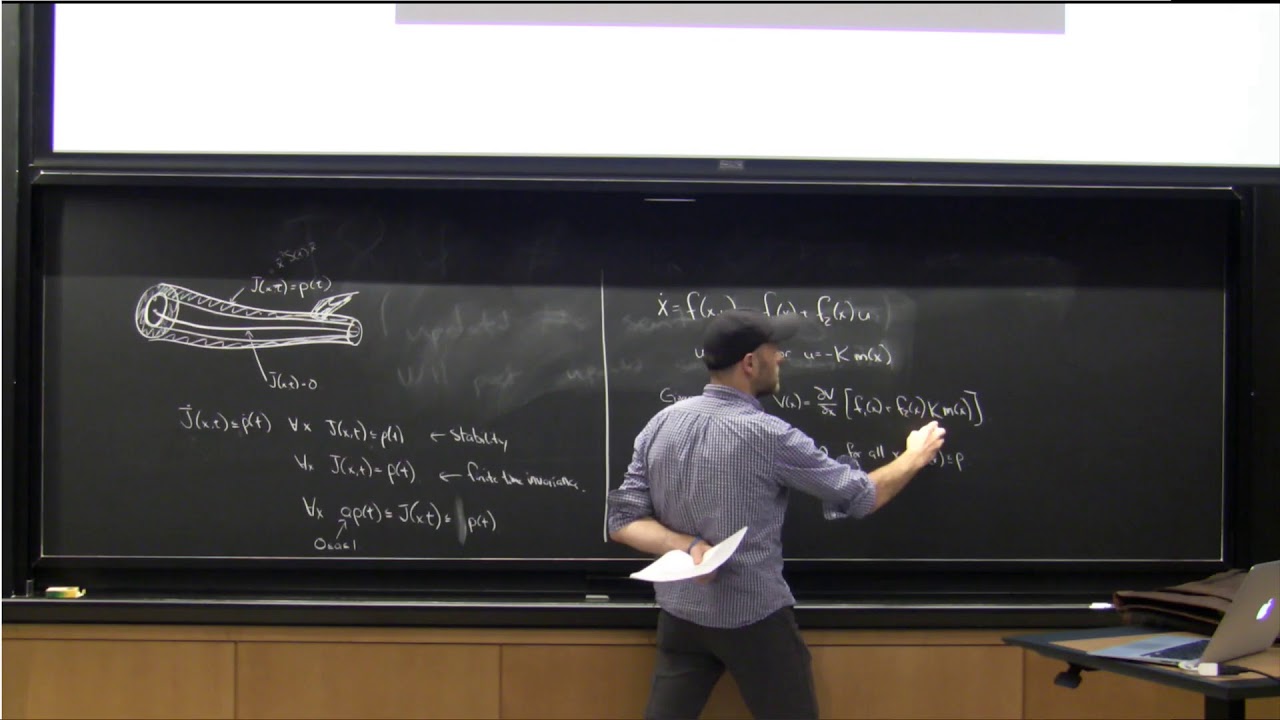
Lecture 18 | MIT 6.832 (Underactuated Robotics), Spring 2019
Keywords
Summary
146 words
Critical Evaluation
The lecture provides a comprehensive and insightful introduction to feedback motion planning, a crucial topic in robotics. Tedrake effectively bridges the gap between theoretical motion planning and practical control, addressing the limitations of purely trajectory-based methods. The use of the juggling example is particularly effective, as it simplifies a complex problem to illustrate key concepts. The lecture is well-structured, building on previous material and clearly motivating the need for feedback. The technical depth is appropriate for an advanced audience, and the explanations are clear. However, the lecture is not a peer-reviewed source, and some concepts are introduced without full mathematical rigor, relying on intuition. The sources cited are primarily the course website, which provides additional materials. Overall, the lecture is highly valuable for students and practitioners in robotics, offering both theoretical insights and practical considerations. The adéquation between title and content is excellent, as the lecture directly addresses the topic of underactuated robotics and feedback motion planning. The presentation is engaging, and the use of real-world examples, such as Boston Dynamics, helps contextualize the material. The lecture could benefit from more detailed derivations, but it serves as an excellent introduction to the subject.
193 words
Title / Content Match
The title accurately reflects the content: a lecture on underactuated robotics, specifically focusing on feedback motion planning.
Quality & Reliability
8/10
Lecture from MIT OpenCourseWare by a leading expert in robotics; content is technically rigorous and well-structured, though it is a lecture rather than peer-reviewed research.
Key Moments
Markers derived by PSI from the transcript: the creator did not define chapters.
- Introduction and recap of motion planning
- Discussion on limitations of randomized planners
- Introduction to feedback motion planning concept
- Example of juggling as a simple model
- Discussion on composing feedback controllers
- Technical details on stability and robustness
- Comparison with traditional planning methods
- Conclusion and future directions
Cited Sources
- Underactuated Robotics Course Website — Course website with lecture notes, assignments, and additional resources.
Concurring Sources
- Underactuated Robotics Course Website — Course materials align with the lecture content.
Contribution & Novelties
The lecture provides a novel perspective on motion planning by advocating for the composition of feedback controllers rather than just trajectories. This approach addresses robustness and uncertainty, which are often overlooked in traditional planning. The use of a simple juggling model to illustrate complex concepts is particularly insightful.
Pour aller plus loin :
- RRT* paper — Foundational paper on optimal RRT variant.
- Feedback Motion Planning — General concept of feedback control.
- Underactuated Robotics — Overview of underactuated systems.
78 words
Radar Profile
The radar profile shows high scores in information quality and technical level, indicating a technically dense and reliable lecture. The quantity of information is also high, but the overall score is slightly lower due to the lack of peer-reviewed sources and the lecture format.