Lecture 17: MIT 6.800/6.843 Robotics Manipulation (Fall 2021) | "Behavior Cloning"
Keywords
Summary
139 words
Critical Evaluation
The lecture provides a rigorous and insightful introduction to behavior cloning, a core technique in robot learning. The instructor, Russ Tedrake, is a renowned expert in robotics, and his expertise is evident in the clarity and depth of the presentation. The content is well-structured, starting with a comparison between planning and policy learning, which effectively motivates the need for behavior cloning. The lecture then delves into the technical details, including the distribution mismatch problem and the use of neural networks, without oversimplifying the material. The discussion of data collection and augmentation is particularly valuable, as it addresses practical challenges that are often overlooked in theoretical treatments. The lecture also benefits from concrete examples and references to relevant research, such as the work on RRT* and AlphaZero, which help contextualize the concepts. However, the lecture is part of a course and assumes prior knowledge of robotics and machine learning, which may limit its accessibility to a broader audience. The presentation style is engaging, with the instructor encouraging questions and providing intuitive explanations. The slides are available online, which is a valuable resource for further study. Overall, this lecture is a high-quality educational resource that offers both theoretical foundations and practical insights into behavior cloning for robotic manipulation.
206 words
Title / Content Match
The title accurately reflects the content, which focuses on behavior cloning as a precursor to reinforcement learning in robotic manipulation.
Quality & Reliability
8/10
Lecture from MIT professor Russ Tedrake, a leading expert in robotics. Content is well-structured, technically accurate, and based on established research. Slides are provided for verification.
Key Moments
Markers derived by PSI from the transcript: the creator did not define chapters.
- Introduction and administrative announcements
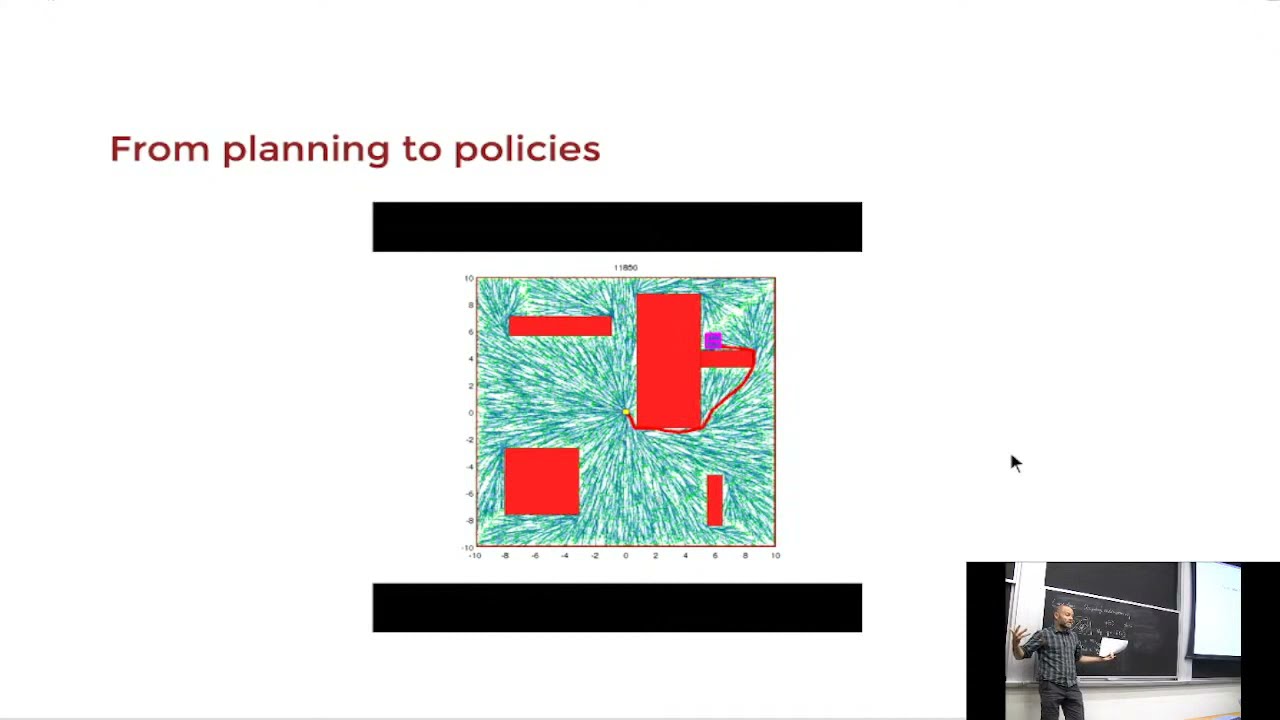
- Comparison of planning vs. policy learning
- Discussion of RRT* and its connection to policies
- Introduction to behavior cloning and its challenges
- Distribution mismatch problem and solutions
- Neural network policies and training considerations
- Data collection and augmentation strategies
- Connection to reinforcement learning and future directions
Cited Sources
- Lecture slides — Slides used in the lecture, providing visual aids and additional details.
Concurring Sources
- RRT* paper — The lecture references RRT* as an example of a planning algorithm that can produce policies.
Contribution & Novelties
The lecture provides a comprehensive overview of behavior cloning, emphasizing its role as a stepping stone to reinforcement learning. It offers a clear comparison between planning and policy learning, highlighting the trade-offs. The discussion of distribution mismatch and data augmentation is particularly insightful. The lecture also connects behavior cloning to broader themes in robot learning, such as the potential for combining planning and learning.
Pour aller plus loin :
- Behavior Cloning — Wikipedia article providing an overview of behavior cloning.
- Imitation Learning — Wikipedia article on imitation learning, a broader category that includes behavior cloning.
- DAgger — Paper introducing DAgger, an algorithm that addresses distribution mismatch in imitation learning.
109 words
Radar Profile
The radar profile shows high scores in quality of information and technical level, indicating a technically rigorous and informative lecture. The quantity of information is also high, but the fiabilite is slightly lower, possibly due to the lack of external sources cited in the video itself.