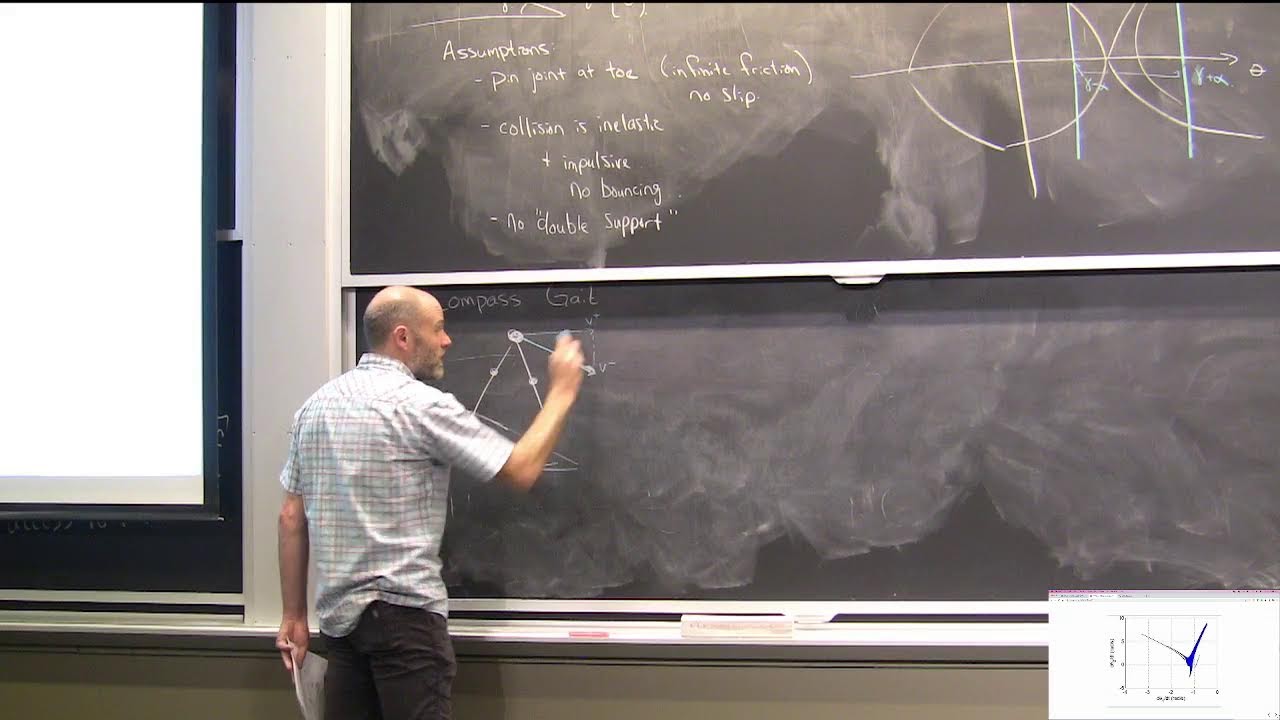
Lecture 15: MIT 6.832 Underactuated Robotics (Spring 2022) | "Simple Models of Walking"
Keywords
Summary
160 words
Critical Evaluation
This lecture is a masterclass in the fundamentals of legged locomotion, delivered by Russ Tedrake, a leading expert in the field. The content is rigorous and mathematically precise, yet presented in an accessible manner for advanced students. The lecture excels in its clear exposition of the concept of limit cycle stability, which is crucial for understanding periodic motions in robotics. The introduction of the Poincaré map as a tool to reduce the stability analysis of a cycle to that of a fixed point is elegantly explained, and the instructor carefully addresses potential pitfalls, such as the non-uniqueness of the surface of section. The use of the rimless wheel as a canonical example is particularly effective, as it allows for a complete analytical treatment while capturing the essential dynamics of walking. The lecture also touches on important practical considerations, such as the choice of Poincaré section and the computation of the Jacobian, which are often glossed over in textbooks. The historical context provided, including references to McGeer and the Cornell walker, adds depth and illustrates the evolution of ideas. The lecture is well-structured, building from simple to more complex concepts, and the instructor’s enthusiasm is contagious. The only minor criticism is that the lecture assumes prior knowledge of Lyapunov stability and hybrid systems, which may be challenging for those without a strong background in dynamical systems. However, for the target audience, this is not a drawback. Overall, this is an outstanding educational resource that provides a solid foundation for understanding the principles of dynamic walking.
254 words
Title / Content Match
The title accurately reflects the content, which focuses on simple models of walking and their stability analysis.
Quality & Reliability
9/10
Lecture from MIT OpenCourseWare by a leading expert in robotics, based on established theory and research, with clear mathematical derivations and references to seminal work.
Key Moments
Markers derived by PSI from the transcript: the creator did not define chapters.
- Introduction to the lecture and motivation for studying walking robots.
- Discussion of passive dynamic walkers, including Tad McGeer's work and the Cornell walker.
- Introduction of the rimless wheel as the simplest model of walking.
- Explanation of limit cycle stability and the need for orbital stability.
- Introduction of the Poincaré map and its role in analyzing limit cycles.
- Derivation of the Poincaré map for the rimless wheel and computation of its Jacobian.
- Discussion of hybrid dynamics and impact events in walking.
- Extension to more complex models and the concept of zero dynamics.
- Conclusion and summary of key takeaways.
Cited Sources
- Tad McGeer's passive dynamic walker — Historical example of a passive walker.
- Cornell passive dynamic walker — Impressive passive walker built by Andy Ruina and Steve Collins.
- Art Kuo's rendition of the McGeer walker — Simplified model of passive walking.
Concurring Sources
- Underactuated Robotics course materials — Course website with additional resources and lecture notes.
Contribution & Novelties
This lecture provides a clear and rigorous introduction to the stability analysis of periodic motions in legged robots, using the Poincaré map and the rimless wheel model. It bridges the gap between classical dynamical systems theory and practical robotics.
Pour aller plus loin :
- Poincaré map — A fundamental tool for analyzing periodic orbits.
- Limit cycle — Definition and examples of limit cycles in dynamical systems.
- Passive dynamics — Overview of passive dynamic walking.
74 words
Radar Profile
The radar profile shows high scores across all dimensions, indicating a lecture that is rich in content, technically rigorous, and highly reliable. The balance between information quantity and technical depth is excellent, making it suitable for advanced students and researchers.
💬 No comments were provided for analysis.