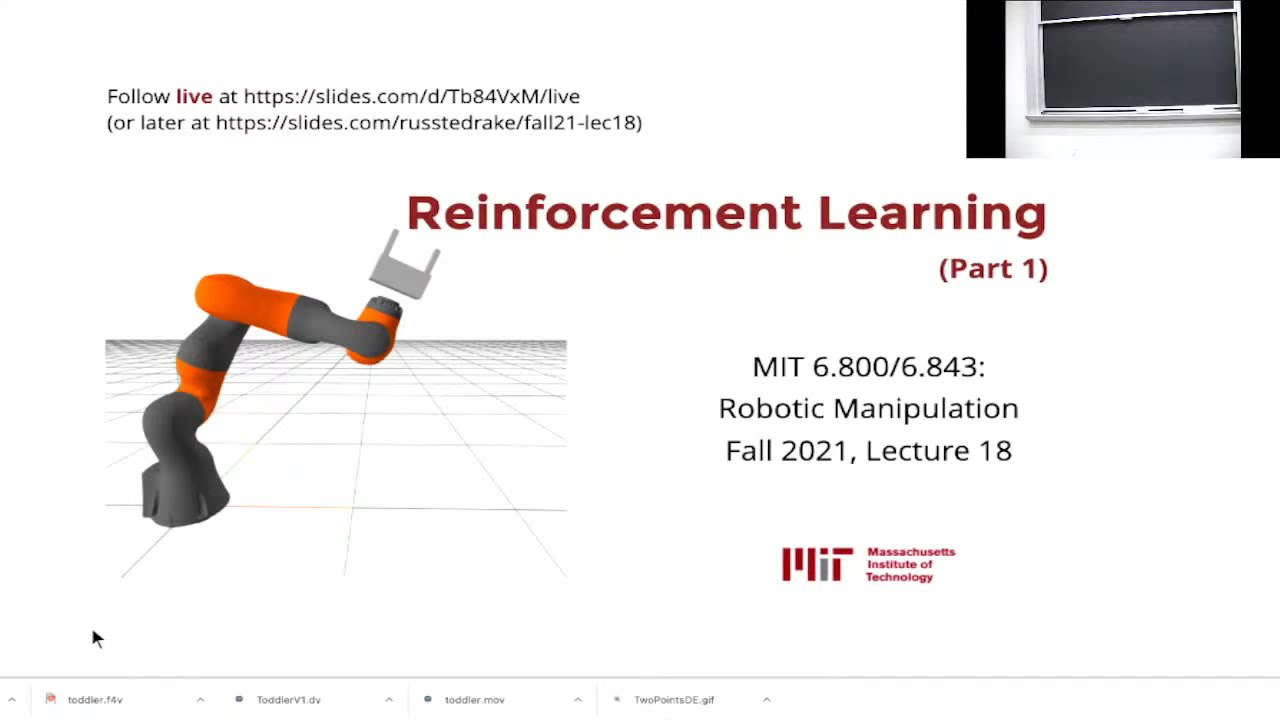
Lecture 18: MIT 6.800/6.843 Robotics Manipulation (Fall 2021) | "Reinforcement Learning (Part 1)"
Keywords
Summary
163 words
Critical Evaluation
This lecture provides a solid introduction to reinforcement learning, particularly from the perspective of policy gradient methods, tailored for robotic manipulation. Professor Tedrake’s expertise is evident, and the content is well-structured, building from basic concepts to more advanced topics. The philosophical contrast between the black-box RL approach and the structured Drake framework is valuable, as it encourages critical thinking about the trade-offs between generality and exploiting known structure. The derivation of the policy gradient using the likelihood ratio method is clear and rigorous, and the discussion of variance reduction techniques (baselines, actor-critic) is practical. However, the lecture is not without limitations. It assumes prior knowledge of optimal control and probability, making it less accessible to beginners. Some claims, such as the effectiveness of certain algorithms, are presented without empirical evidence or citations. The lecture also focuses heavily on the theoretical underpinnings, with limited discussion of practical implementation challenges in real-world manipulation, such as safety and sample efficiency, which are briefly mentioned but not deeply explored. The use of a single example (the walking robot) is anecdotal and not central to the lecture. The adéquation between title and content is strong, as the lecture squarely addresses reinforcement learning for manipulation. Overall, the lecture is a valuable resource for graduate students or researchers with a background in control and robotics, offering a rigorous foundation in policy gradient RL. However, it would benefit from more concrete examples and references to recent research to support its claims.
243 words
Title / Content Match
The title accurately reflects the content: a lecture on reinforcement learning for robotic manipulation, focusing on policy gradient methods.
Quality & Reliability
8/10
Lecture from MIT professor Russ Tedrake, known for expertise in robotics and control. Content is technically rigorous, well-structured, and based on established RL concepts. However, it is a single lecture without peer review, and some claims are presented without citations.
Key Moments
Markers derived by PSI from the transcript: the creator did not define chapters.
- Administrative announcements: drop date, grades, project meetings, final presentation format.
- Introduction to reinforcement learning: black-box environment, agent loop, stochastic optimal control.
- Discussion of RL software: OpenAI Gym interface, comparison with Drake systems framework.
- Personal anecdote: Tedrake's thesis on RL for a walking robot, emphasizing online learning.
- Formulation of RL as stochastic optimal control, introduction of policy gradient.
- Derivation of likelihood ratio method and REINFORCE algorithm.
- Variance reduction: baselines, actor-critic methods, and their importance.
- Exploration-exploitation trade-off, reward design, and challenges in real-world manipulation.
- Preview of next lecture: Q-learning and actor-critic methods, guest lecture by Abhishek Gupta.
Cited Sources
- Lecture slides — Slides used in the lecture, containing detailed content and references.
Concurring Sources
- Reinforcement Learning: An Introduction (Sutton & Barto) — Standard textbook covering policy gradient methods and RL fundamentals.
Contribution & Novelties
This lecture provides a clear and rigorous introduction to policy gradient methods for robotic manipulation, emphasizing the importance of stochasticity and black-box optimization. It bridges the gap between classical optimal control and modern RL, offering a unique perspective from a leading robotics researcher.
Pour aller plus loin :
- REINFORCE algorithm — The core algorithm discussed, with a concise explanation.
- OpenAI Gym — The standard interface for RL environments, mentioned in the lecture.
- Drake — The robotics toolbox used in the course, providing a structured alternative to black-box RL.
88 words
Radar Profile
The radar profile shows high scores across all dimensions, indicating a well-balanced and comprehensive lecture. The strongest aspects are the quantity and quality of information, with a high technical level and good reliability, reflecting the expertise of the lecturer and the rigorous structure of the content.