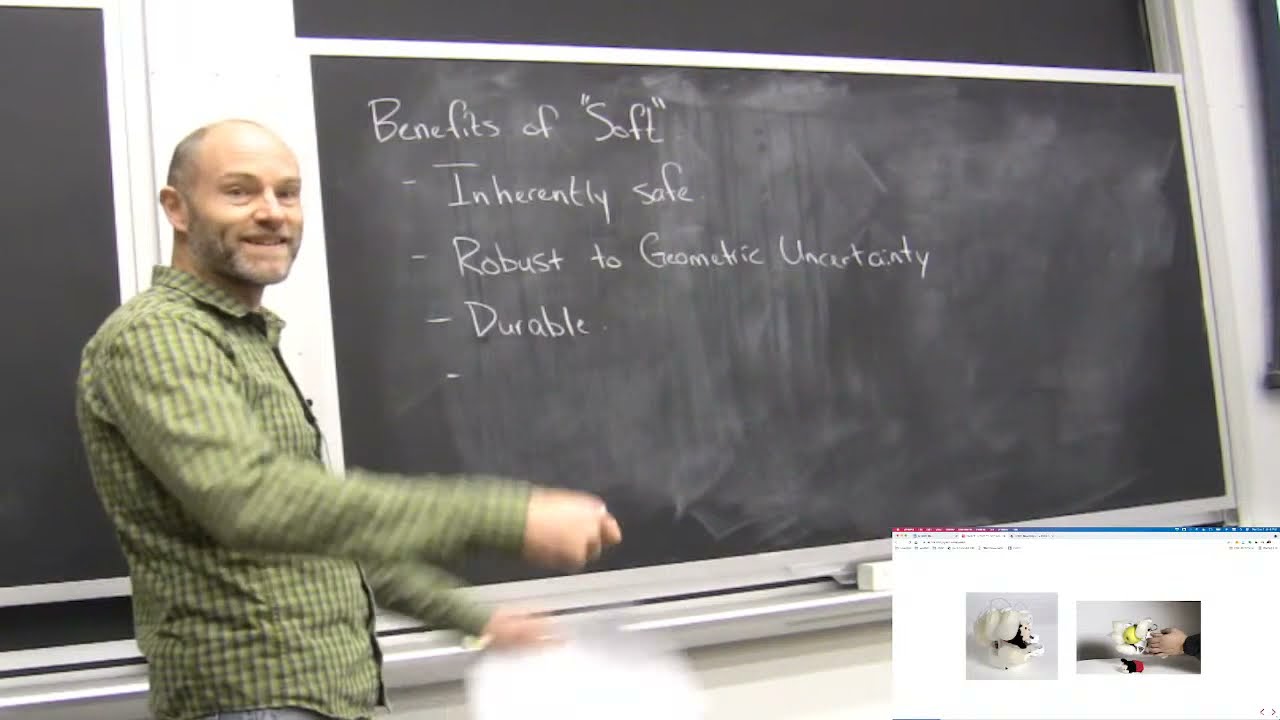
Lecture 23: MIT 6.800/6.843 Robotics Manipulation (Fall 2021) | "Tactile sensing and course wrap-up"
Keywords
Summary
134 words
Critical Evaluation
The lecture provides a rigorous and insightful analysis of soft robotics, challenging common assumptions with clear mechanical reasoning. The instructor, Russ Tedrake, is a renowned expert in robotics, and his credibility lends weight to the content. The use of simplified models (e.g., mass-spring-damper) effectively illustrates the fundamental trade-offs between compliance and control. The argument that softness does not inherently guarantee safety is well-supported, as steady-state forces are unaffected by compliance, and springs can store energy. The discussion on control bandwidth is particularly valuable, highlighting the limitations of soft actuators in high-frequency tasks. The lecture also integrates tactile sensing, connecting it to the benefits of softness for contact-rich manipulation. The content is well-structured and accessible to an audience with a background in robotics and control. However, the lecture is not a comprehensive review of the field; it focuses on specific aspects and does not delve into fabrication or durability in depth. The sources cited are limited to the course slides, which may contain additional references. Overall, the lecture offers a solid conceptual framework for understanding soft robotics, but it is not without limitations. The title accurately reflects the content, and the lecture serves as an excellent conclusion to the course.
199 words
Title / Content Match
The title accurately reflects the content: the lecture covers tactile sensing and concludes the course with a wrap-up, including reflections on soft robotics.
Quality & Reliability
8/10
Lecture by a leading expert in robotics, based on established principles of mechanics and control. The content is well-structured and critically examines common claims about soft robotics. However, it is a single lecture without peer review, and some claims are presented as opinions.
Key Moments
Markers derived by PSI from the transcript: the creator did not define chapters.
Cited Sources
- Lecture slides — Official slides for the lecture, containing additional references and figures.
Concurring Sources
- Soft Robotics: A Review — A comprehensive review of soft robotics, supporting the lecture's discussion of benefits and challenges.
Dissenting Sources
- Inherent safety of soft robots — Some researchers claim that soft robots are inherently safe, but the lecture argues that this is not always true, especially at steady state.
Contribution & Novelties
The lecture provides a critical and nuanced perspective on soft robotics, moving beyond common claims to analyze the fundamental trade-offs using simple mechanical models. It offers a clear framework for understanding when softness is beneficial and when it is not, which is valuable for both researchers and practitioners.
Pour aller plus loin :
- Soft robotics on Wikipedia — Overview of the field, including applications and challenges.
- Tactile sensing in robotics — Background on tactile sensors and their role in manipulation.
- Compliant mechanisms — Related concept of using flexibility in mechanical design.
91 words
Radar Profile
The radar profile shows high scores in information quantity, quality, technical level, and reliability, indicating a well-rounded and authoritative lecture. The balanced scores suggest a comprehensive treatment of the topic.