Mini-Lecture 4 | MIT 6.832 (Underactuated Robotics), Spring 2021
Keywords
Summary
143 words
Critical Evaluation
This mini-lecture provides a clear and insightful comparison between discrete-time and continuous-time LQR, a fundamental topic in optimal control. The instructor, presumably Russ Tedrake, demonstrates deep expertise and pedagogical skill. The content is mathematically rigorous, with derivations performed on a virtual whiteboard, and numerical examples are used to reinforce the theoretical findings. The key contribution is the explanation of why the discrete-time cost-to-go is always higher than the continuous-time one, attributing it to the constraint of holding control actions constant over time steps. This is a subtle point that is often glossed over in textbooks, and the lecture does an excellent job of making it intuitive. The argumentation is solid, and the use of the double integrator as a simple yet illustrative example is effective. The sources are not explicitly cited in the video, but the content is based on standard control theory and the instructor’s own course notes, which are available online. The video is well-structured, with a clear progression from recap to new material. The only minor weakness is that the video is a mini-lecture, so it does not cover all aspects of LQR, but it serves its purpose as a focused discussion. The title accurately reflects the content. Overall, this is a high-quality educational resource for students of robotics and control theory.
215 words
Title / Content Match
The title accurately describes the content: a mini-lecture from MIT's Underactuated Robotics course, covering material from Lecture 4.
Quality & Reliability
8/10
Lecture from MIT OpenCourseWare, presented by an expert in robotics, with clear mathematical derivations and numerical demonstrations. The content is rigorous and well-structured, though it is a mini-lecture and not a peer-reviewed publication.
Key Moments
Markers derived by PSI from the transcript: the creator did not define chapters.
- Introduction and recap of previous lecture topics
- Discussion of the Hamilton-Jacobi-Bellman sufficiency theorem and technical conditions
- Introduction of the linear quadratic regulator (LQR) and its relevance in reinforcement learning
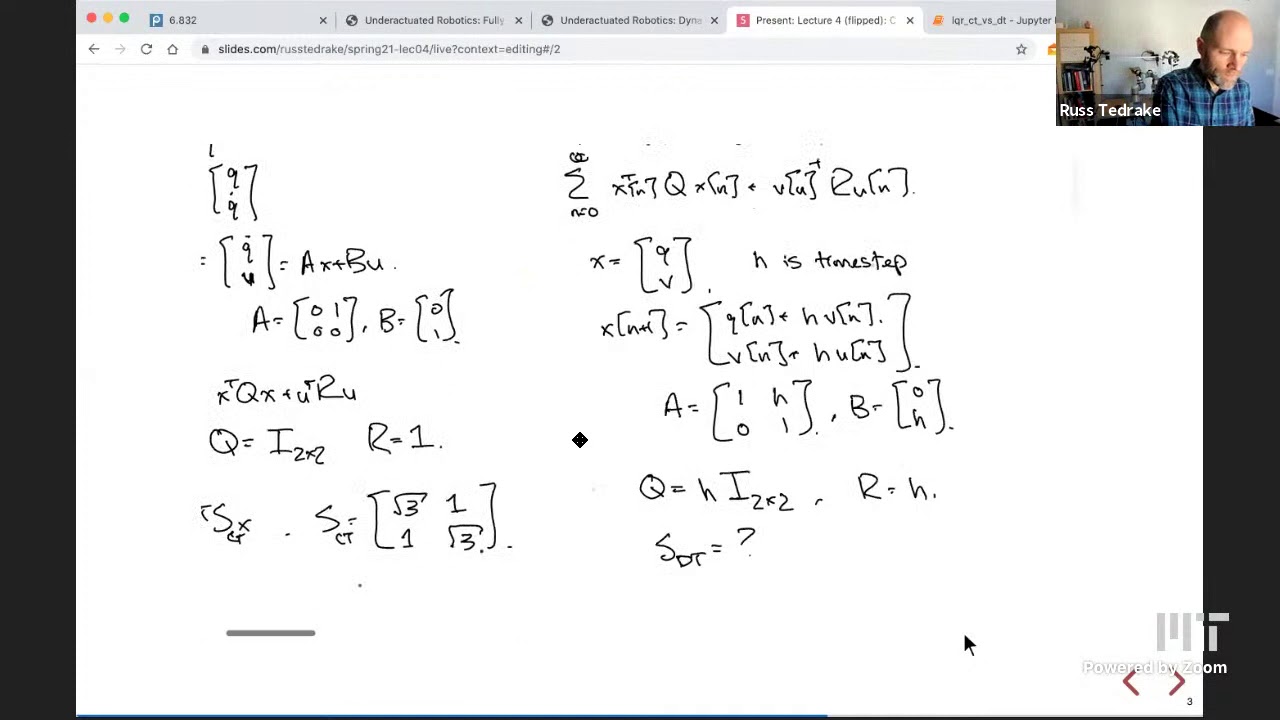
- Setup of the double integrator example and continuous-time LQR formulation
- Derivation of the discrete-time LQR using Euler integration
- Key insight: discrete-time cost-to-go is always greater than continuous-time for any positive time step
- Explanation of why discrete-time costs more: constraint of holding control actions constant
- Numerical demonstration of the cost difference using MATLAB-like code
- Plotting eigenvalues and eigenvectors of the cost-to-go matrices
- Discussion of the limit as time step goes to zero and conclusion
Cited Sources
- MIT 6.832 Underactuated Robotics Course Notes — The lecture refers to the course notes for technical details and derivations.
Concurring Sources
- MIT 6.832 Underactuated Robotics Course Notes — The lecture is based on the course notes, which provide a more detailed treatment of the topics.
Contribution & Novelties
The lecture provides a clear and intuitive explanation of the difference between discrete-time and continuous-time LQR, specifically why the discrete-time cost-to-go is always higher. This is a subtle point that is often not emphasized in standard treatments. The use of the double integrator example and numerical demonstrations makes the concept accessible.
Pour aller plus loin :
- Linear-quadratic regulator - Wikipedia — Provides a general overview of LQR and its applications.
- Hamilton–Jacobi–Bellman equation - Wikipedia — Related to the optimality conditions discussed in the lecture.
- Dynamic programming - Wikipedia — Foundational concept for the lecture’s approach.
95 words
Radar Profile
The radar profile shows high scores across all dimensions, indicating a well-balanced and reliable educational resource. The lecture excels in technical depth and clarity, with strong quantitative and qualitative information.