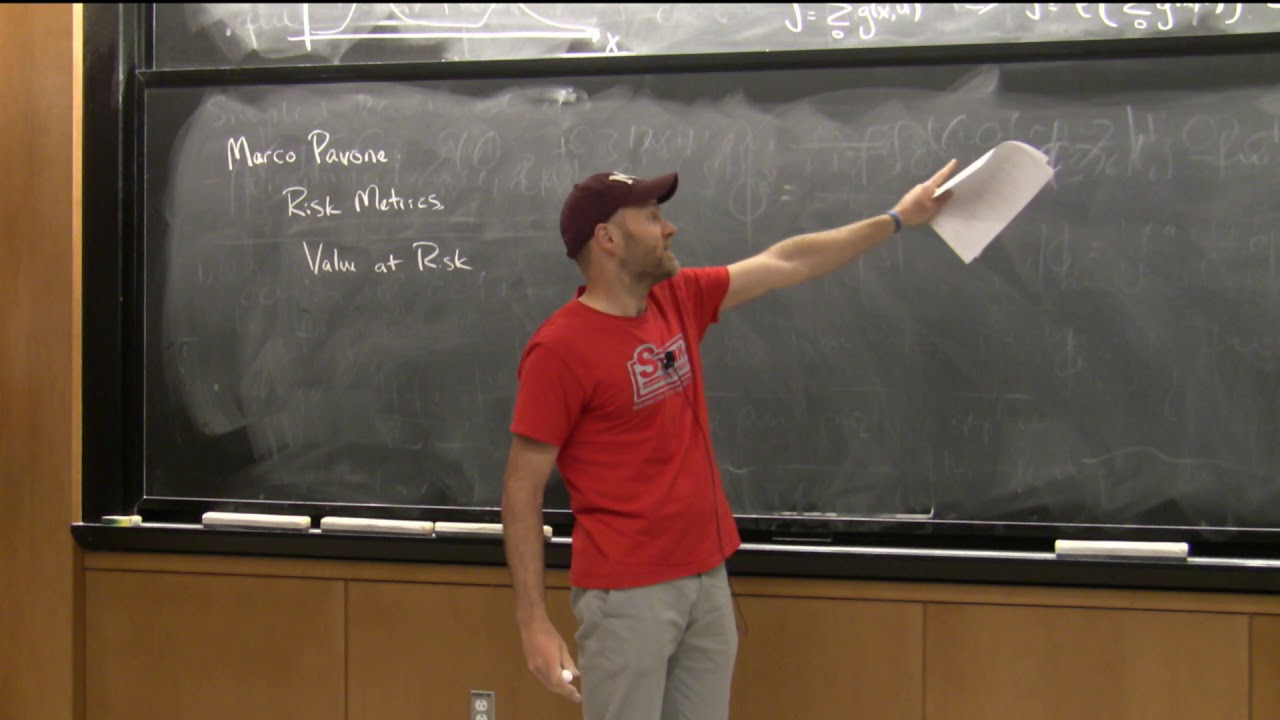
Lecture 19 | MIT 6.832 (Underactuated Robotics), Spring 2018
Keywords
Summary
168 words
Critical Evaluation
This lecture provides a solid introduction to stochastic and robust control within the context of underactuated robotics. The instructor, presumably a leading expert in the field, delivers content with clarity and depth, making it suitable for graduate-level students or researchers. The lecture is well-structured, starting with a review of stochastic dynamics and then progressing to control objectives and algorithms. The emphasis on expected value as a primary objective is well-justified, and the discussion of its limitations and alternatives is insightful. The presentation of stochastic dynamic programming is particularly valuable, as it offers a practical method for low-dimensional systems, and the example of the compass gait demonstrates its effectiveness. The transition to continuous systems and the LQG framework is logical, and the instructor correctly highlights the separation principle and certainty equivalence. However, the lecture could benefit from more concrete examples or case studies to illustrate the concepts further. Additionally, while the instructor mentions risk-sensitive metrics, he does not delve deeply into their mathematical formulations or computational challenges. The sources cited are primarily the course website, which provides additional materials but not specific references to the literature. Overall, this is a high-quality lecture that effectively communicates key ideas in stochastic and robust control, though it assumes a certain level of prior knowledge in control theory and dynamic programming.
216 words
Title / Content Match
The title accurately reflects the content, which is a lecture on underactuated robotics focusing on stochastic and robust control.
Quality & Reliability
8/10
Lecture from a reputable MIT course, presented by an expert in the field. Content is technically rigorous and well-structured, though it is a single lecture and not peer-reviewed.
Key Moments
Markers derived by PSI from the transcript: the creator did not define chapters.
- Introduction to the lecture topic: stochastic and robust control.
- Review of last lecture: nonlinear dynamics with Brownian motion and the shift to distribution stability.
- Discussion on controlling the expected value of the cost function and its linearity.
- Introduction to risk-sensitive metrics and limitations of expected value optimization.
- Stochastic dynamic programming: formulation and computational efficiency.
- Example: compass gait walking on rough terrain using stochastic dynamic programming.
- Transition to continuous systems: LQR with process noise and the LQG problem.
- Discussion on the separation principle and certainty equivalence in LQG.
- Limitations of LQG and introduction to robust control approaches.
- Conclusion and summary of key takeaways.
Cited Sources
- Underactuated Robotics Course Website — Course website providing lecture notes, assignments, and additional resources.
Concurring Sources
- Underactuated Robotics Course Website — Course materials likely contain lecture notes and references that align with the content presented.
Contribution & Novelties
This lecture provides a comprehensive overview of stochastic and robust control methods for underactuated robotic systems. It bridges the gap between theoretical concepts and practical algorithms, such as stochastic dynamic programming and LQG. The discussion on risk-sensitive metrics and the importance of robustness offers valuable insights for designing controllers that perform well under uncertainty.
Pour aller plus loin :
- Stochastic Dynamic Programming — Provides background on dynamic programming, which is foundational to the stochastic version discussed.
- Linear Quadratic Gaussian Control — Explains the LQG problem and its solution, including the separation principle.
- Risk-Sensitive Control — Introduces risk-sensitive control, an alternative to expected value optimization that addresses tail risk.
108 words
Radar Profile
The radar profile shows high scores in technical level and information quality, indicating a technically dense and reliable lecture. The quantity of information is also high, but the overall score is slightly lower due to the lack of diverse sources and the narrow focus on a single lecture.