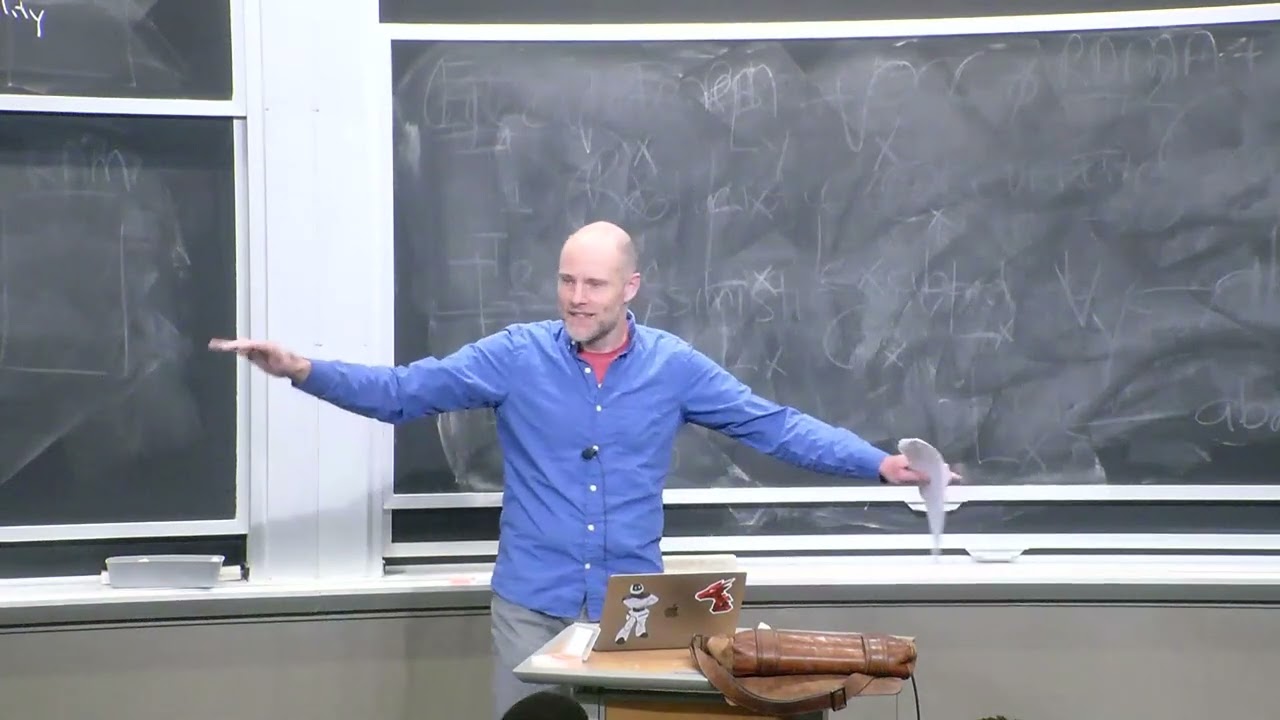
6.8210 Spring 2024 Lecture 15: Planning + Control Through Contact
Keywords
Summary
165 words
Critical Evaluation
The lecture provides a rigorous and well-structured introduction to advanced control techniques for legged robots, specifically focusing on orbital stability and hybrid systems. The instructor, likely Russ Tedrake, is a leading expert in the field, and the content reflects deep understanding and practical experience. The use of the SLIP model as a case study is effective, as it is simple yet captures essential dynamics of legged locomotion. The historical context, including the Leg Lab and Raibert’s robots, adds valuable perspective and motivation. The theoretical tools presented—Poincaré maps, transverse coordinates, transverse LQR, and Lyapunov methods—are standard and well-established, and the lecture explains them clearly with intuitive reasoning. However, the lecture assumes prior knowledge of control theory and robotics, making it suitable for graduate students. The lack of formal citations in the video is a minor weakness, but the content is consistent with published literature. The instructor’s remarks about reinforcement learning provide a balanced view, acknowledging its practical success while emphasizing the importance of understanding the underlying control principles. Overall, the lecture is of high quality, offering both theoretical depth and practical insights. The only minor issue is that the lecture is part of a series, so some context from previous lectures is assumed, but this does not detract significantly from its value.
211 words
Title / Content Match
The title accurately reflects the content: the lecture focuses on planning and control for systems with contact, using the spring-loaded inverted pendulum as a running example.
Quality & Reliability
8/10
The lecture is part of MIT's graduate-level course on underactuated robotics, taught by a recognized expert (likely Russ Tedrake). It presents established theoretical frameworks (Poincaré maps, transverse coordinates, LQR, Lyapunov) with references to historical and current research. The content is rigorous and well-structured, though it lacks formal citations in the video itself.
Key Moments
Markers derived by PSI from the transcript: the creator did not define chapters.
- Introduction to the lecture topic: stabilizing hybrid systems and limit cycles.
- Motivation for orbital stability vs trajectory stability.
- Introduction to the SLIP model and its historical origins.
- Discussion of the Leg Lab and Raibert's hopping robots.
- Explanation of the SLIP model assumptions and energy conservation.
- Foot placement control strategy for the SLIP model.
- Introduction to Poincaré maps for analyzing periodic orbits.
- Generalization to transverse coordinates and moving Poincaré sections.
- Transverse LQR and Lyapunov methods for stabilizing periodic orbits.
- Extension to hybrid systems and limit cycles.
Cited Sources
- Underactuated Robotics course materials — The lecture is part of this course, and the notes likely contain references to the topics discussed.
Concurring Sources
- Underactuated Robotics — The course materials align with the lecture content, providing detailed derivations and references.
Contribution & Novelties
The lecture provides a clear and accessible explanation of advanced control techniques for legged robots, bridging the gap between classical control theory and modern reinforcement learning approaches. It emphasizes the importance of orbital stability and offers a systematic framework for designing controllers for hybrid systems.
Pour aller plus loin :
- Underactuated Robotics — The course website with comprehensive lecture notes and references.
- Spring-loaded inverted pendulum — Wikipedia article on the SLIP model.
- Poincaré map — Wikipedia article on Poincaré maps.
- Transverse coordinates — Wikipedia article on transverse coordinates (if exists).
90 words
Radar Profile
The radar profile shows high scores in information quantity, quality, technical level, and reliability, indicating a comprehensive and rigorous lecture. The balance between theoretical depth and practical relevance is well maintained.