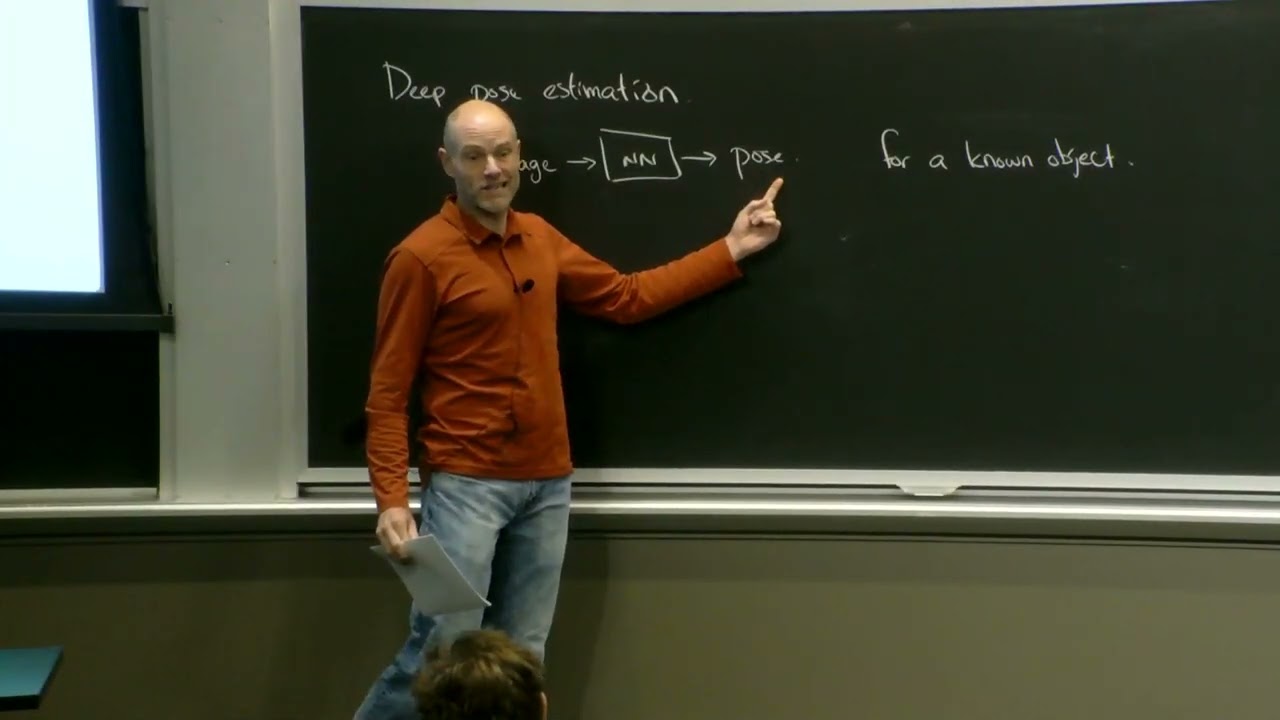
6.4210 Fall 2023 Lecture 17: Deep Perception Pt. 2
Keywords
Summary
116 words
Critical Evaluation
The lecture provides a comprehensive overview of deep perception for robotics, with a focus on pose estimation. The instructor’s expertise is evident, and he effectively explains complex concepts such as rotation representations and loss functions. The discussion on the pitfalls of Euler angles and the advantages of quaternions and rotation matrices is particularly valuable. The lecture also addresses practical issues like symmetry and occlusion, which are often overlooked in introductory materials. However, the content is presented in a conversational style, which may lack the rigor of a formal paper. The instructor does not provide specific citations, but he references common practices and research trends. The lecture is well-structured, starting with a review of previous topics and then delving into new material. The use of examples, such as the textureless bottle, helps illustrate the challenges. Overall, the lecture is informative and suitable for an advanced audience, though it may not be accessible to beginners. The adéquation between title and content is strong, as the lecture indeed covers deep perception, specifically focusing on intermediate representations for manipulation.
175 words
Title / Content Match
The title accurately reflects the content, which is a lecture on deep perception for robotics, continuing from a previous lecture.
Quality & Reliability
8/10
Lecture from MIT course 6.4210, presented by an expert in robotics, with clear technical content and references to established methods. The content is well-structured and based on current research, though it lacks formal citations and peer review.
Key Moments
Markers derived by PSI from the transcript: the creator did not define chapters.
- Introduction and context setting for the lecture.
- Discussion on traditional computer vision tasks and their relevance to robotics.
- Introduction to intermediate representations for manipulation.
- Deep dive into pose estimation and its challenges.
- Comparison of rotation representations: Euler angles, quaternions, rotation matrices.
- Discussion on loss functions for pose estimation, including geodesic distance.
- Handling symmetries and occlusions in pose estimation.
- Mention of other representations like keypoints and dense correspondences.
- Discussion on synthetic data and transfer learning.
- Conclusion and preview of next lecture on end-to-end learning.
Contribution & Novelties
The lecture provides a clear and practical guide to choosing intermediate representations for robotic manipulation, emphasizing the importance of rotation representation and loss functions. It highlights common pitfalls and offers insights into handling symmetries and occlusions.
Pour aller plus loin :
- Quaternions and spatial rotation — Useful for understanding quaternion-based rotation representation.
- Rotation matrix — Background on rotation matrices and their properties.
- Pose estimation — Overview of pose estimation in computer vision.
72 words
Radar Profile
The radar profile shows high scores across all dimensions, indicating a well-balanced and informative lecture. The technical depth is high, and the content is reliable and comprehensive.