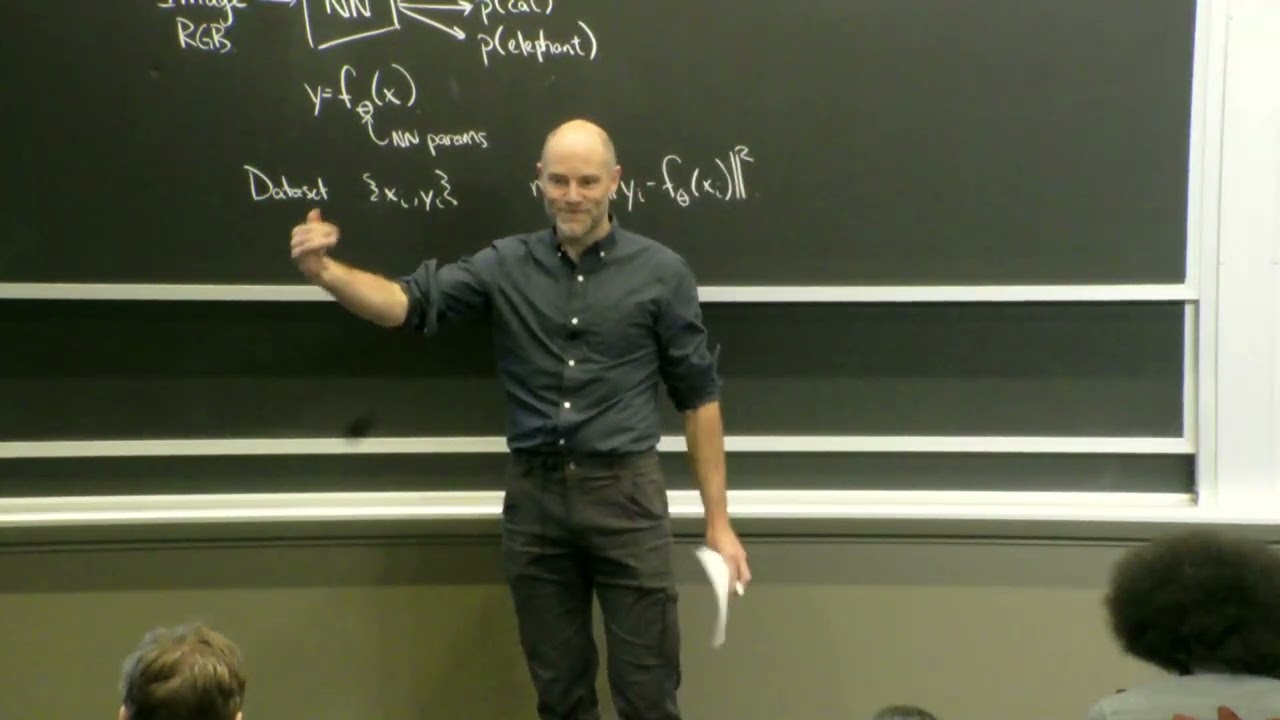
6.4210 Fall 2023 Lecture 16: Deep Perception
Keywords
Summary
142 words
Critical Evaluation
The lecture provides a solid introduction to deep learning for perception in the context of robotic manipulation. The instructor, Russ Tedrake, is a leading expert in robotics, and his explanations are clear and grounded in practical experience. The content is accurate and up-to-date, covering key concepts such as image classification, object detection, semantic segmentation, and instance segmentation, as well as the importance of large datasets and transfer learning. The lecture is well-structured, starting with motivation and then building up to more complex tasks. One strength is the emphasis on the limitations of traditional geometric methods and how learning can address them, such as handling unknown objects or partial views. The instructor also provides valuable insights into the history of the field, such as the role of ImageNet and MS COCO, and the accidental discovery of transfer learning. However, the lecture is relatively high-level and does not delve into the mathematical details of neural networks or training algorithms. It also assumes some familiarity with the basics of deep learning, as it does not explain what a neural network is. The discussion of specific applications to manipulation is useful but could be more detailed. Overall, the lecture is a valuable resource for students and practitioners interested in applying deep learning to robotics, offering a clear overview and practical considerations. The title accurately reflects the content, and the lecture meets its objectives.
229 words
Title / Content Match
The title accurately reflects the content: a lecture on deep perception within a robotics course.
Quality & Reliability
8/10
Lecture from MIT OpenCourseWare by a renowned robotics professor, presenting established concepts in deep learning for perception with practical insights for manipulation. Content is accurate and well-structured, though it is a lecture rather than peer-reviewed research.
Key Moments
Markers derived by PSI from the transcript: the creator did not define chapters.
- Introduction and motivation for deep learning in manipulation
- Limitations of geometric perception and need for learning
- Overview of computer vision tasks: classification, detection, segmentation
- Discussion of ImageNet and large datasets
- Introduction to MS COCO and instance segmentation
- Transfer learning and its importance for robotics
- Practical considerations for using segmentation in manipulation
- Q&A and discussion on multi-camera segmentation
Cited Sources
Concurring Sources
Contribution & Novelties
The lecture provides a clear and practical overview of deep learning for perception in robotic manipulation, emphasizing the importance of instance segmentation and transfer learning. It bridges the gap between computer vision and robotics, offering insights into how to apply these techniques in real-world manipulation tasks.
Pour aller plus loin :
- Deep Learning Book — Comprehensive resource on deep learning fundamentals.
- Mask R-CNN paper — A key architecture for instance segmentation.
- Transfer Learning in Computer Vision — Overview of transfer learning techniques.
82 words
Radar Profile
The radar profile shows high scores in quantity and quality of information, with a moderate technical level. This indicates a well-balanced lecture that is informative and accurate, but not overly technical, making it accessible to a broad audience.