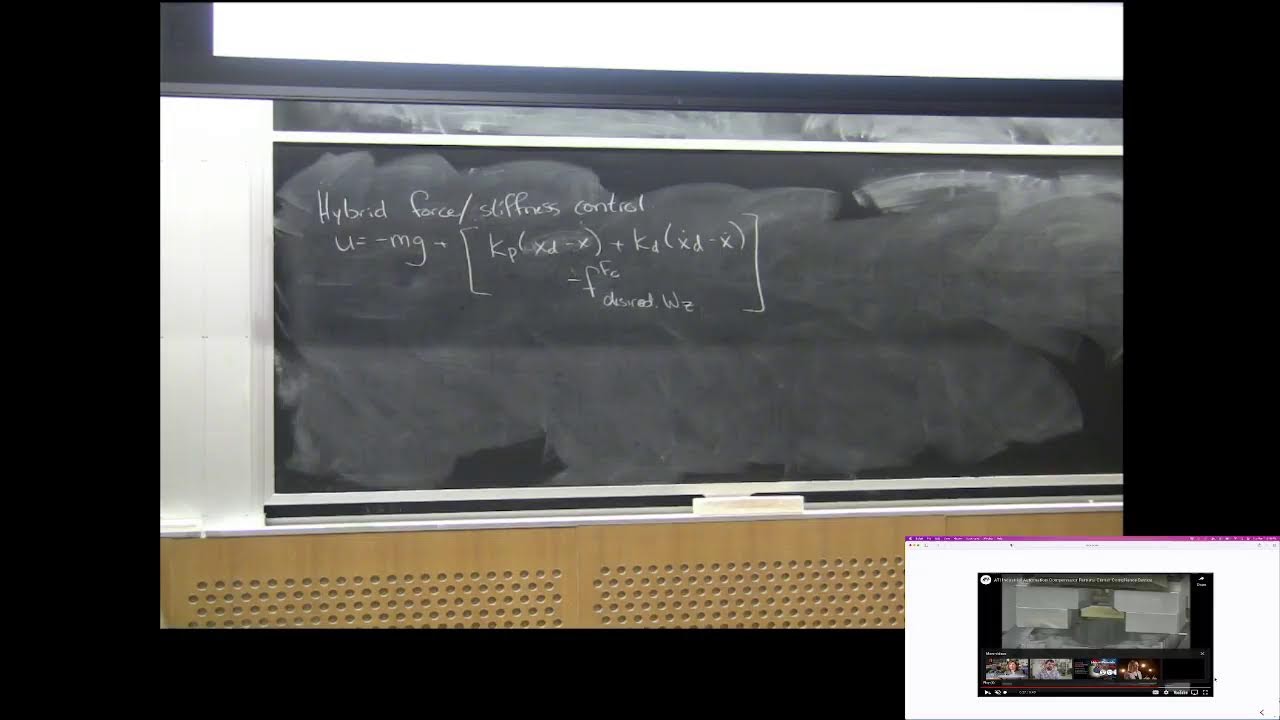
Fall 2022 6.4210/2 Lecture 15: Force control
Keywords
Summary
108 words
Critical Evaluation
The lecture provides a solid introduction to force control in robotics, building on previous material on trajectory optimization. The instructor effectively distinguishes between kinematic and dynamic trajectory optimization, clarifying when each is appropriate. The motivation examples are relatable and illustrate the need for force control in real-world tasks. The technical content is presented clearly, with derivations of equations of motion for a point robot and extensions to manipulator control. The discussion of impedance control is particularly valuable, as it bridges the gap between position and force control. The lecture also touches on practical considerations such as friction cones and sliding objects, which are often overlooked in theoretical treatments. The use of slides as supplementary material is helpful, though no external sources are cited. Overall, the lecture is well-structured and informative, suitable for an advanced undergraduate or graduate-level audience. The instructor’s teaching style is engaging, and the content is both rigorous and accessible. The main limitation is the lack of references to external literature, which could provide additional depth. However, the lecture stands on its own as a comprehensive overview of force control principles.
183 words
Title / Content Match
The title accurately reflects the content, which focuses on force control in robotics.
Quality & Reliability
8/10
Lecture from MIT OpenCourseWare-style course, presented by an expert in robotics. Content is technically rigorous, with clear explanations and references to standard methods. No external sources cited beyond slides, but the material is well-established.
Key Moments
Markers derived by PSI from the transcript: the creator did not define chapters.
- Introduction and motivation for force control, referencing student projects involving dynamic manipulation.
- Contrast between kinematic and dynamic trajectory optimization, with examples of when dynamics matter.
- Motivation for force control: writing on a board, pushing objects, and dexterous manipulation.
- Introduction to force control for a point robot, deriving equations of motion.
- Discussion of control strategies for force regulation, including proportional-integral control.
- Extension to manipulator control, introducing impedance control and Jacobian transpose.
- Practical considerations: friction cones, sliding objects, and force control in clutter clearing.
- Summary and connection to course projects, emphasizing when to use force control.
Cited Sources
- Lecture slides — Slides accompanying the lecture, providing visual aids and additional details.
Concurring Sources
- MIT OpenCourseWare: Underactuated Robotics — Related course materials on underactuated robotics, covering similar topics.
Contribution & Novelties
The lecture provides a clear pedagogical bridge between kinematic trajectory optimization and force control, emphasizing when dynamics matter. It offers practical insights into force control for manipulation, including impedance control and friction cone considerations. The discussion of sliding objects and dexterous manipulation is particularly insightful.
Pour aller plus loin :
- Impedance control — Overview of impedance control, a key concept in force control.
- Force control in robotics — General overview of force control techniques.
- Manipulation and grasping — Broader context on robotic manipulation.
83 words
Radar Profile
The radar profile shows high scores across all dimensions, indicating a well-rounded lecture with substantial information, technical depth, and reliability. The balance between theory and practical examples is strong.