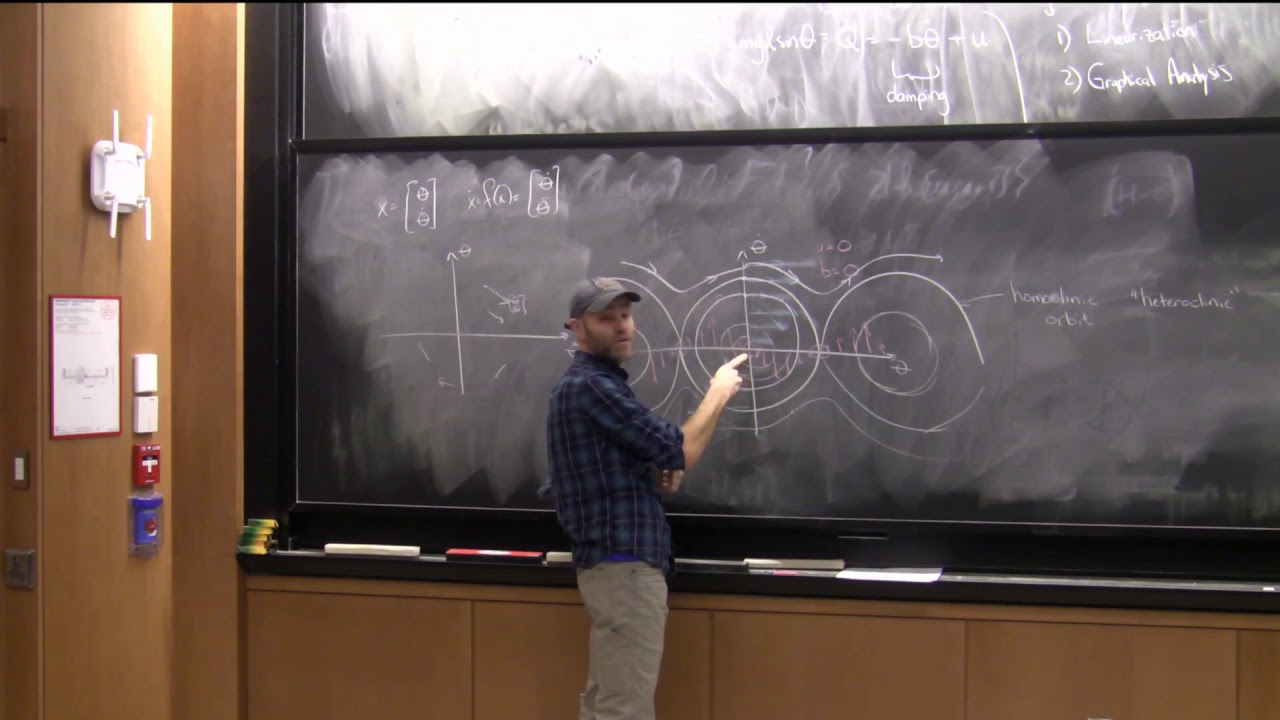
Lecture 2 | MIT 6.832 (Underactuated Robotics), Spring 2019
Keywords
Summary
104 words
Critical Evaluation
The lecture is an excellent introduction to nonlinear dynamics for robotics students. The instructor’s pedagogical approach is effective, using the simple pendulum to illustrate fundamental concepts that are applicable to more complex systems. The mathematical derivations are clear and rigorous, and the emphasis on graphical analysis provides an intuitive understanding that complements the analytical methods. The discussion of dimensional analysis is particularly valuable, as it demonstrates how to simplify equations by choosing appropriate characteristic scales. The lecture also highlights the limitations of traditional differential equation solving and motivates the need for alternative tools. The content is well-structured, building from basic principles to more advanced ideas, and the instructor’s enthusiasm for the subject is evident. The only minor weakness is that the lecture assumes some prior knowledge of Lagrangian mechanics and differential equations, which might be challenging for absolute beginners. However, for the target audience of graduate-level robotics students, this is appropriate. Overall, this is a high-quality lecture that effectively conveys the core ideas of nonlinear dynamics in a robotics context.
170 words
Title / Content Match
The title accurately reflects the content: a lecture on underactuated robotics, focusing on nonlinear dynamics.
Quality & Reliability
9/10
Lecture from MIT OpenCourseWare, presented by an expert in the field, with rigorous mathematical derivations and references to established literature. The content is well-structured and pedagogically sound.
Key Moments
Markers derived by PSI from the transcript: the creator did not define chapters.
- Introduction and recap of underactuation definition
- Introduction to the pendulum as the simplest robot
- Derivation of pendulum dynamics using Lagrangian mechanics
- Discussion on the impossibility of closed-form solutions for nonlinear systems
- Introduction to graphical analysis and phase portraits
- Dimensional analysis and characteristic time constants
- Simplification to first-order system in overdamped limit
- Discussion on stability and long-term behavior
- Introduction to linearization and its limitations
- Summary and transition to next topics
Cited Sources
- Underactuated Robotics Course Website — Course website with lecture notes and additional resources
Concurring Sources
- Underactuated Robotics Course Website — Course materials align with the lecture content
Contribution & Novelties
This lecture provides a foundational understanding of nonlinear dynamics as applied to robotics, emphasizing graphical and dimensional analysis techniques. It bridges the gap between theoretical dynamics and practical robotics applications.
Pour aller plus loin :
- Nonlinear Dynamics and Chaos — A comprehensive textbook by Steven Strogatz, referenced in the lecture.
- Phase portrait — A graphical tool for analyzing dynamical systems.
- Dimensional analysis — A method to simplify equations by scaling.
70 words
Radar Profile
The radar profile shows high scores in quality and reliability, with slightly lower scores in quantity and technical level, indicating a focused and rigorous lecture that may not cover an exhaustive range of topics but excels in depth.
💬 No comments were provided for analysis.